








 CoinDesk

As perpetuals edge into regulated US venues, the loudest critique frames them as a retail-driven, high-leverage import of systemic risk into mainstream markets. That critique, advanced by Bullish president Chris Tyrer and the exchange's product marketing lead Tram Doman in a CoinDesk opinion column, is aimed at the wrong target, they argue.
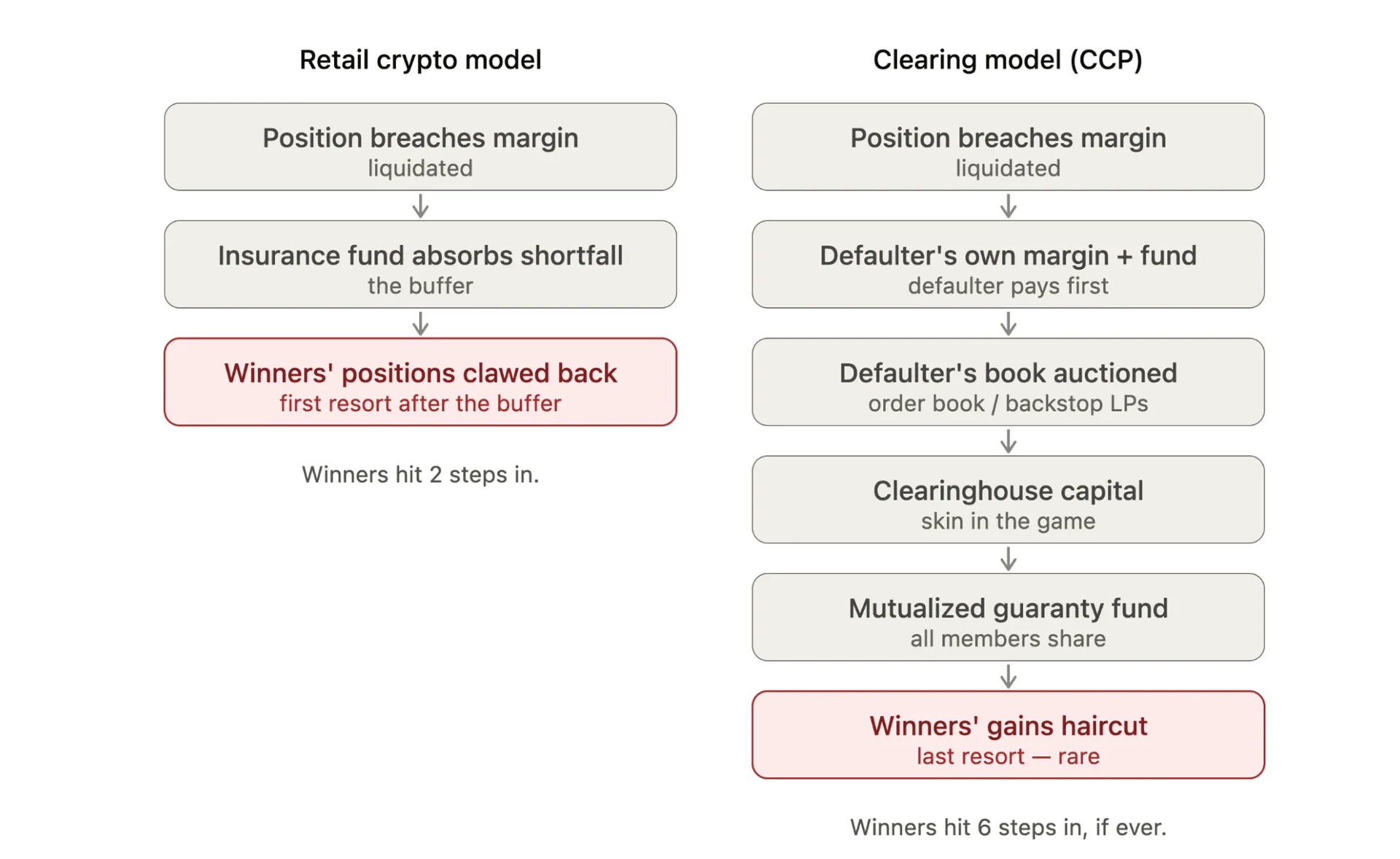
Perpetuals themselves carry no inherent risk profile: the danger lives in the venue. Leverage caps, margin design, funding mechanics, and how a book handles a default under stress decide whether a sell-off becomes a cascade. The October 2025 deleveraging, stablecoin de-pegs, oracle failures, and thin liquidity all fed recent blowups, but what turned them systemic was the liquidation cascade and the auto-deleveraging that claws back profitable trades to cover shortfalls. Neither mechanic is a feature of perpetuals; both are venue choices.
Why it matters
Regulated clearing has a decades-old answer to default management that crypto perpetuals venues largely bypass. A registered clearing entity starts with the defaulter's own margin and fund contribution, works the position off through the order book or an auction, and sits behind that a pre-funded guaranty fund at clearinghouse scale. Loss-sharing beyond that is broad and rare. Auto-deleveraging socializes losses onto offsetting winners at off-market prices; a clearing model absorbs the default at its source.
The institutional piece is the half critics under-weight. A JPMorgan note flagged limited institutional appetite for perpetuals as dated-futures substitutes, citing funding variability and weak term structure. But a desk hedging options delta in real time wants liquidity, not elegance, and perpetuals are the deepest continuously tradable delta-one instruments in crypto. That liquidity is structural: retail gravitates to no-expiry, no-roll contracts, and that flow concentrates depth where hedgers want it.
Market impact
Bullish has filed with the CFTC for designation as a Designated Contract Market and for registration as a Derivatives Clearing Organization.
Frequently asked questions
-
Who wrote this column and what is their argument?
Chris Tyrer, president of Bullish Exchange, and Tram Doman, who leads product marketing there, argue that systemic risk in derivatives is a property of the venue, not the contract. Perpetuals carry no inherent danger; leverage caps, margin design, funding mechanics, and default handling decide the risk profile.
-
Why do institutions use perpetuals if they are imperfect substitutes for futures?
Because they need liquidity, not term structure. A desk hedging options delta in real time wants execution over elegance, and perpetuals are the deepest continuously tradable delta-one instruments in crypto. Funding variability is the trade-off for that depth.
-
What has Bullish filed for with the CFTC?
Bullish has filed for designation as a Designated Contract Market (DCM) and for registration as a Derivatives Clearing Organization (DCO), aiming to operate a regulated perpetuals venue in the US.
-
What is auto-deleveraging and why does it matter?
Auto-deleveraging force-closes offsetting profitable positions at off-market prices to absorb a defaulter's loss when the insurance fund is exhausted. Critics argue it socializes losses onto winners and transmits stress into a falling market. A registered clearing model absorbs the default at its source instead.
-
What did the JPMorgan note say about institutional appetite for perpetuals?
It found limited appetite, treating perpetuals as speculative rather than as substitutes for regulated dated futures. The note flagged funding variability and basis risk as the reasons perpetuals fall short as hedges with locked-in term structure.
 CryptoSlate
 TheBlock
 WuBlockchain
 CoinTelegraph
 Crypto Rank News
 Glassnode