








 CryptoSlate


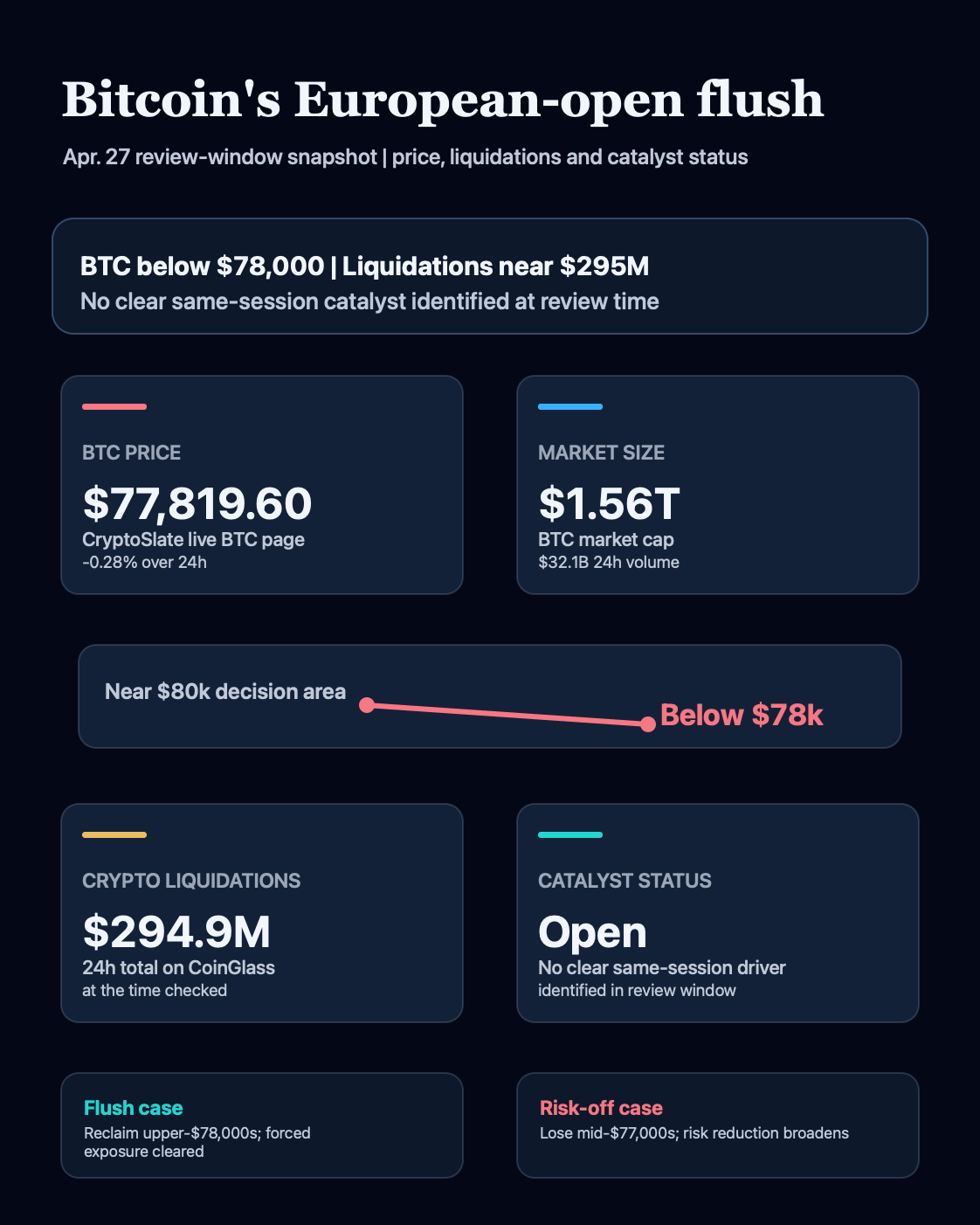

Bitcoin fell below $78,000 as European markets opened on Monday, hitting $77,819 before steadying, with BTC market capitalization near $1.56 trillion and 24-hour volume around $32.1 billion. Total crypto liquidations reached approximately $294.9 million over the prior 24 hours, per CoinGlass, with 89,011 traders forced out and the largest single order — an $11.98M ETHUSDT hit on Binance — underscoring how broad the deleveraging was. The move came without a fresh macro, regulatory, exchange, ETF, or issuer catalyst, leaving positioning rather than news as the dominant driver.
Why it matters
The decline lands inside a crowded technical zone: $80,000 had already acted as a decision area, and the rejection there pulled price back into the upper-$78,000s before Monday's European open broke it. The macro calendar adds background pressure — a two-day FOMC meeting on April 28–29, followed quickly by GDP and PCE prints — but none of those events had hit the tape yet when the move occurred. That separation matters: it means the trigger is still unresolved, and the market is being repriced on positioning, not on a defined narrative.
Market impact
The split inside the liquidation data complicates a clean directional read. Total crypto liquidations of $294.9M were large enough to confirm forced position closure across the market, yet Bitcoin-specific liquidations of $95.55M were actually short-heavy, with about $38.8M in longs and $56.75M in shorts. That mix points to a leverage flush rather than a one-direction wipeout — the market is clearing crowded exposure on both sides. The constructive path is a hold of the $77,000 to $77,500 area followed by a reclaim of the upper-$78,000s, which would put $80,000 back into play. A failure to hold the mid-$77,000s — particularly if equities weaken or yields firm into the Fed week — would start to look like the first leg of a broader risk reduction rather than a contained deleveraging event.


Frequently asked questions
-
Why did Bitcoin drop below $78,000 on Monday?
Bitcoin slipped below $78,000 as European markets opened, but no fresh macro, regulatory, exchange, ETF, or issuer headline had emerged to explain the move. The available evidence points to positioning and liquidity stress rather than a defined catalyst, with $294.9M in total crypto liquidations over 24 hours…
-
How much was liquidated during the Bitcoin drop?
Total crypto liquidations reached approximately $294.9 million over the prior 24 hours, per CoinGlass, with 89,011 traders forced out. The largest single order was an $11.98 million ETHUSDT liquidation on Binance. Bitcoin-specific liquidations were about $95.55 million.
-
Was the Bitcoin drop driven by long or short liquidations?
The split was mixed. Total crypto liquidations of $294.9M were large enough to confirm forced position closure, but the Bitcoin-specific reading was short-heavy — about $38.8M in longs versus $56.75M in shorts. That points to a two-sided leverage flush rather than a clean long liquidation cascade.
-
What price level does Bitcoin need to hold?
The constructive path requires Bitcoin to hold the $77,000 to $77,500 area and then reclaim the upper-$78,000s, which would put $80,000 back into play. A failure to defend the mid-$77,000s — particularly if equities weaken or yields firm into the Fed week — would flip the read from a contained flush to a broader…
-
How does the Fed meeting affect Bitcoin this week?
A two-day FOMC meeting is scheduled for April 28–29 with a press conference on April 29, and GDP and PCE data are stacked right behind it. That compressed calendar gives traders fewer reasons to add risk into a fast drop, which is why the mid-$77,000s test matters more than the search for a tidy headline explanation.
 Lookonchain
 Benjamin Cowen
 CoinDesk
 WuBlockchain
 Crypto News
 TheBlock
 CoinTelegraph