








 CryptoSlate



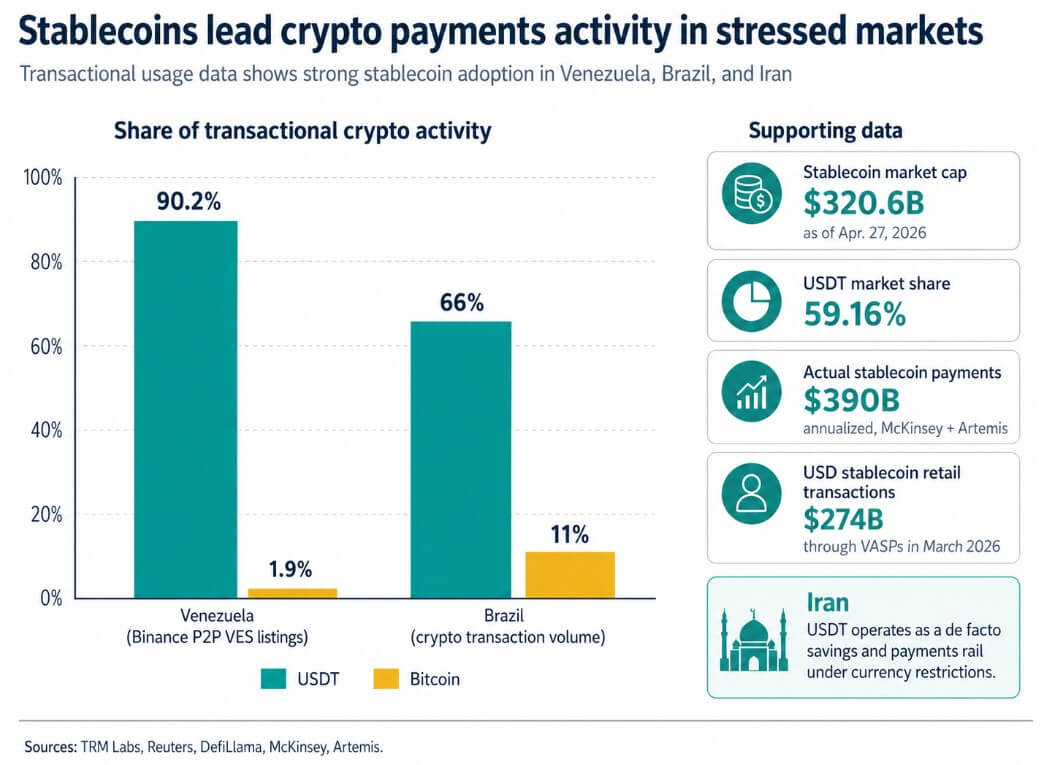
Cathie Wood told The Rollup that stablecoins have absorbed the emerging-market payments role ARK Invest once expected Bitcoin to fill, marking a public concession that the original Bitcoin-as-global-monetary-layer thesis has narrowed. Stablecoin payment volumes run roughly $390 billion annualized per McKinsey and Artemis data, about 0.02% of global payments, while the stablecoin market cap sits above $320.6 billion as of Apr. 27, up over 56% since early 2025, with USDT commanding 59.16% of the market.
Why it matters
In stressed, capital-constrained markets, the split is empirical. TRM Labs' Q1 adoption report found USDT accounting for 90.2% of active Binance P2P Venezuelan bolivar listings and 1.9% for Bitcoin, with roughly 66% of Brazilian crypto transaction volume conducted via USDT against 11% for Bitcoin. The pattern repeats in Iran, where dollar-pegged stablecoins processed $274 billion in retail transactions through VASPs in March 2026 alone. ARK's published model still targets roughly $710,000 per Bitcoin in the base case and $1.5 million bull case by 2030, but those prices now rest on scarcity and balance-sheet demand rather than transactional utility.
Market impact
The institutional bid Wood argues is softening the four-year cycle is visible in the data. CoinShares logged $1.2 billion in crypto investment-product inflows last week, the fourth consecutive positive week and third straight above $1 billion, with Bitcoin taking $933 million, Ethereum $192 million, and Solana $31.8 million. Total AUM climbed to $155 billion, the highest since Feb. 1, though still 41% below the October 2025 peak of $263 billion. Strategy added another 3,273 BTC during Apr. 20-26, bringing its total to 818,334 BTC at an aggregate cost of $61.8 billion, while US spot Bitcoin ETFs posted nine consecutive positive sessions from Apr. 14 to Apr. 24 totaling over $2 billion. Glassnode's Apr. 22 report places Bitcoin above the reclaimed True Market Mean at $78,100, with the short-term holder cost basis at $80,100 acting as immediate resistance, while short-term holders' realized profits spiked to $4.4 million per hour, nearly three times the $1.5 million threshold that marked prior local tops this year. The Apr. 28-29 FOMC decision now frames whether the institutional demand rebuild can absorb that profit-taking or whether the cycle reasserts itself.




Frequently asked questions
-
What did Cathie Wood actually concede about Bitcoin?
In a recent interview with The Rollup, the ARK Invest CEO acknowledged that stablecoins have absorbed the emerging-market payments role ARK once expected Bitcoin to fill, narrowing Bitcoin's thesis to scarcity and institutional allocation.
-
How much of Venezuela's crypto transactional activity runs on USDT vs. Bitcoin?
Per TRM Labs' Q1 adoption report, USDT accounted for 90.2% of active Binance P2P Venezuelan bolivar listings, while Bitcoin represented just 1.9%. In Brazil, USDT ran roughly 66% of crypto transaction volume against 11% for Bitcoin.
-
What are crypto investment-product inflows showing this week?
CoinShares logged $1.2 billion in crypto investment-product inflows last week — the fourth consecutive positive week and the third straight above $1 billion. Bitcoin took $933M, Ethereum $192M, and Solana $31.8M, lifting total AUM to $155 billion.
-
What is Bitcoin's key technical level to watch right now?
Per Glassnode's Apr. 22 report, Bitcoin reclaimed the True Market Mean at $78,100, with the short-term holder cost basis at $80,100 acting as immediate resistance. Short-term holder realized profits spiked to $4.4M per hour, nearly 3x the threshold that marked prior local tops.
-
Why does the Apr. 28-29 FOMC meeting matter for Wood's thesis?
The Fed decision will test whether the four-week institutional demand rebuild can absorb elevated profit-taking near $80,100 resistance. A neutral Fed supports Wood's 'institutions softening the cycle' argument; fresh macro stress could break the inflow streak and revive NYDIG's cyclical-bust framing.
 WatcherGuru
 Whale Alert
 WuBlockchain
 Crypto News
 Glassnode