








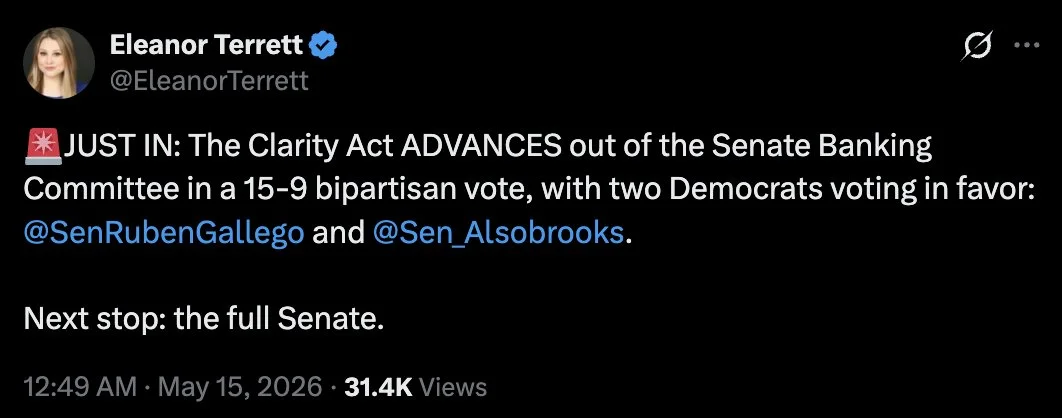

The Clarity Act cleared the U.S. Senate Banking Committee on a 15-9 bipartisan vote, advancing federal crypto market-structure legislation to a full Senate floor vote, according to crypto reporter Eleanor Terrett. Democrats Ruben Gallego and Angela Alsobrooks broke ranks to vote in favor, marking a notable crossover on an issue that has historically split along party lines.
Why it matters
The committee vote is the first procedural milestone for a comprehensive digital-asset market-structure bill this Congressional session. The Clarity Act, as drafted, would draw firmer lines between the SEC and CFTC's respective jurisdictions over digital assets — a long-running source of regulatory friction that major TradFi entrants have cited as a reason to hold back on tokenisation and stablecoin deployment at scale. Bipartisan support inside committee raises the probability of a floor vote, though not necessarily of final passage in a tight Senate calendar.
Market impact
The move is bullish for U.S.-domiciled crypto venues and any institution with a tokenisation roadmap gated on jurisdictional clarity. Watch for stablecoin issuers and the largest spot BTC ETF sponsors — both groups have publicly lobbied for the bill's definitions around digital commodities vs. securities. A floor vote timing is the next catalyst; committee passage alone is procedural, not a guarantee of enactment.

Frequently asked questions
-
What does the Clarity Act do?
As drafted, the bill would draw firmer jurisdictional lines between the SEC and CFTC over digital assets — clarifying which agency regulates which token category and addressing a long-running source of regulatory friction for crypto venues and TradFi entrants alike.
-
What just happened with the Clarity Act?
The U.S. Senate Banking Committee advanced the bill in a 15-9 bipartisan vote, sending it to a full Senate floor vote. Democrats Ruben Gallego and Angela Alsobrooks voted in favor, breaking with most of their caucus.
-
Is the Clarity Act law now?
No. Committee passage is a procedural step. The bill still needs a full Senate floor vote, House passage, and presidential signature before it can become law. Committee advancement raises the odds of a floor vote but does not guarantee enactment.
-
Who supports the Clarity Act?
The bill drew bipartisan support inside the Senate Banking Committee, including crossover votes from Democrats Ruben Gallego and Angela Alsobrooks. Crypto industry groups and major TradFi firms with tokenisation roadmaps have publicly lobbied for the bill's market-structure definitions.
-
Why does the Clarity Act matter for crypto markets?
Regulatory clarity between the SEC and CFTC is widely cited by institutions as a gating factor on stablecoin issuance, tokenisation, and broader digital-asset deployment. A clearer framework would lower legal uncertainty for U.S.-domiciled venues and any firm with a tokenisation roadmap.

 WatcherGuru
 CoinDesk
 Crypto News