








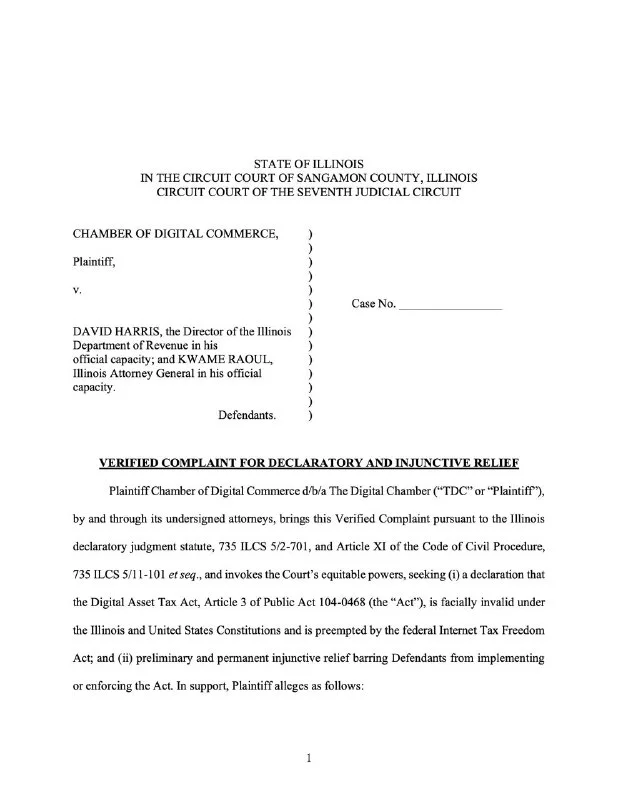

The Digital Chamber filed suit against Illinois on Thursday to block the Digital Asset Tax Act before its January 2027 effective date, arguing the law is internally incoherent and unconstitutional as drafted.
Why it matters
The Act treats digital asset transfers as taxable sales events, but the Chamber's complaint highlights that Illinois tax code already defines digital assets as non-possessory, intangible records. Levying a transaction tax on property the state has said does not exist as possessable property creates a category mismatch the lawsuit argues violates the Illinois Constitution's uniformity clause. Several other states have passed or floated similar transfer-tax language; the Illinois suit becomes the first major test of whether the language survives an in-state constitutional challenge rather than a federal one.
Market impact
The filing does not delay the law's effective date, but it forces the state to defend the tax in court before any revenue can be collected. For crypto businesses operating in Illinois, the next milestone is the state's response to the complaint and any preliminary injunction motion; until then, the 2027 effective date stays on the books.
Frequently asked questions
-
What is the Digital Asset Tax Act?
It is an Illinois law that treats transfers of digital assets as taxable sales events. The Digital Chamber argues the tax conflicts with Illinois tax code, which classifies digital assets as non-possessory intangible records.
-
When does the Illinois digital asset tax take effect?
The law's effective date is January 2027. The Digital Chamber's lawsuit was filed before that date to prevent any revenue from being collected.
-
What is the Digital Chamber's legal argument?
The complaint argues that levying a transaction tax on assets Illinois has already classified as non-possessory creates a category mismatch that violates the Illinois Constitution's uniformity clause.
-
Does the lawsuit stop the tax from taking effect?
No. The filing does not delay the January 2027 effective date on its own. A preliminary injunction motion, if granted, would be the mechanism that halts collection.
-
Are other states passing similar digital asset transfer taxes?
Several states have passed or floated transfer-tax language comparable to Illinois'. The Digital Chamber's suit is the first major in-state constitutional test of that framework.

 CoinDesk
 CryptoSlate
 TheBlock
 WatcherGuru
 Crypto News