








 CoinDesk


DogeOS has opened a public testnet for Ethereum-compatible trading, lending and stablecoin applications that use test DOGE for transaction fees. The launch gives developers a way to build financial services around Dogecoin, a roughly $13 billion cryptocurrency whose main network does not run such applications. DogeOS has not set a mainnet launch date.
Why it matters
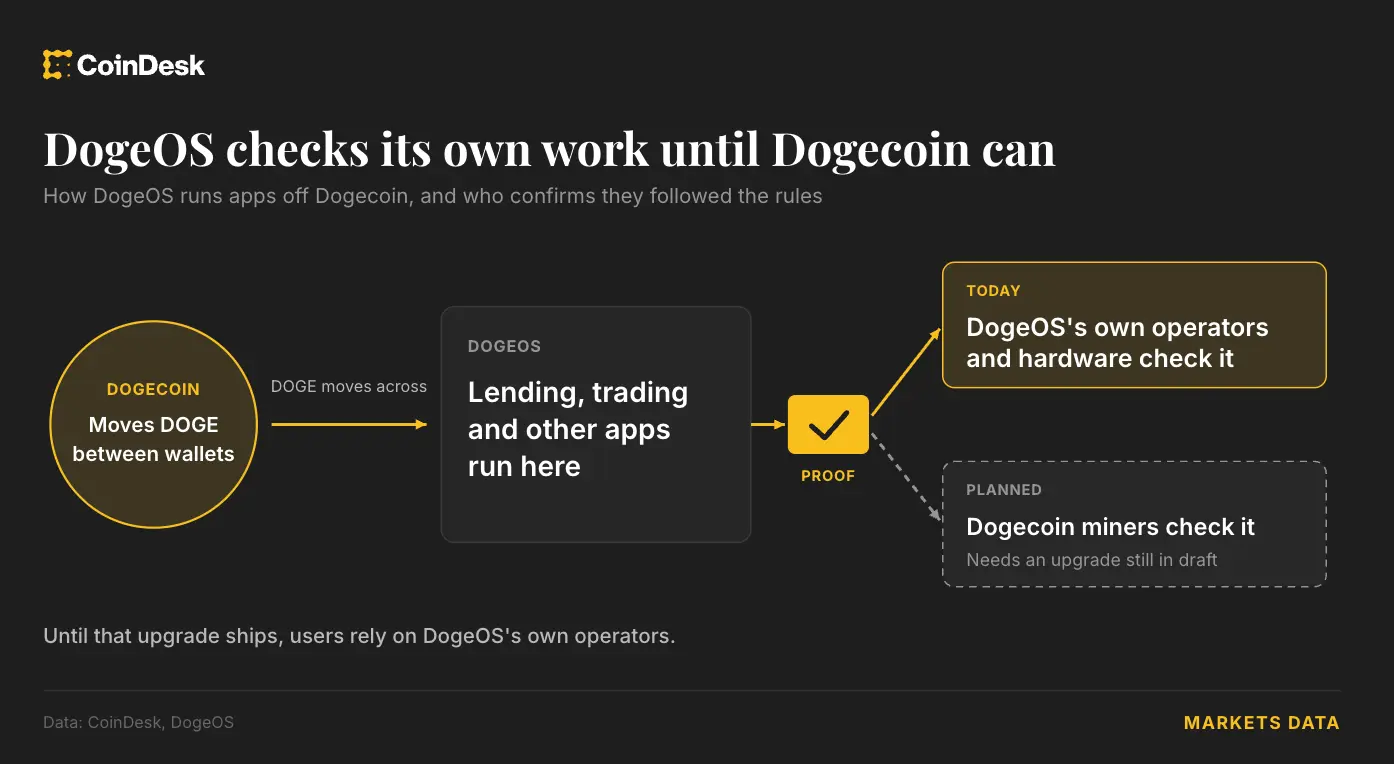
Dogecoin was built to move DOGE between wallets. DogeOS runs applications on a separate system, aiming to give holders ways to lend, borrow and trade rather than simply hold the coin or transfer it. Developers can use familiar Ethereum tooling, but users would need to trust DogeOS to maintain accurate records when bringing DOGE into that system.
That trust is not yet backed by Dogecoin miners. The testnet uses a permissioned transaction sequencer, selected validators, protected hardware and a Security Council. DogeOS wants miners to verify application proofs through a proposed Dogecoin Core upgrade called OP_CHECKZKP. An implementation remains a draft, with more work needed before activation.
Market impact
The testnet expands what developers can try with DOGE; it does not establish demand for the resulting applications. Three U.S. Dogecoin ETFs drew about $12 million in net inflows over nearly 10 months and recorded no net flows on 166 of 199 trading days. Earlier memecoin application networks also saw deposits dwindle after launch.
For DOGE holders, the milestones are whether usable applications attract deposits and whether the proposed upgrade advances toward miner verification. Neither a mainnet launch nor an upgrade activation date has been announced.

Frequently asked questions
-
What can developers build on the DogeOS testnet?
Developers can build Ethereum-compatible trading, lending and stablecoin applications. The public testnet uses test DOGE for transaction fees.
-
Why does DogeOS run applications separately from Dogecoin?
Dogecoin's main network moves DOGE between wallets but does not run lending services or exchanges. DogeOS runs those applications on a separate system.
-
Who verifies DogeOS activity on the testnet?
The system currently relies on a permissioned sequencer, selected validators, protected hardware and a Security Council. Dogecoin miners do not yet verify its application proofs.
-
What would the proposed Dogecoin Core upgrade change?
The proposed OP_CHECKZKP upgrade would allow Dogecoin computers to check proofs of calculations performed elsewhere. Its implementation remains a draft and has no activation date.
-
What evidence is there of demand for Dogecoin financial applications?
Demand remains unproven. Three U.S. Dogecoin ETFs drew about $12 million in net inflows over nearly 10 months, while deposits in earlier memecoin application networks declined after launch.
 TheBlock
 CryptoSlate
 Crypto Rank News
 Crypto News
 CoinTelegraph