


 CryptoSlate



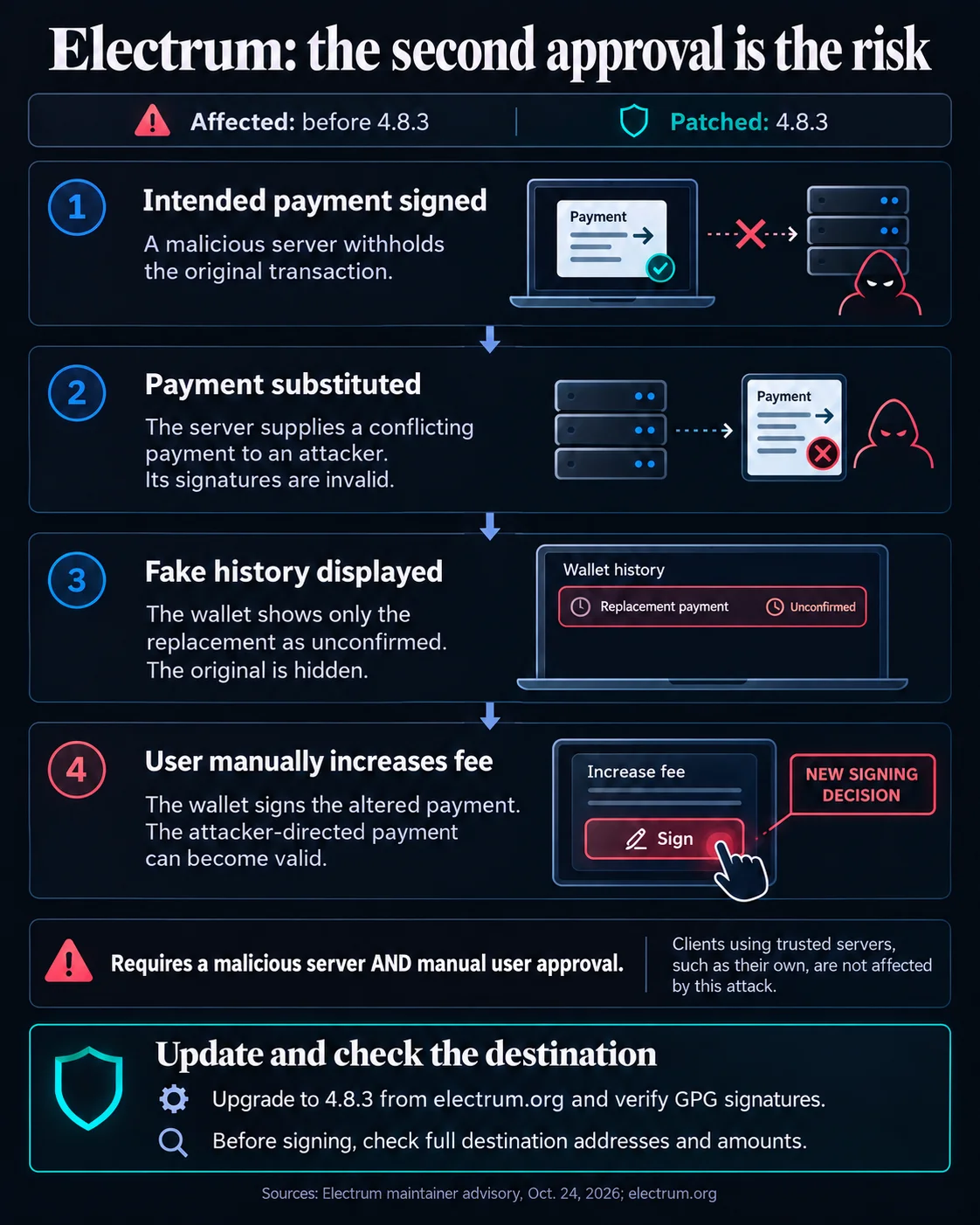
Electrum released version 4.8.3 after confirming that malicious servers were actively exploiting a high-severity flaw in earlier wallet versions. The attack could redirect pending Bitcoin payments when users manually increased fees, and at least one user lost funds after approving a fraudulent transaction. Electrum received two complaints on Oct. 11 and Oct. 18, but did not disclose the total amount stolen or the number of affected wallets.
Why it matters
The vulnerability exploited Electrum's handling of unconfirmed transaction data from external servers. A malicious server could withhold a legitimate payment and display a conflicting transaction that sent funds to an attacker-controlled address. The substituted transaction initially carried invalid signatures, but affected clients displayed it in the wallet's unconfirmed history without verifying those signatures first.
The deception became actionable through Bitcoin's Replace-by-Fee feature. When a user tried to accelerate the apparently delayed payment, Electrum generated fresh signatures for the altered transaction, making the attacker-directed transfer valid without exposing the user's private keys. Attackers also created addresses matching the final four characters of intended recipients' addresses, exploiting partial address checks.
Market impact
The immediate risk is concentrated in users running Electrum versions earlier than 4.8.3, not in a change to Bitcoin's consensus rules. Electrum's patch adds signature checks for wallet-owned inputs before unconfirmed transactions enter local history, blocking the reported substitution path before a fee increase can authorize it.
Users should upgrade through Electrum's official website and verify complete recipient addresses and payment amounts before signing. The advisory says clients connected exclusively to trusted servers, including privately operated ones, were not exposed to this attack. The patch does not extend signature verification to every incoming transaction, so transaction review remains essential.

Frequently asked questions
-
Which Electrum versions are affected by the payment-redirection flaw?
The flaw affects Electrum versions earlier than 4.8.3. Electrum released version 4.8.3 with checks intended to block the reported substitution technique.
-
How did attackers redirect Bitcoin without obtaining private keys?
Malicious servers supplied a conflicting unconfirmed transaction that redirected funds. When a victim increased the fee, the wallet generated fresh signatures for the altered payment.
-
Why did Bitcoin's Replace-by-Fee feature matter in the attack?
Replace-by-Fee lets users increase fees on delayed payments. In the exploit, that routine action caused Electrum to authorize the attacker-directed transaction.
-
How did attackers make fraudulent recipient addresses look legitimate?
They generated Bitcoin addresses whose final four characters matched the intended recipients' addresses. This could deceive users who checked only a partial address.
-
What should Electrum users do after the vulnerability disclosure?
Users should upgrade to version 4.8.3 through Electrum's official website and verify complete recipient addresses and payment amounts before signing transactions.
 CoinDesk
 TheBlock
 WuBlockchain
 WatcherGuru
 Lookonchain