


 CryptoSlate

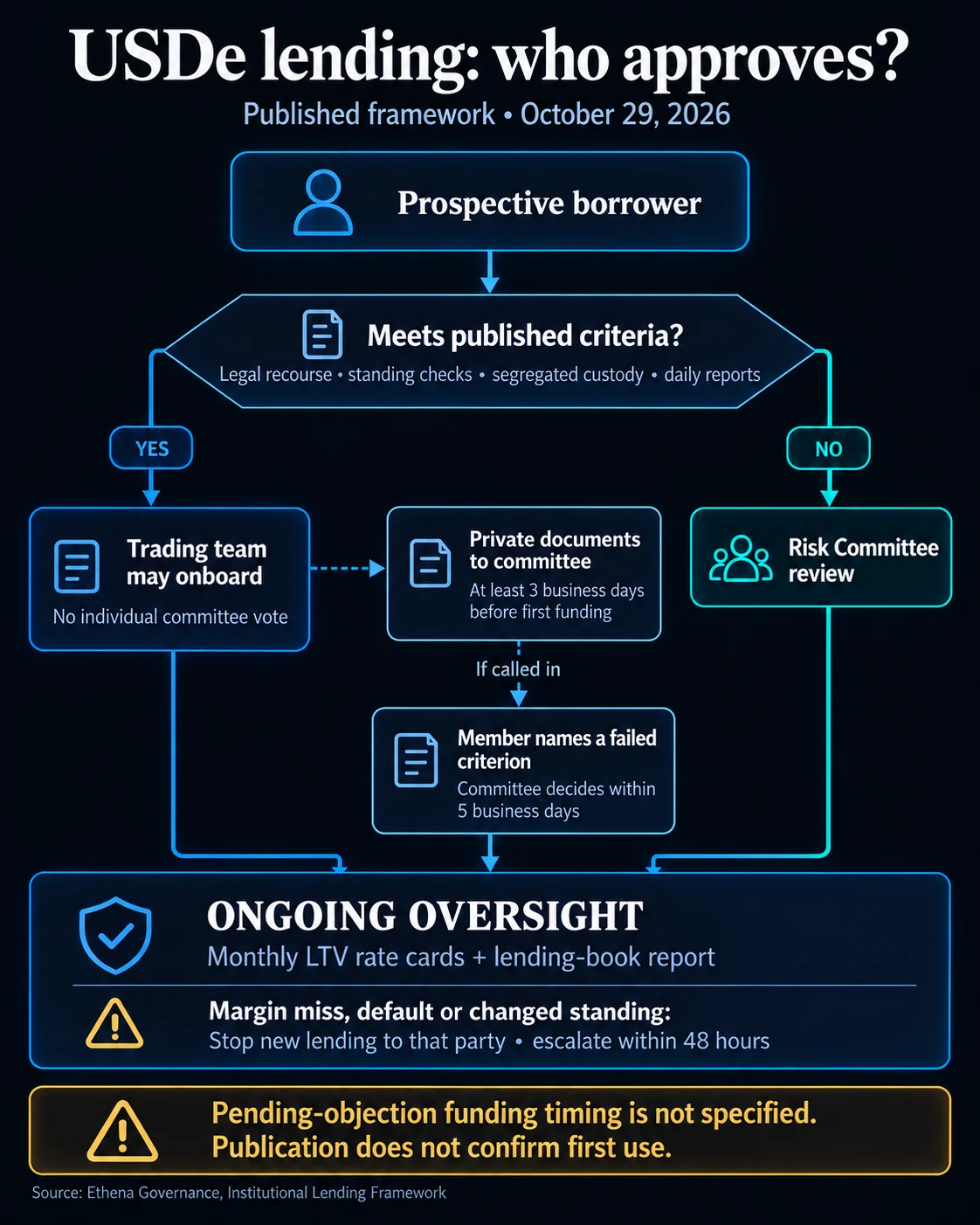


Ethena’s October 29 framework lets its trading team approve qualifying borrowers of assets backing USDe without an individual Risk Committee vote. Borrower documents must go to the committee at least three business days before first funding, and a member who objects must identify a failed criterion. The text does not specify whether funding can proceed while an objection is pending.
Why it matters
The framework shifts routine screening authority to the trading team, while retaining committee oversight and review for cases outside the criteria. Borrowers must meet requirements including full recourse or a parent guarantee, sanctions and standing checks, segregated tri-party custody, and verifiable daily collateral reports. A missed margin call, default, or change in standing stops new lending to that counterparty and triggers escalation within 48 hours.
The rules allow collateral such as BTC and ETH but exclude USDe, sUSDe, ENA, USDtb and borrowers’ own assets. They publish no numerical aggregate lending cap or per-borrower concentration ceiling. Existing governance documents place exposure limits under committee review, but do not provide a public number.
Market impact
The November 1 dashboard capture had no borrower rows or update time, so it does not establish current borrower balances, concentration or collateral ratios. Historical allocation figures do not fill that gap: an October 12 assessment put institutional lending at 14.3% of backing, against roughly $5 billion in total backing, while an October 13 governance update reported 8% of liquid cash as of September 30. The dates and denominators differ, so the figures cannot be read as a direct increase.
For USDe holders, the approval change matters alongside the underlying loan details: which legal entity signed, how much it currently owes, what collateral supports the loan, and how enforceable recovery would be. The framework identifies no newly funded borrower using the delegated route.




Frequently asked questions
-
What changes in Ethena’s borrower approval process?
The trading team can approve borrowers that meet the framework’s criteria without an individual Risk Committee vote. Cases outside the framework still require committee review.
-
How can the Risk Committee object to a proposed borrower?
A committee member must identify a failed criterion to call in a borrower. The rules do not specify whether funding can proceed while an objection is pending.
-
What collateral does Ethena’s framework permit or exclude?
BTC and ETH are among the permitted assets. USDe, sUSDe, ENA, USDtb and borrowers’ own assets are excluded; XAUT is conditional on custody, liquidation venues and a weekend liquidation test.
-
Do the published rules set a lending cap or concentration ceiling?
No numerical aggregate lending cap or per-borrower concentration ceiling is published in the framework. Existing governance documents place exposure limits under committee review.
-
What do the October lending figures reveal about current exposure?
They do not establish current borrower exposure. The figures use different dates and denominators, and the November 1 dashboard capture had no borrower rows or update time.
 WuBlockchain
 TheBlock
 CoinTelegraph
 CoinDesk