


 CryptoSlate


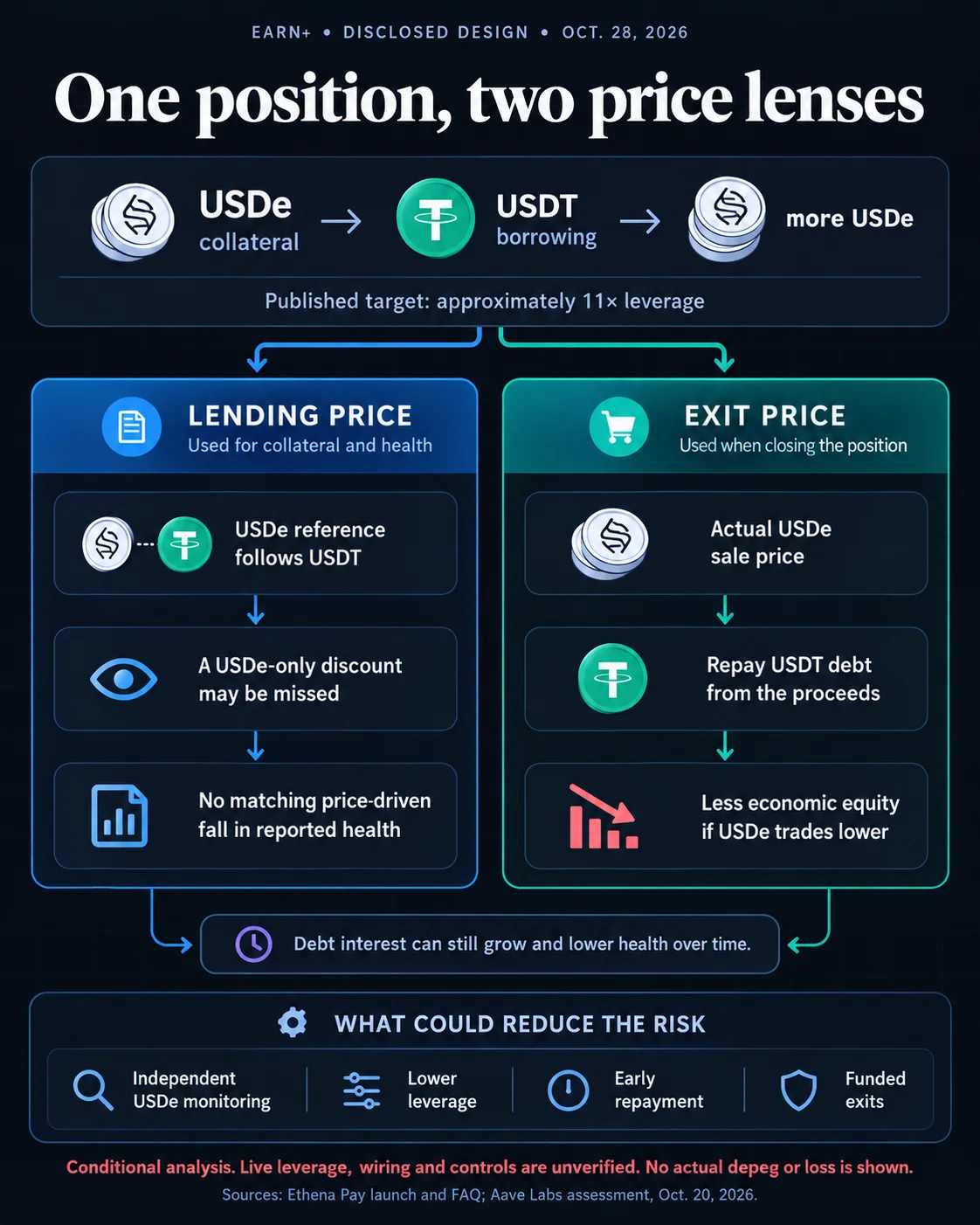

Ethena Pay launched Earn+, a vault strategy targeting roughly 11x leverage by using USDe as collateral and borrowing USDT through Aave v4 on Avalanche. The disclosed oracle follows USDT, which could leave reported collateral health insensitive to a USDe-specific discount. In a hypothetical position at 11x assets-to-equity, a 2% USDe discount cuts initial equity by 22%, before costs.
Why it matters
The oracle valuation and the cash recoverable on exit answer different questions. Aave Labs said the Avalanche USDe price reference follows USDT and would miss a USDe-specific downside depeg. If collateral and debt are both valued against USDT, a falling USDe market price may not be reflected in the health calculation, even as the position's economic equity shrinks.
The model assumes $100 of equity backs $1,100 of USDe and $1,000 of USDT debt. With USDe at $0.98 and USDT held at $1, the remaining equity is $78, a 22% loss. This is an illustrative calculation, not an observed Earn+ position or a liquidation threshold. The actual vault account, balances and live oracle wiring are unverified.
Market impact
Leverage magnifies financing costs as well as price moves. In the same assumptions, a 1 percentage-point rise in annual USDT borrowing cost reduces simple annual return on starting equity by about 10%, before other costs or changes to the position. Earn+ advertises up to 12% APY, but its net return depends on borrowing costs, rewards, fees and vault performance.
Ethena Pay says withdrawal requests have no lock-up and are processed into the USD Account within 24 hours, while its FAQ warns processing can take longer. Aave liquidation health, net return and available exit liquidity are separate measures of risk for users considering the strategy.


Frequently asked questions
-
How does the Earn+ strategy use leverage?
Earn+ targets roughly 11x leverage by using USDe as collateral and borrowing USDT through Aave v4 on Avalanche.
-
Why could the oracle miss a USDe discount?
Aave Labs said the Avalanche USDe price reference follows USDT. A USDe-specific decline could therefore go unreflected in the oracle valuation.
-
What does the 22% modeled equity loss assume?
The hypothetical starts with $100 equity, $1,100 in USDe and $1,000 of USDT debt. With USDe at $0.98 and USDT at $1, equity falls to $78 before costs.
-
Does the modeled loss describe an actual Earn+ position?
No. It is an illustrative calculation, not an observed Earn+ position or a liquidation threshold. The actual vault account, balances and live oracle wiring are unverified.
-
What other risks can affect Earn+ returns and withdrawals?
Borrowing costs, rewards, fees and vault performance affect net returns. Ethena Pay says withdrawal requests have no lock-up, but its FAQ warns processing can take longer than 24 hours.
 Lookonchain
 CoinDesk
 WuBlockchain
 CoinTelegraph
 TheBlock