








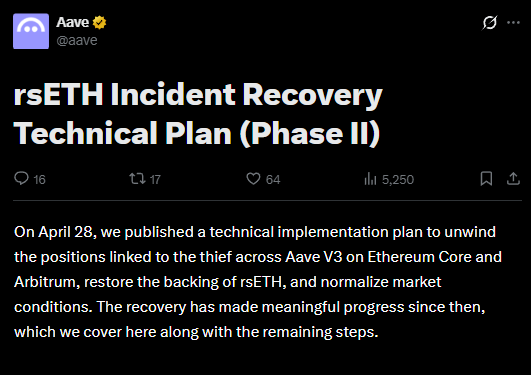

Aave has rolled out Phase II of its rsETH recovery plan, confirming that the attacker's Aave V3 positions were liquidated on May 6. The protocol had previously secured community approval to return roughly $71 million in recovered ETH to affected users.
Why it matters
Those funds were temporarily frozen by plaintiffs holding a judgment against North Korea, which prevented the direct transfer back to Aave users. A court has now cleared the way for the restricted assets to move into Aave LLC, but the legal detour is the reason the protocol will borrow against the shortfall in the meantime rather than wait for the assets to be formally released.
Market impact
The protocol will also burn the liquidated rsETH to cancel out the inflated supply the attacker left behind on Aave. That deflationary step is what gradually unlocks bridge withdrawals and restores normal Aave V3 operations on the rsETH market. The mechanics matter for LPs and borrowers exposed to rsETH collateral: supply is being shrunk, not just positions being closed.


Frequently asked questions
-
What happened to the $71M in recovered ETH from the Aave rsETH hack?
The Arbitrum DAO voted to return roughly $71M in recovered ETH to affected Aave users, but the funds were temporarily frozen by plaintiffs holding a judgment against North Korea. A court has since permitted the transfer of those restricted assets to Aave LLC.
-
Why is Aave borrowing to cover the rsETH shortfall?
Because the recovered ETH is still tied up in legal proceedings. Aave is bridging the gap with borrowed funds so affected users are not left waiting, with the intention of repaying once the court releases the assets.
-
What does burning the liquidated rsETH do?
Burning the seized rsETH cancels out the inflated supply the attacker left behind on Aave V3. The deflationary step is what gradually restores bridge withdrawals and normal operations on the rsETH market.
-
When were the attacker's Aave V3 positions liquidated?
Aave confirmed the attacker's Aave V3 positions were liquidated on May 6 as part of Phase II of the recovery plan.
-
Why is the North Korea judgment relevant to a DeFi recovery?
Plaintiffs holding a judgment against North Korea were able to place a freeze on the recovered ETH, blocking the Arbitrum DAO's vote to return the funds. The episode shows that cross-border legal claims tied to state-sponsored actors can pause on-chain recovery flows mid-process.

 TheBlock
 CoinDesk
 CryptoSlate