








 CoinDesk

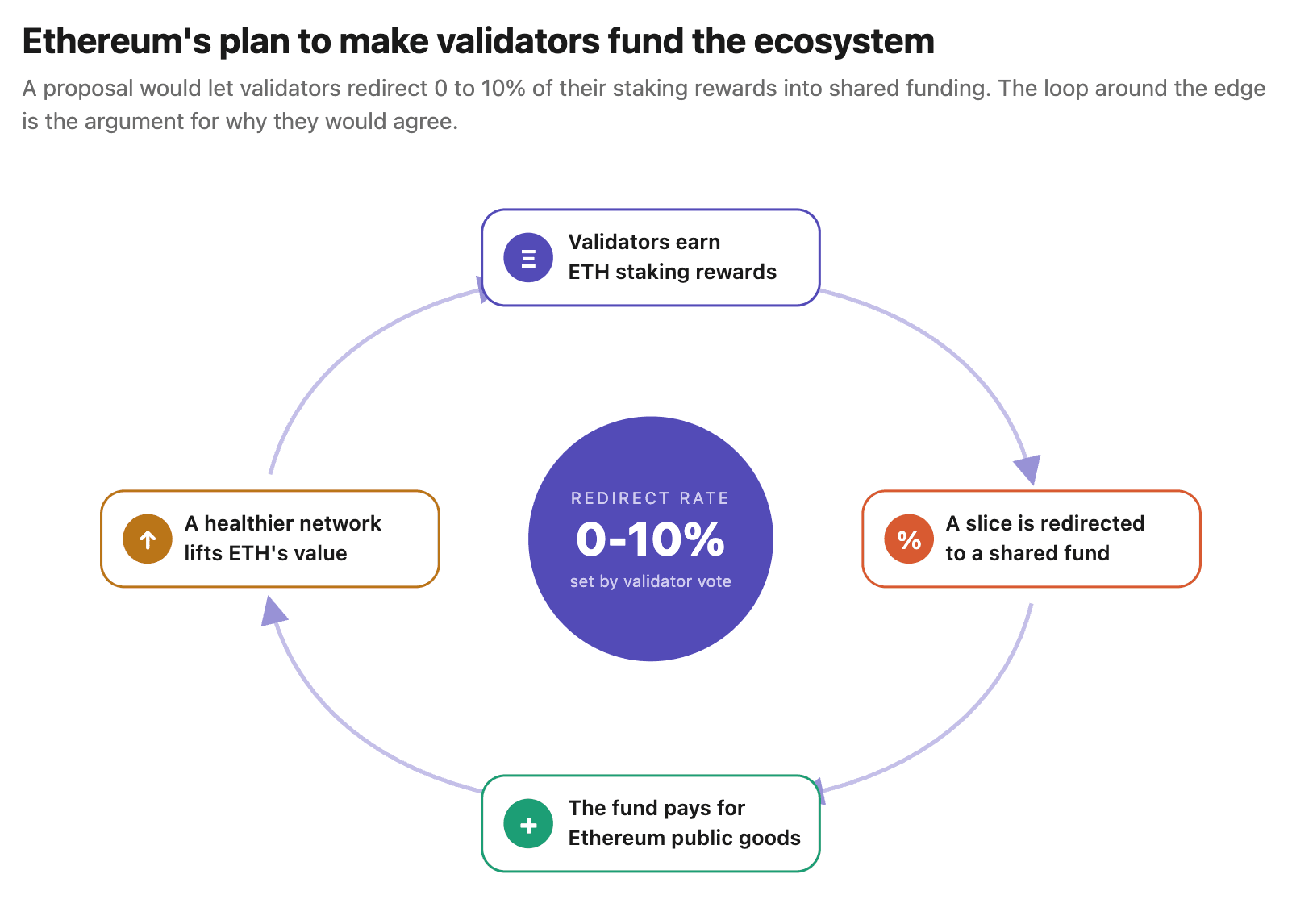


A new governance proposal on Ethereum's research forum would let validators redirect 0% to 10% of their staking rewards toward shared ecosystem infrastructure and public goods, with the contribution becoming mandatory for all validators once a majority signals support for any nonzero rate.
The mechanism, called "validator redirected revenue," would route funds through a "splitter" contract that combines each validator's stated preferences and distributes the redirected ETH accordingly. The author frames it as a structural fix for Ethereum's "free-rider" problem, where shared tooling, security work, research and public goods are chronically underfunded because no single actor wants to absorb the cost when others benefit for free.
The proposal estimates validators receive roughly 700,000 ETH a year in rewards at current staking levels. A 5% to 10% redirect would channel between 50,000 and 70,000 ETH annually into ecosystem funding, worth about $120 million at current market prices.
Why it matters
Validators are the natural long-term stakeholders the proposal targets, because better-funded ecosystem work can lift network activity, ETH burn and the value of staked ETH. The redirect is opt-in at the signal stage but binding once a majority picks a rate, and the splitter design lets validators "set and forget" preferences rather than vote on every individual grant. That makes the mechanism cheap to administer but also concentrates influence in the hands of whoever actually runs validators.
The biggest tension is between staking operators and the ETH holders who delegate to them. Most staked ETH sits behind liquid-staking protocols, centralized exchanges and staking firms, so the operators likely set the funding preferences while the lost yield comes out of the rewards that belong to delegators. That gap between who decides and who pays is the part of the design critics are most likely to attack.
Market impact
A second critique lands on issuance: if validators are willing to give up 5–10% of rewards, critics may argue Ethereum could simply cut base issuance instead and hand the same value back to holders rather than to a grant pool.

Frequently asked questions
-
What does the Ethereum "validator redirected revenue" proposal actually do?
It would let validators signal what share of their staking rewards, between 0% and 10%, to redirect to ecosystem funding. Once a majority picks any nonzero rate, the contribution becomes mandatory for every validator, and funds are split via a "splitter" contract based on each validator's stated preferences.
-
How much ETH could the redirect send to ecosystem funding?
The proposal estimates validators earn roughly 700,000 ETH a year at current staking levels. A 5% to 10% redirect would channel about 50,000 to 70,000 ETH annually, which the author values at roughly $120 million at current market prices.
-
Why do supporters say validators should fund Ethereum's public goods?
Validators are framed as long-term stakeholders whose payoff rises with network activity, ETH burn and the value of staked ETH. The redirect is presented as a structural fix for the "free-rider" problem, where shared tooling, security research and infrastructure are underfunded because no single actor wants to pay…
-
What are the main risks critics are raising?
Three stand out. First, a coordinated majority of validators could raise the redirect rate and route funds to itself or favoured groups. Second, staking operators likely set the preferences while delegators absorb the lost yield, creating a decision-versus-payment gap. Third, if validators will give up 5–10% of…
-
Does the proposal head to a formal vote next?
No. It is a research-forum discussion post, not a binding Ethereum Improvement Proposal. The next step is community debate, and whether Lido, Rocket Pool, Coinbase, Kraken and other major staking pools signal support, oppose, or counter-propose will effectively decide whether a redirect rate ever clears a majority.
 TheBlock
 CryptoSlate
 Crypto News
 Lookonchain