








 WuBlockchain
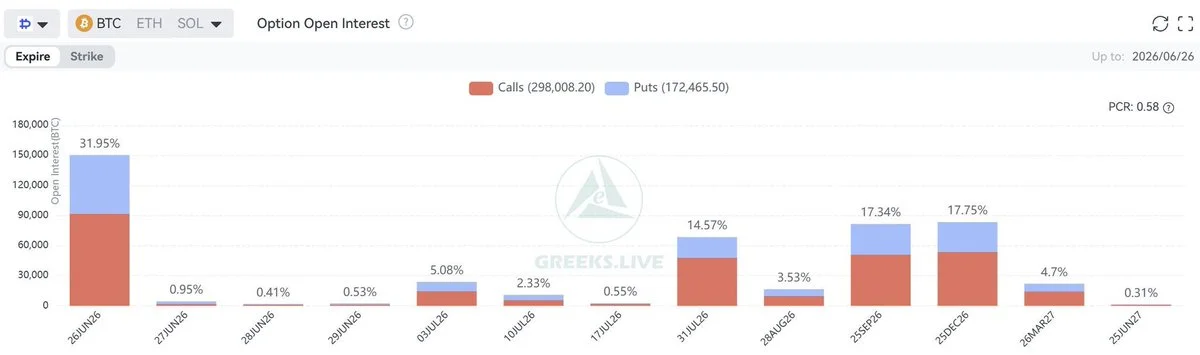
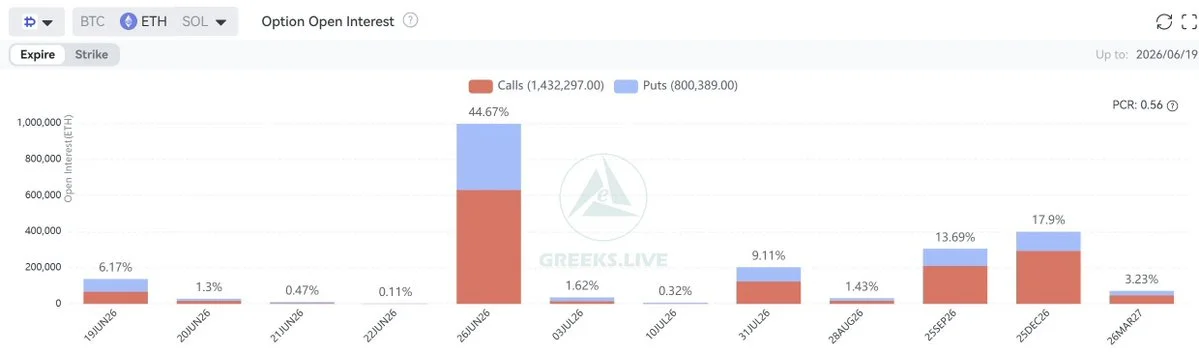
Roughly 150,000 BTC options expired on June 26 with a put-call ratio of 0.63, a max-pain point of $70,000, and $9 billion in notional value. A separate 1 million ETH options block expired the same day at a 0.5 put-call ratio, a $2,000 max-pain point, and $1.57 billion notional. GreeksLive framed the expiry as weak on a quarterly basis and noted that continued selling pressure from Strategy and spot Bitcoin ETFs reflects persistent market risk aversion.
Why it matters
Put-call ratios below 1 on both BTC and ETH legs show the option market is still structurally long gamma into expiry, not hedging a downside shock. The skew is neutral-to-cautious rather than defensive, which lines up with GreeksLive's read that risk aversion is being expressed through spot ETF outflows and Strategy's ongoing distribution rather than through a wave of protective puts.
Market impact
A max-pain cluster near $70,000 on BTC and $2,000 on ETH tends to act as a magnet into settlement, pulling spot closer to those strikes as dealers unwind. With quarterly volumes running light, dealer gamma pin risk is modest but directional. The bigger signal sits in the spot complex: persistent ETF outflows and Strategy selling keep a ceiling on any post-expiry squeeze, and the next leg likely follows net ETF flow rather than derivatives positioning.


Frequently asked questions
-
What was the max-pain price for the June 26 BTC options expiry?
The max-pain point for the roughly 150,000 BTC options that expired on June 26 was $70,000, against a put-call ratio of 0.63 and $9 billion in notional value.
-
How many ETH options expired on June 26?
Around 1 million ETH options expired on June 26 with a put-call ratio of 0.5, a max-pain level of $2,000, and $1.57 billion in notional value.
-
What does a put-call ratio below 1 mean for options expiry?
A put-call ratio below 1 on both BTC and ETH legs means more calls than puts were open into expiry. The option market was structurally long gamma rather than loading up on protective puts, a neutral-to-cautious skew rather than a defensive one.
-
Why did GreeksLive call the June 26 expiry weak?
GreeksLive described the June 26 expiry as weak on a quarterly basis and pointed to continued selling pressure from Strategy and spot Bitcoin ETFs as evidence that market risk aversion is being expressed in the spot complex, not through derivatives hedges.
-
How does max-pain price action typically affect spot after expiry?
Max-pain levels often act as a magnet into settlement as dealers unwind hedges, pulling spot price toward the strike where the most contracts expire worthless. With quarterly volumes light, the pin effect on June 26 was modest but still directional.
 Glassnode
 Lookonchain
 Whale Alert
 Crypto Rank News
 CoinDesk
 TheBlock