








 Crypto News


GSR Markets launched BESO on Nasdaq, the first US-listed crypto fund to actively manage a multi-asset basket of BTC, ETH, and SOL with built-in protocol-level staking yield passed through to shareholders. The fund charges a 1% annual fee, rebalances weekly, and passes through ETH staking yield at 3.3–4.0% APY directly to holders — a product structure that did not exist a week ago and slots into a US ETF shelf now defined by BlackRock's IBIT (with $54 billion AUM) and Bitwise's BAVA, which offers concentrated AVAX exposure at 5.4% staking APY.
Why it matters
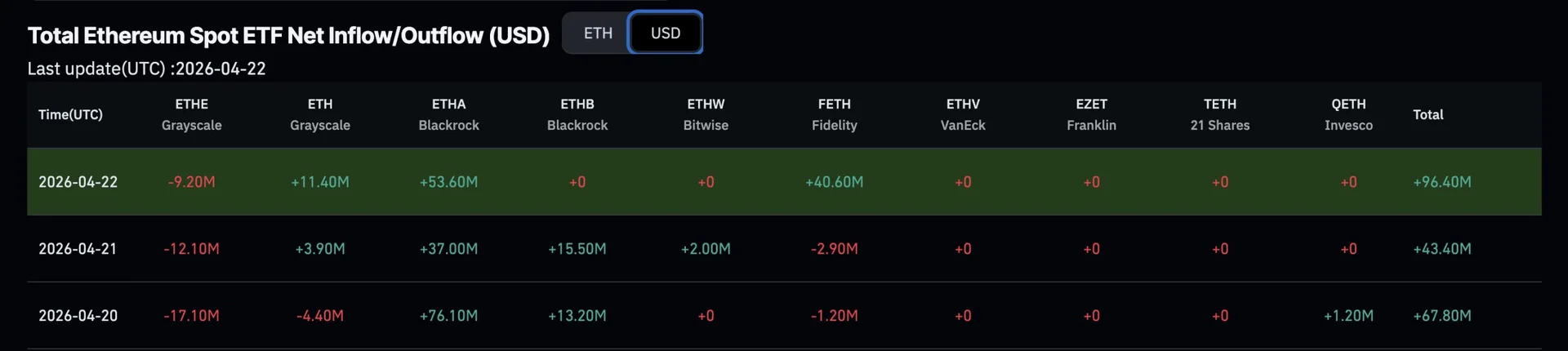
Three ETF structures now represent three distinct institutional bets on crypto's role in a portfolio: spot BTC exposure, a yield-bearing multi-asset basket, and a single-asset high-yield alternative. BESO's staking pass-through is the structural novelty — it makes yield a fund-level feature rather than something investors have to chase off-platform. Spot Ethereum ETFs meanwhile logged $206 million in net inflows across three sessions this week, the strongest weekly pace since launch, with cumulative inflows closing in on $12 billion and two more trading days still to go. ETH network transactions rose 41% week-over-week against that backdrop.
Market impact
ETH is consolidating in a $2,200–$2,400 support band, with $2,400 acting as the critical pivot after the April 17 surge to $2,440 on heavy ETF volume established a near-term ceiling. Exchange supply is thinning as staking pulls assets off-market — a structural squeeze that historically precedes directional moves. With sustained ETF demand through the next 72 hours, a break above $2,400 opens a run toward $2,500; TD Cowen carries a $3,650 target, and Standard Chartered's institutional-flow thesis sits at $7,500. The institutional accumulation case carries the most weight heading into the second half of 2026.



Frequently asked questions
-
What is the BESO ETF and how does it differ from BlackRock's IBIT?
BESO is a Nasdaq-listed ETF launched by GSR Markets that actively manages a multi-asset basket of BTC, ETH, and SOL with built-in staking yield (3.3–4.0% APY) passed through to shareholders. BlackRock's IBIT is a spot Bitcoin ETF with $54 billion AUM and no yield component.
-
How much have spot Ethereum ETFs pulled in recently?
Spot Ethereum ETFs logged $206 million in net inflows across three sessions this week — the strongest weekly pace since launch — with cumulative inflows closing in on $12 billion and two trading days still to go.
-
What is ETH's key price level to watch right now?
ETH is consolidating in a $2,200–$2,400 support band, with $2,400 acting as the critical pivot. A sustained break above that level on continued ETF demand opens a run toward $2,500.
-
What are the institutional price targets for ETH?
TD Cowen carries a $3,650 target on ETH, while Standard Chartered's institutional-flow thesis sits at $7,500 — a stretch case built on sustained ETF accumulation into the second half of 2026.
-
Why is exchange supply dropping and why does it matter for ETH price?
Exchange supply is thinning as staking pulls ETH off-market into validator deposits. Historically, that kind of structural supply squeeze has preceded directional moves in ETH price.
 Lookonchain
 Altcoin Daily
 CoinDesk
 TheBlock
 CryptoSlate
 WuBlockchain