








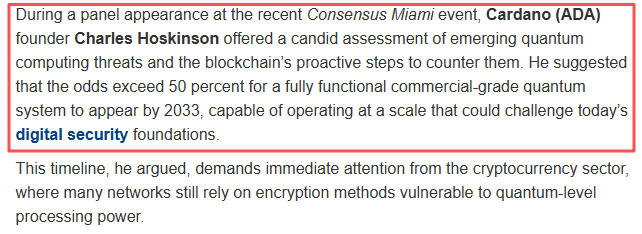

Cardano founder Charles Hoskinson told attendees at Consensus Miami that there is a more than 50% chance commercial quantum systems capable of threatening today's digital security could emerge before 2033, urging the crypto industry to begin hardening its cryptographic stack now rather than react later.
Why it matters
Hoskinson framed the threat as structural rather than speculative: existing public-key schemes underpin wallet signatures, transaction validation, and consensus security across the industry, and a sufficiently capable quantum machine would not discriminate by chain. Cardano's response, per his remarks, leans on lattice-based cryptography and a planned integration of U.S. FIPS 203–206 post-quantum standards — a family of NIST-approved algorithms designed to resist quantum attacks while remaining deployable on existing hardware.
Market impact
The timeline is short enough that protocols still relying on classical signatures for high-value keys have a narrow migration window. Cardano's pre-emptive posture puts it among the first majors to publicly commit to lattice primitives and a named federal standard, giving institutional and government-facing integrations a concrete reference point. Watch for peer chains to follow with their own post-quantum roadmaps; the next year of standards work will likely shape which protocols get designated for regulated custody, settlement, and tokenised-asset rails.
Source: [Cardano Founder Charles Hoskinson Highlights Quantum Computing Risks And Potential Blockchain Network — Crowdfund Insider](https://www.crowdfundinsider.com/2026/05/278955-cardano-founder-charles-hoskinson-highlights-quantum-computing-risks-and-potential-blockchain-network-defenses/#webpage)

Frequently asked questions
-
What did Charles Hoskinson say about quantum computing and crypto?
At Consensus Miami, Hoskinson said there is a more than 50% chance commercial quantum systems capable of threatening today's digital security could emerge before 2033, and urged the crypto industry to harden its cryptographic stack now.
-
How is Cardano preparing for quantum threats?
Hoskinson said Cardano is advancing post-quantum security based on lattice cryptography and plans to incorporate U.S. FIPS 203–206 standards to strengthen private keys, transaction signatures, and consensus security.
-
What are FIPS 203–206 standards?
FIPS 203–206 are NIST-approved post-quantum cryptographic standards designed to resist attacks from future quantum computers while remaining deployable on existing hardware. They cover encryption, signatures, and key-encapsulation primitives.
-
Why is lattice cryptography relevant to post-quantum security?
Lattice-based schemes are a leading family of post-quantum algorithms because their underlying math problems are believed to remain hard for both classical and quantum computers, unlike RSA and elliptic-curve signatures.
-
What is the 2033 quantum threat timeline for crypto?
Hoskinson framed the risk as emerging before 2033, a window narrow enough that protocols still relying on classical signatures for high-value keys face a constrained migration path to post-quantum primitives.

 CryptoSlate
 Crypto News
 TheBlock
 Crypto Rank News
 CoinTelegraph