








 CoinDesk
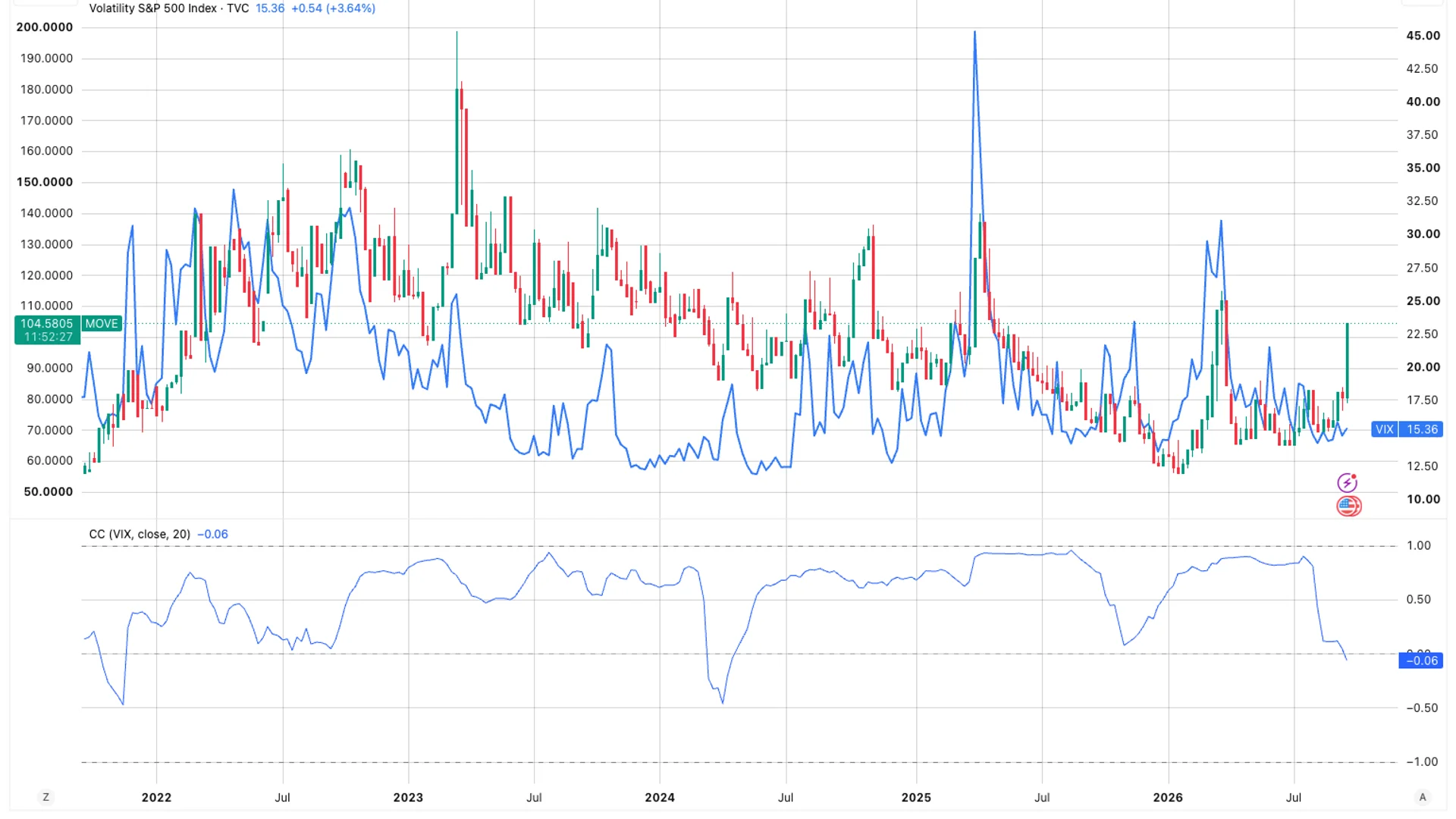



The MOVE index, a measure of expected U.S. Treasury-market volatility, climbed from around 80 on Tuesday to 104 on Thursday, its highest level since March. Bitcoin’s BVIV implied-volatility index remained near its year-to-date low at around 37, while the S&P 500’s VIX hovered near 14, also close to its yearly low.
Why it matters
The gap suggests bond traders are pricing more uncertainty than equity and bitcoin options markets. Rising energy prices and Treasury yields are adding to inflation concerns, while the U.S. 10-year yield briefly touched 5.2% on Thursday before easing to 5.163%. Higher bond volatility can tighten financial conditions because Treasuries underpin global finance and credit creation.
Market impact
The 20-day correlation between MOVE and VIX turned slightly negative at −0.06, its first negative reading since April 2024. The relationship between MOVE and BVIV was more clearly negative at −0.37, as Bitcoin’s expected volatility stayed subdued. These readings show that bond-market stress has yet to spread to stocks or Bitcoin, not that it cannot.
Bitcoin’s calm also comes despite rising yields, which have shown little consistent relationship with its returns. The key watch is whether inflation and bond-market pressure begin to lift volatility in risk assets.

Frequently asked questions
-
What does the MOVE index measure?
MOVE measures expected volatility in the U.S. Treasury market. It climbed to 104 on Thursday, its highest level since March.
-
How did Bitcoin’s implied volatility compare with bond volatility?
Bitcoin’s BVIV index was around 37, near its year-to-date low, even as MOVE rose to 104.
-
What did the MOVE and VIX correlation indicate?
Their 20-day correlation was −0.06, a slightly negative reading and the first below zero since April 2024.
-
Why are rising bond yields a concern for risk assets?
Higher bond volatility can tighten financial conditions because Treasuries underpin global finance and credit creation. Rising energy prices and yields are also adding to inflation concerns.
-
Has bond-market volatility already spread to Bitcoin and stocks?
Not in the volatility measures cited. Bitcoin’s BVIV and the S&P 500’s VIX remained near their year-to-date lows, though the article identifies inflation and yields as pressure points to watch.
 WatcherGuru
 Crypto News
 Crypto Rank News
 CoinTelegraph
 TheBlock
 WuBlockchain