








 CoinDesk
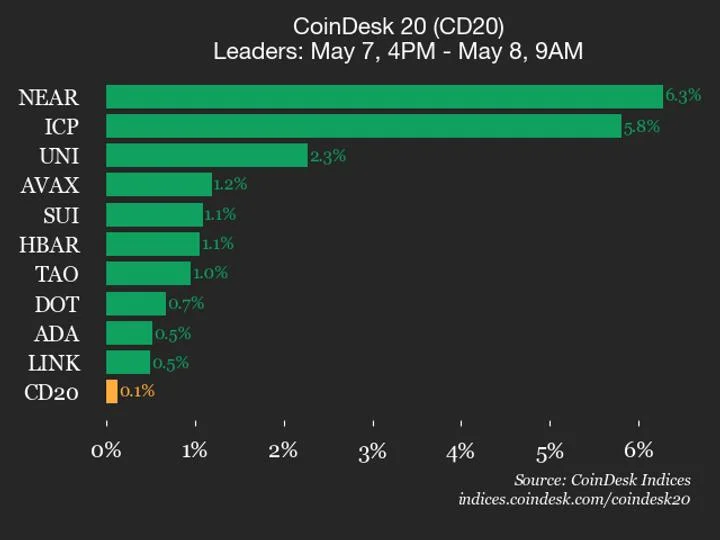
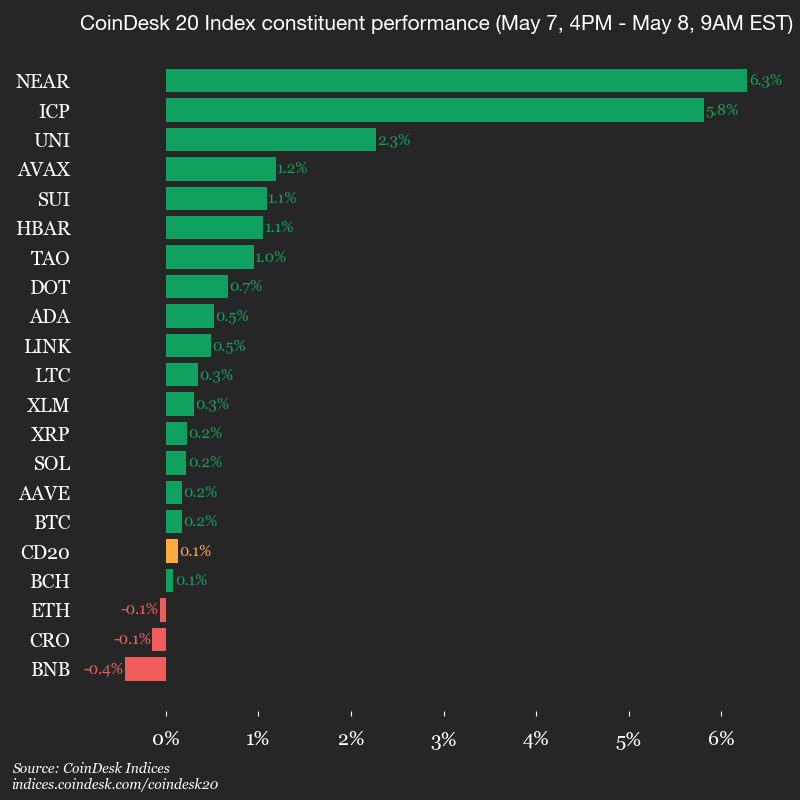


NEAR Protocol jumped 6.3% on Friday to lead the CoinDesk 20 higher, with Internet Computer (ICP) close behind at +5.8%. Seventeen of the index's twenty constituents finished in the green, though the breadth did not translate into a meaningful move for the benchmark itself.
Why it matters
The CoinDesk 20 closed at 2142.44, up just 0.1% (+2.73 points) from Thursday's 4 p.m. ET reference. The split between constituent-level strength and index-level flatness is the story: leadership was concentrated in a handful of names rather than a broad advance, which is more typical of rotation than risk-on continuation.
Market impact
NEAR and ICP are not the heaviest-weighted names in the index, so their outsized moves lifted only a few index points. Laggards BNB (-0.4%) and CRO (-0.1%) offset the leadership, leaving the benchmark effectively unchanged on the day despite the overwhelmingly green tape underneath.


Frequently asked questions
-
What is the CoinDesk 20 Index?
The CoinDesk 20 is a broad-based crypto index tracking twenty of the largest digital assets by market capitalization. It is traded on multiple platforms in several regions globally and serves as a benchmark for overall crypto market performance.
-
How much did the CoinDesk 20 move on Friday?
The index closed at 2142.44, up just 0.1% or +2.73 points from Thursday's 4 p.m. ET reference price, despite seventeen of twenty constituents finishing higher.
-
Why was NEAR Protocol the top performer?
NEAR led the index with a 6.3% gain, though the seed does not specify a catalyst. Its outperformance was concentrated rather than part of a broader advance across the index.
-
What lagged the CoinDesk 20 on the day?
BNB was the biggest laggard at -0.4%, followed by CRO at -0.1%. These declines offset much of the leadership from NEAR and ICP on a cap-weighted basis.
-
What does the breadth-vs-index split suggest?
With 17 of 20 names green but the index effectively flat, the move points to rotation among a few leaders rather than a broad risk-on advance. Cap-weighted indices move less when small-cap names outperform heavyweights.
 Crypto News
 Glassnode
 WatcherGuru
 Altcoin Daily