








 CoinDesk

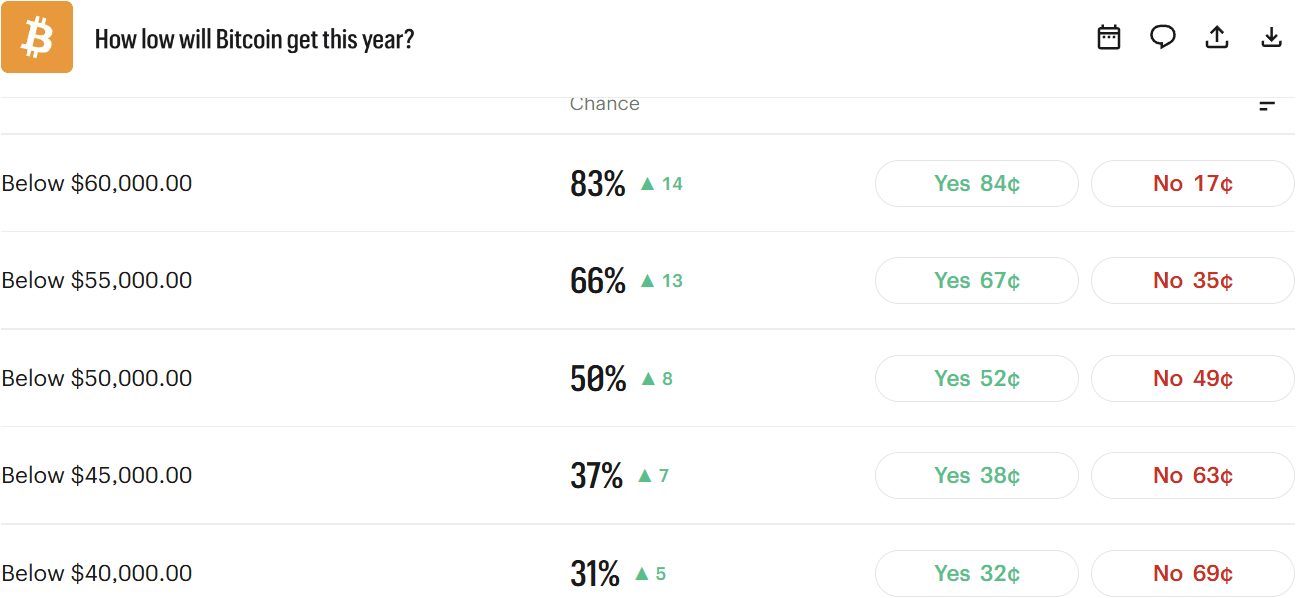

Prediction market traders are now wagering that bitcoin's slide toward $65,000 has further to run. On Kalshi, contracts imply a 66% probability that BTC drops below $55,000 by year-end, a 50% chance of sub-$50,000 prices, and a 31% chance of a drop under $40,000. Polymarket traders are pricing in a similar view, with roughly 67% odds of sub-$55,000 and a better-than-even chance of sub-$50,000 BTC.
The bearish positioning comes against a brutal tape: U.S.-listed spot bitcoin ETFs shed $2.4 billion in May and another $1 billion in the first two trading days of June, according to SoSo Value. BTC itself is down roughly 37% over the past year while gold — the traditional safe-haven comparison — is up 33%. Polymarket gives bitcoin only a 30% chance of outperforming gold in 2026.
Why it matters
The prediction-market signal matters because it captures where hedgers and speculators are actually positioning, not just where surveys point. A 66% implied probability of sub-$55,000 is the kind of number that, when it shows up on regulated U.S. exchanges like Kalshi, tends to be backed by real capital rather than social-media sentiment. The fact that Kalshi and Polymarket are converging on the same distribution — both around two-thirds odds of a sub-$55K print — gives the read more weight than either venue alone.
The driver is a rotation, not an exodus. K33 Research's Vetle Lunde wrote this week that "much of the market views the opportunity cost of holding BTC as too high while anything AI-related soars," as AI-linked equities push major indexes to record highs. K33 still views bitcoin as undervalued versus equities over the long term, but the near-term trade is clear: capital wants AI exposure more than BTC exposure right now.
Market impact
The capital that is leaving spot bitcoin ETFs is not leaving crypto — it is parking in stablecoins. Both USDT and USDC have gained market share during bitcoin's slide toward $66,000, a sign traders are raising dry powder rather than closing the book on the asset class.



Frequently asked questions
-
What do prediction markets say about bitcoin's price by year-end?
Kalshi contracts imply a 66% probability BTC falls below $55,000 by year-end, a 50% chance of sub-$50,000 prices, and a 31% chance of a sub-$40,000 print. Polymarket is pricing roughly the same distribution at ~67% odds of sub-$55K.
-
How much have U.S. spot bitcoin ETFs lost in recent outflows?
U.S.-listed spot bitcoin ETFs shed $2.4 billion in May and another $1 billion in the first two trading days of June, according to SoSo Value — roughly $3.4B total over five weeks of institutional selling.
-
Why are prediction market traders betting against bitcoin?
Heavy U.S. spot ETF outflows, weakening institutional demand, and a rotation into AI-linked equities pushing major indexes to record highs have made the opportunity cost of holding bitcoin too high for many investors, per K33 Research's Vetle Lunde.
-
Are traders leaving crypto entirely or just rotating?
Capital is rotating rather than exiting. Both USDT and USDC have gained market share during bitcoin's slide toward $66,000, indicating traders are raising dry powder in stablecoins and waiting for better entry points rather than leaving the asset class.
-
How does bitcoin's performance compare to gold right now?
Bitcoin is down roughly 37% over the past year while gold is up 33% over the same period. Polymarket traders give bitcoin only a 30% chance of outperforming gold in 2026.
 WatcherGuru
 Lookonchain
 Glassnode
 Crypto Rank News
 Crypto News
 Benjamin Cowen
 CoinTelegraph