








 CoinDesk

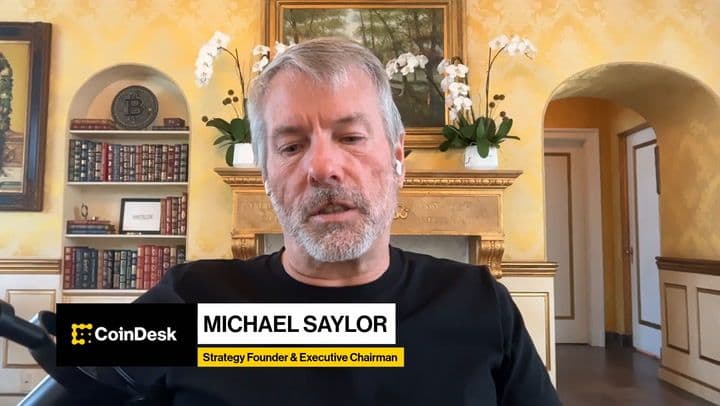

Michael Saylor dismissed investor concern that Strategy (MSTR) might sell bitcoin to fund its dividend obligations, calling the scenario "a big nothing burger" in a CoinDesk interview at Consensus Miami. His argument: even if Strategy funded every dividend with bitcoin, the company would simultaneously be buying 20 BTC for every one sold, against a market carrying $20-50B in daily liquidity — making any single sale economically and market-impact-wise "immeasurable." Saylor also framed the open option to retire high-cost-basis bitcoin for up to $2.2B in tax credits as one of several capital-markets trades the firm evaluates weekly against two metrics: BTC yield per share and balance-sheet credit risk.
Why it matters
The substantive defense isn't really about whether MSTR might sell a few thousand coins. It's Saylor's description of Strategy's operating logic: equity swaps executed in the three-hour windows when MSTR's premium to bitcoin is widest, capturing risk-free yield by swapping an overvalued share for a stable underlying. The same logic drives STRC, the perpetual preferred that pays SOFR plus a credit spread and carries no put right — the instrument has grown at a roughly 400% pace, and Saylor frames the recent trading discount to par and slower post-dividend recovery as healthy flex, not stress. Critics who say Strategy "buys the weekly top" are misreading the signal, in Saylor's telling: the buys cluster exactly when MSTR's equity premium expands, which is mechanically when bitcoin has just rallied.
Market impact
For MSTR holders, the takeaway is that the dividend-funding disclosure is optionality, not policy — Saylor explicitly refused to telegraph timing. For bitcoin, the structural point is that a $3.2B STRC issuance in a couple of weeks has expanded the supply of MSTR-linked capital instruments dramatically, and the market is still digesting that float. Strategy's reported average cost basis of $75,540 per coin against last week's purchase at $80,340 leaves roughly $61.8B of cumulative treasury spend — and a meaningful tax-credit option if high-cost lots are ever retired. The next data point to watch is whether STRC's discount to par continues to close on full monthly cycles, which would validate Saylor's "designed to flex" framing; persistent widening would be the first real sign of structural stress in the preferred.

Frequently asked questions
-
Did Michael Saylor say Strategy will sell bitcoin to pay dividends?
No. Saylor called the scenario a "big nothing burger" and said even if dividends were funded entirely with bitcoin sales, the company would simultaneously buy 20 BTC for every one sold. He described the dividend-funding disclosure as optionality, not policy, and refused to telegraph timing.
-
Why do critics say Strategy buys the weekly top on bitcoin?
Because MSTR's reported bitcoin purchases tend to cluster on weeks when price has already rallied. Saylor argues this is mechanical: equity swaps are most profitable when MSTR's premium to BTC is widest, and the premium expands right after bitcoin rallies — so the buys are landing at the top of both the equity and…
-
What is STRC and how does it work?
STRC, marketed as "Stretch," is Strategy's perpetual preferred share. It pays SOFR plus a credit spread indefinitely, has no put right, and is not redeemable by the company. Saylor pegged its growth rate at roughly 400% and said Strategy issued $3.2B of it in a couple of weeks.
-
How much tax credit could Strategy capture by selling high-cost bitcoin?
Saylor said the firm has the optionality to capture up to $2.2B in tax credit by retiring high-cost-basis bitcoin, but the value of that credit changes with bitcoin's price daily. He framed it as one of several capital-markets trades the firm evaluates against BTC yield per share and balance-sheet credit risk.
-
What is Strategy's average cost basis on its bitcoin holdings?
Per the disclosure in the article, Strategy has spent roughly $61.8B on bitcoin at an average cost of $75,540 per coin. Last week's reported purchase was 535 BTC at an average of $80,340.
 CoinTelegraph
 WatcherGuru
 Crypto News
 WuBlockchain
 CryptoSlate