


 CryptoSlate


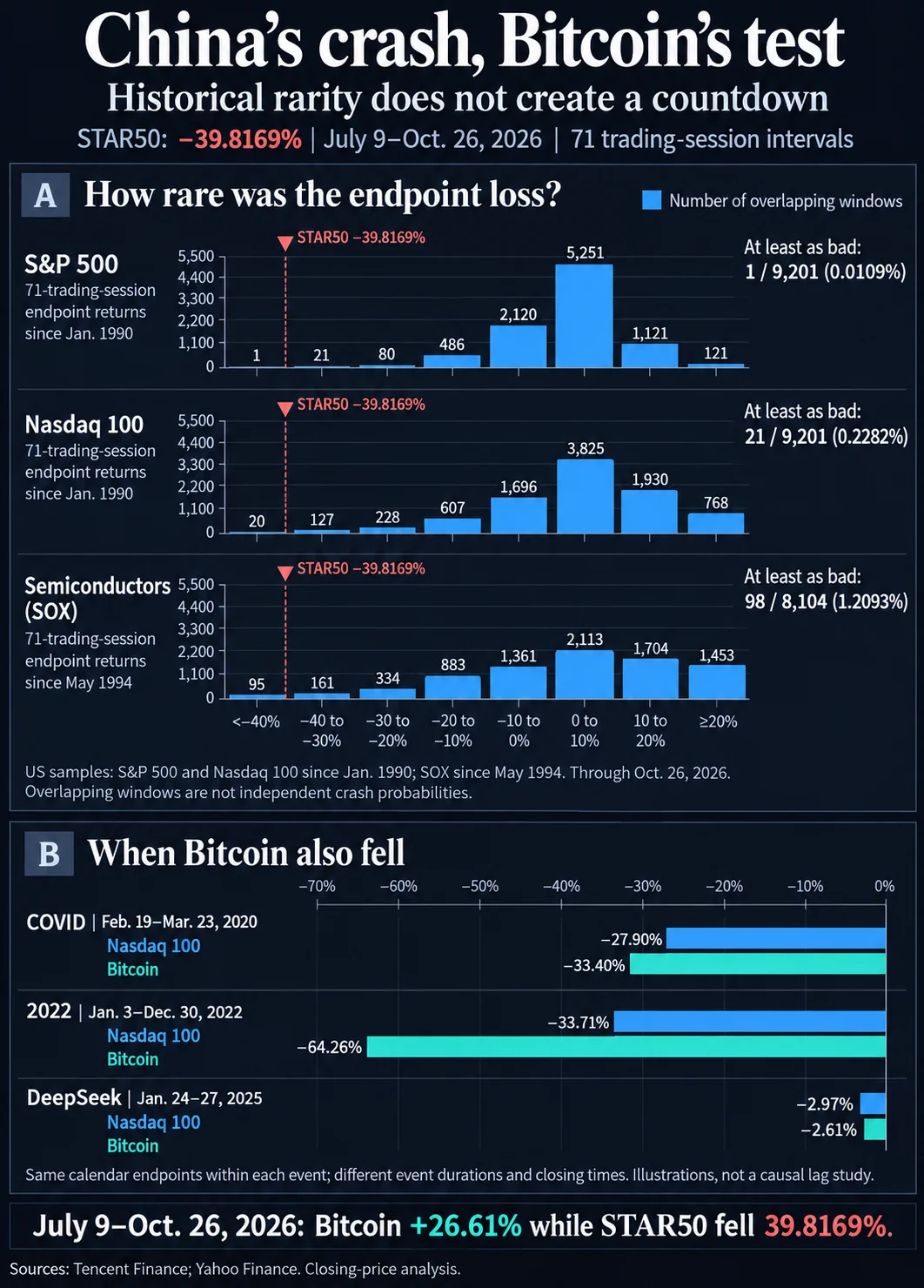

China’s STAR50 index fell 39.8% from July 9 through Oct. 26, erasing an estimated $480 billion in market value, while Bitcoin gained 26.6% over the same dates. The loss was rare against historical US equity-index windows, but the comparison does not establish that a selloff will spread to crypto.
Across overlapping 71-session windows, only 1 of 9,201 S&P 500 observations matched or exceeded STAR50’s decline. The Nasdaq 100 recorded 21 such windows and the Philadelphia Semiconductor Index 98. Because the windows overlap and cluster around crises, these frequencies are not independent crash probabilities.
Bitcoin’s gains over this period do not erase its history of moving with risk assets. Its daily-return correlation with the Nasdaq 100 was about 0.63 over 30 matched US market dates ending Oct. 26, up from 0.36 for the 30 dates ending July 9. The current evidence of potential spillover is mixed: US spot Bitcoin ETFs saw $636 million in net outflows on Oct. 22, followed by $110 million in net inflows on Oct. 26. High-yield spreads narrowed slightly from 3.4% to 3.3% over those dates.
A stronger contagion signal would require sustained US technology losses alongside wider credit spreads, rising funding pressure and persistent ETF withdrawals. Orderly financing and renewed ETF buying despite further Chinese equity losses would weaken that case.

Frequently asked questions
-
How much did China's STAR50 fall over the period, and how did Bitcoin perform?
From July 9 through Oct. 26, STAR50 fell 39.8%, while Bitcoin gained 26.6% over the same dates.
-
How unusual was STAR50's decline compared with historical S&P 500 windows?
One of 9,201 overlapping 71-session S&P 500 windows matched or exceeded STAR50's decline. The windows overlap, so this is not an independent crash probability.
-
Did Bitcoin move in step with the Nasdaq 100 during the comparison period?
Bitcoin's daily-return correlation with the Nasdaq 100 was about 0.63 over 30 matched US market dates ending Oct. 26, compared with 0.36 for the 30 dates ending July 9.
-
What did US spot Bitcoin ETF flows show in late October?
The funds recorded $636 million in net outflows on Oct. 22, followed by $110 million in net inflows on Oct. 26, making the readings mixed.
-
What would strengthen or weaken the case for contagion to Bitcoin?
Wider credit spreads, rising funding pressure and persistent ETF withdrawals alongside US technology losses would strengthen the case. Orderly financing and renewed ETF buying would weaken it.
 CoinDesk
 WatcherGuru
 Crypto Rank News
 Lookonchain
 Whale Alert
 Altcoin Daily
 WuBlockchain