


 CryptoSlate



Block Scholes’ October 26 snapshot put Bitcoin options’ annualized forward implied volatility at 37.8% for the seven-to-14-day window containing the November 3 US midterms. That was 0.1 volatility point above the 30-to-60-day reading of 37.7%, and 2.8 points above the 14-to-30-day reading of 35%. Eight days before the 2024 presidential election, those premiums were 10.8 and 14.4 points, respectively.
Why it matters
The comparison shows a much flatter election premium than in 2024, not a forecast that Bitcoin will rise or a measure of the odds of a particular result. Forward volatility describes variability priced into options for a specified interval. It does not translate directly into an expected election-week price move.
The political events also differ: the 2026 vote is a midterm election, not a presidential contest. Block Scholes found little contemporaneous relationship between changes in Kalshi’s Democratic Senate-control probability and Bitcoin’s daily returns in 2026 through October 26, with an average correlation of -0.02. That result covers one contract and period; it does not rule out a sharp response to an unexpected outcome.
Market impact
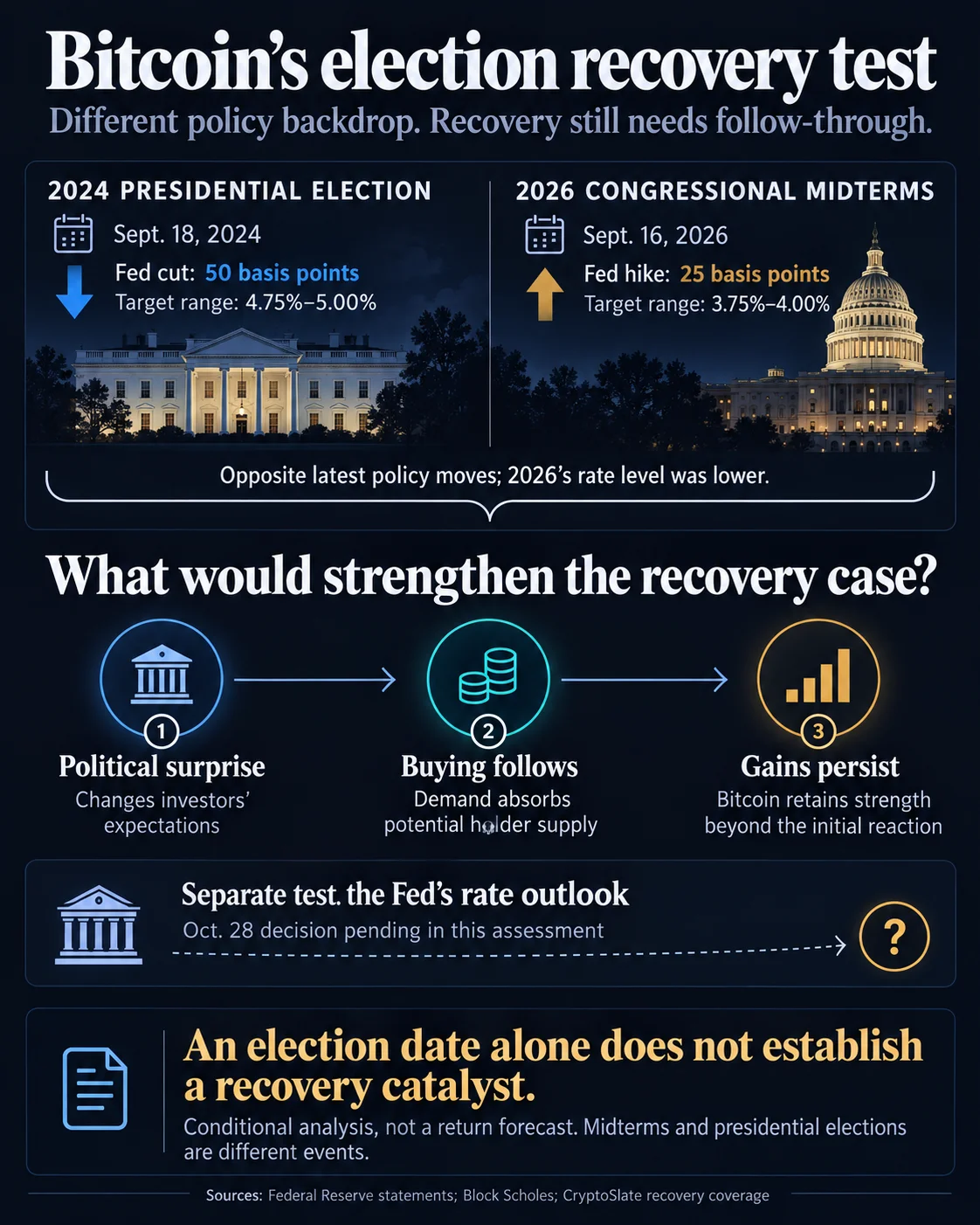
The monetary backdrop differs as well. In September 2024, the Fed cut its target range by half a percentage point to 4.75%–5%. In September 2026, it raised the range by a quarter point to 3.75%–4%, then held rates at that level on October 28 in a 10–2 vote. The options snapshot predates the hold, and future rate expectations remain a separate factor.
Bitcoin was quoted near $80,069 on October 29, down 4.9% over 30 days and 36.6% below its all-time high. A reported holder acquisition-price concentration between $81,000 and $82,500 is a price area to watch, not proof of sell orders or a guaranteed ceiling. An election-led recovery would look more convincing if changed political expectations were followed by sustained buying and gains through that area. Earlier post-midterm recoveries do not provide an automatic template because they overlap with Bitcoin’s cycle and other market events.

Frequently asked questions
-
What did Bitcoin options price for the 2026 midterm election window?
Block Scholes measured 37.8% annualized forward implied volatility for the seven-to-14-day window containing the election. That was 0.1 point above the 30-to-60-day reading.
-
How did the 2026 election premium compare with the 2024 premium?
Eight days before the 2024 presidential election, the election window carried premiums of 14.4 points over days 14–30 and 10.8 points over days 30–60. The corresponding 2026 premiums were 2.8 and 0.1 points.
-
Does 37.8% implied volatility mean Bitcoin could move 37.8% during election week?
No. The annualized figure describes variability embedded in options pricing for a specified interval. It is not an expected election-week price move or a probability of a particular result.
-
What did Block Scholes find about Senate election expectations and Bitcoin returns?
Its analysis found an average correlation of -0.02 between changes in Kalshi’s Democratic Senate-control probability and Bitcoin’s daily returns through October 26, 2026.
-
Which Bitcoin price area was identified as a recovery test?
A reported concentration of holder acquisition prices sat between $81,000 and $82,500. The range is not confirmed sell orders or proof that Bitcoin will be rejected there.
 CoinDesk
 Whale Alert
 Lookonchain
 WuBlockchain
 CoinTelegraph
 Crypto Rank News
 WatcherGuru