








 WuBlockchain

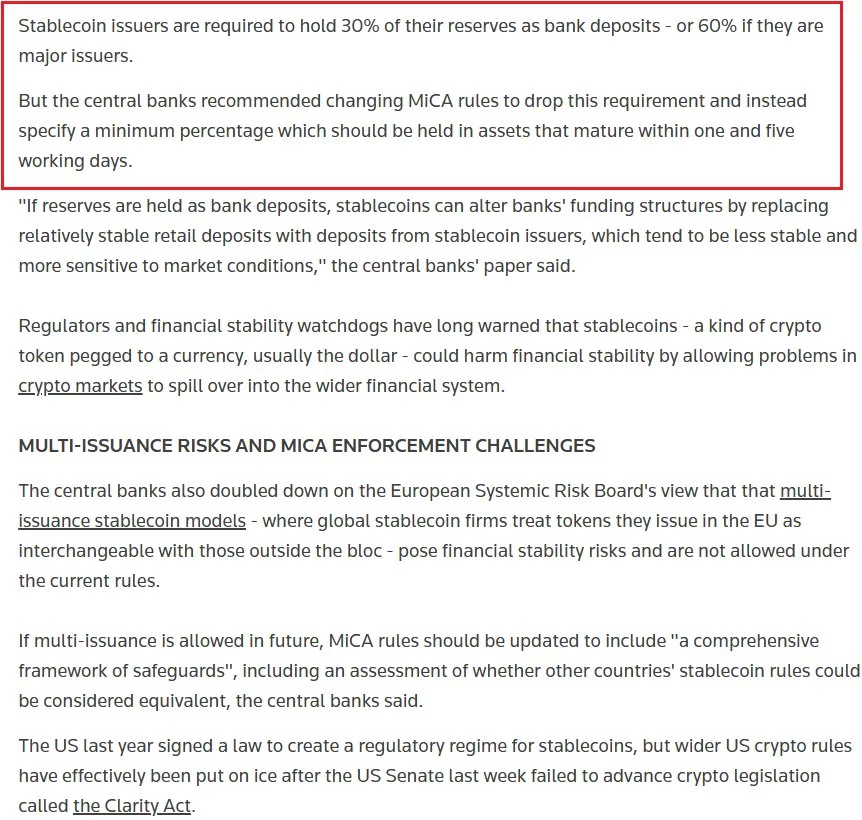
Tether CEO Paolo Ardoino said the company refused to apply for an EU MiCA license because of the rule requiring major stablecoin issuers to hold at least 60% of their reserves in commercial bank deposits.
The remarks follow a proposal by the European Central Bank and other EU central banks to remove the requirement, citing the risk that volatile stablecoin deposits could expose banks to sudden withdrawals. The central banks instead recommend liquidity requirements based on assets maturing within one to five working days.
The proposed change has not yet been adopted.
Why it matters
The dispute puts Tether, the largest stablecoin issuer, at odds with the EU's flagship crypto framework over how reserves should be held. The irony is sharp: the very bank-deposit requirement Tether rejected is the one EU central banks now want to drop, arguing that fast-moving stablecoin flows could destabilise commercial bank funding.
Market impact
Without a MiCA license, USDT's availability on EU-regulated venues remains constrained, leaving compliant rivals with a clearer runway in the bloc. Watch whether the central banks' proposal is adopted; a rule change could reopen the door for Tether or entrench competitors that already complied.

Frequently asked questions
-
Why did Tether refuse to apply for an EU MiCA license?
CEO Paolo Ardoino said the company objected to the rule requiring major stablecoin issuers to hold at least 60% of their reserves in commercial bank deposits.
-
What do EU central banks want to change in MiCA?
The ECB and other EU central banks proposed removing the 60% bank-deposit requirement, citing the risk that volatile stablecoin deposits could trigger sudden bank withdrawals.
-
What liquidity model do EU central banks recommend instead?
They recommend requirements based on assets maturing within one to five working days, rather than mandates tied to commercial bank deposits.
-
Has the MiCA reserve rule change been adopted yet?
No, the proposal from the EU central banks has not yet been adopted, so the current 60% bank-deposit requirement still stands.
-
What does this mean for USDT in the EU?
Without a MiCA license, USDT remains outside the EU's regulated stablecoin framework, while issuers that complied with the current rules hold the compliant market position.
 CoinDesk
 TheBlock
 CryptoSlate
 Crypto News
 CoinTelegraph