








 WuBlockchain
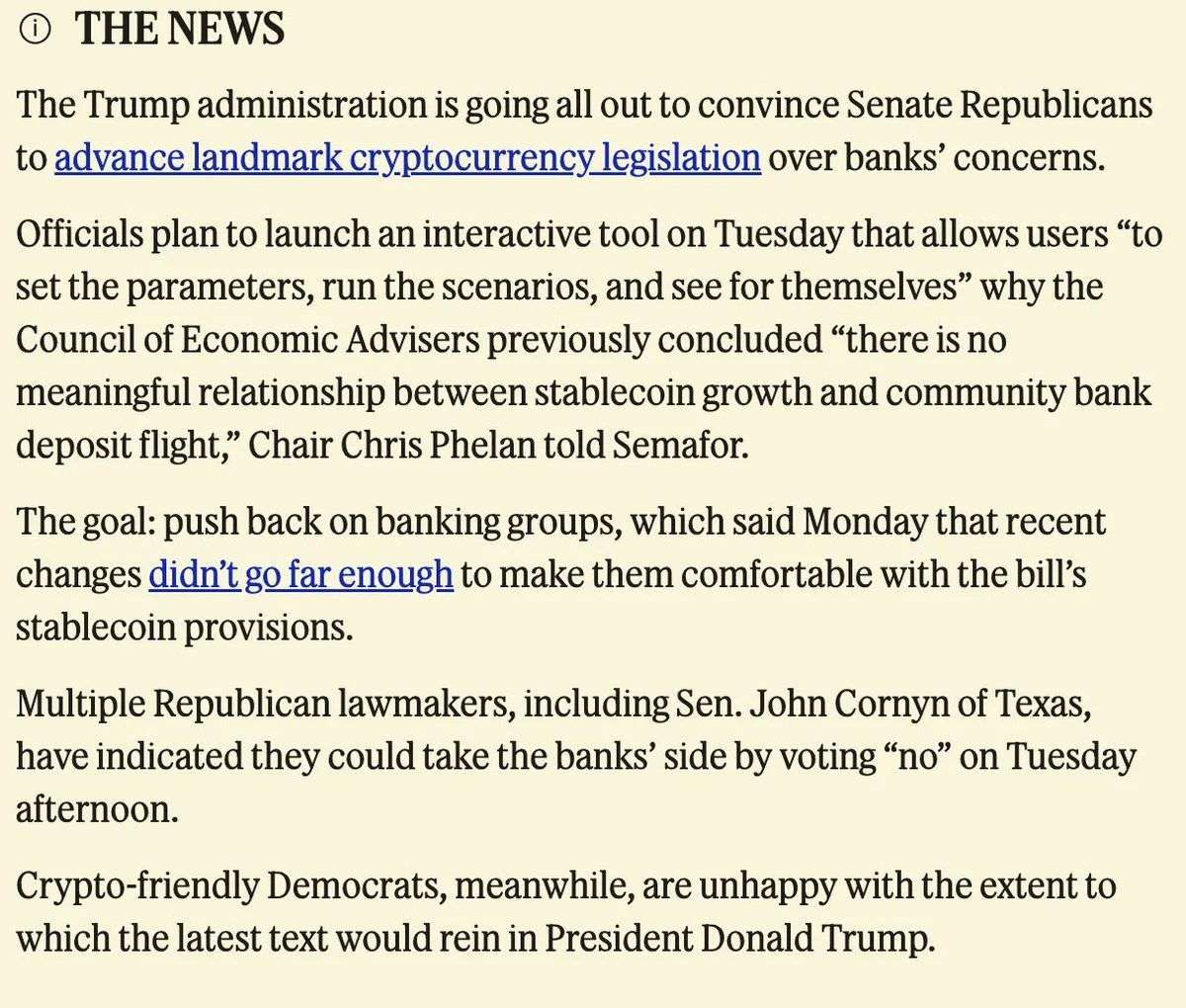
The Trump administration is making a final push for Senate Republican support of the CLARITY Act ahead of Tuesday's procedural vote, arguing that fears of large-scale deposit flight from community banks into stablecoins are not supported by current data. The White House Council of Economic Advisers plans to release an interactive tool that lets users model stablecoin growth against community-bank deposit trends, framing it as a direct rebuttal to the banking lobby's core objection.
Why it matters
The CLARITY Act is the most consequential stablecoin legislation to reach the Senate floor in the US, and Tuesday's cloture vote is the first hard test of whether the administration can hold its coalition together. Banking groups have argued that yield-bearing stablecoins could pull retail deposits away from community banks, threatening their lending capacity. The White House's decision to release a public modelling tool rather than a static report signals it wants to neutralise that argument in real time, before senators cast their votes.
Market impact
The outcome is binary for stablecoin issuers and the broader crypto regulatory calendar. A failed cloture vote would push the legislative timeline well past 2026 and remove near-term regulatory clarity that institutional issuers have been pricing in. Complicating the count, some Republican senators including Sen. John Cornyn of Texas have indicated they could side with the banks, while some Democrats argue the bill's ethics restrictions on the Trump family do not go far enough. Both flanks represent real defection risk heading into Tuesday.
Source: [Exclusive: White House makes closing argument on crypto bill](https://www.semafor.com/article/09/15/2026/white-house-makes-closing-argument-on-crypto-bill)
Frequently asked questions
-
What is the CLARITY Act and why does Tuesday's vote matter?
The CLARITY Act is the primary stablecoin regulatory bill before the US Senate. Tuesday's procedural cloture vote is the first hard test of whether the administration can hold enough votes to advance it; failure would push the legislative timeline well past 2026.
-
What is the deposit-flight concern that the White House is trying to counter?
Banking groups argue that yield-bearing stablecoins could pull retail deposits away from community banks, reducing their capacity to lend. The White House Council of Economic Advisers says current data does not support large-scale deposit flight and is releasing a modelling tool to make that case publicly.
-
Which senators could vote against the CLARITY Act and why?
Sen. John Cornyn of Texas and several other Republicans have indicated they may side with the banks over concerns about stablecoin rewards. Some Democrats also oppose the bill, arguing its ethics restrictions on Trump-linked stablecoin activity do not go far enough.
-
What is the Council of Economic Advisers' interactive tool designed to do?
The tool lets users model different stablecoin growth scenarios against community-bank deposit trends, giving senators and the public a way to assess deposit-flight risk themselves rather than relying on static industry or lobby projections.
-
What happens to stablecoin issuers if the cloture vote fails?
A failed cloture vote would remove near-term regulatory clarity that institutional stablecoin issuers have been pricing into their expansion plans and would push any comprehensive US stablecoin framework well beyond 2026.
 CoinTelegraph
 Crypto News
 WatcherGuru
 CryptoSlate
 Crypto Capital Venture
 TheBlock
 Glassnode