








 CoinDesk

Zcash plunged as much as 50% in 24 hours after nonprofit developer Shielded Labs disclosed a now-patched vulnerability in ZEC's Orchard privacy pool that, if exploited, could have let an attacker mint counterfeit tokens invisible to the network. The Orchard flaw had been live since the pool's May 2022 debut — four years undetected — before security engineer Taylor Hornby surfaced it last week using Anthropic's Opus 4.8 model; an emergency fix shipped by June 1.
Why it matters
The damage runs deeper than the bug itself. Because Orchard's privacy design obscures transaction details by construction, Shielded Labs admitted there is no cryptographic way to prove whether anyone exploited the flaw before it was closed. The firm said it probably was not, but cannot be sure — and that uncertainty now hangs over the integrity of ZEC's entire supply. Arthur Hayes, CIO of Maelstrom, said he sold his entire zcash position over it.
Market impact
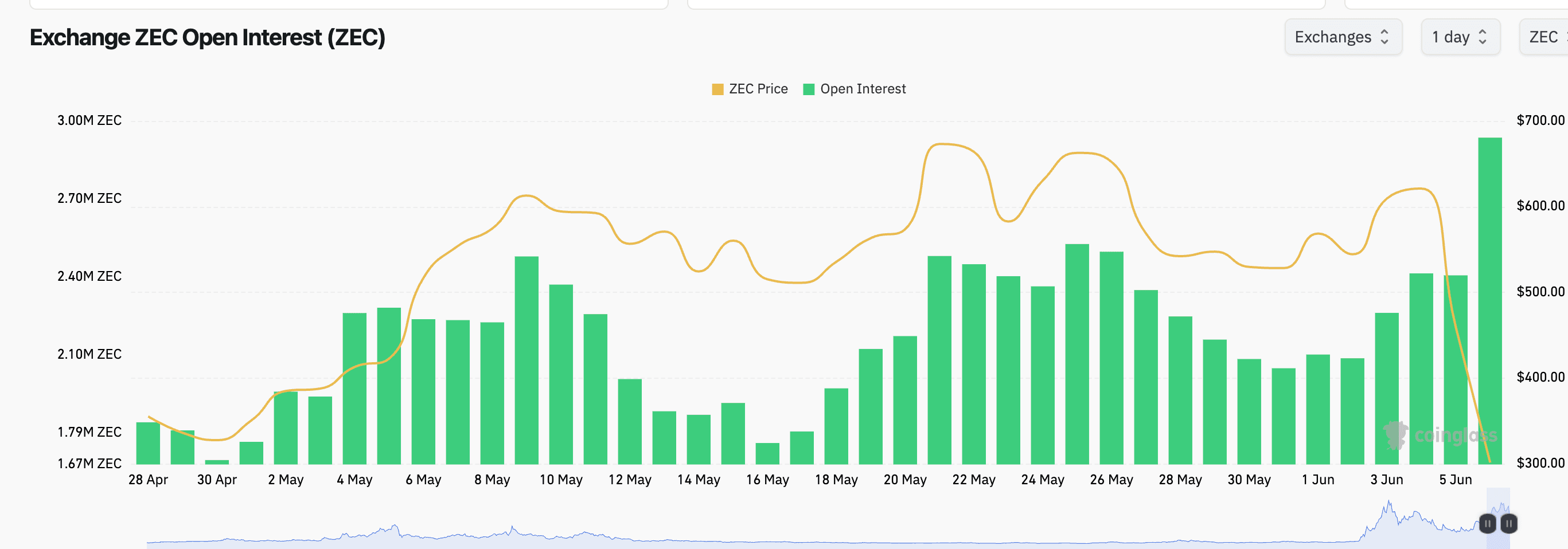
Forced liquidations ran roughly $118 million, modest for a token that halved in a day, per CoinGlass — only about 14% of leveraged positions got wiped out, which points to spot-led selling rather than a leverage cascade. Open interest in ZEC futures, by contrast, climbed to a record high in token terms as traders opened new bearish positions rather than closing them. Long/short ratios confirm the skew: Binance retail sat at 0.77, OKX retail at 0.67, with only Bybit retail leaning long at 1.49. Even after the slide, ZEC remains up roughly 490% over the past year, leaving a heavily-shorted setup where any stabilisation could trigger a squeeze as shorts buy to cover.

Frequently asked questions
-
What vulnerability was disclosed in Zcash's Orchard pool?
A flaw in Zcash's Orchard privacy pool, live since May 2022, that could have let an attacker mint counterfeit ZEC undetectable by the network. Security engineer Taylor Hornby found it using Anthropic's Opus 4.8 model; Shielded Labs patched it by June 1.
-
Was the Zcash Orchard vulnerability ever exploited?
Shielded Labs said it probably was not, but admitted there is no cryptographic way to prove that — because Orchard's privacy design obscures transaction details by construction, the question is structurally unanswerable.
-
How much did Zcash drop and how big were the liquidations?
ZEC fell as much as 50% in 24 hours. Forced liquidations totalled roughly $118 million, per CoinGlass, and only about 14% of leveraged positions were wiped out — small for a move that size, pointing to spot-led selling rather than a leverage cascade.
-
Why is open interest in ZEC futures at a record high?
Open interest in ZEC futures climbed to a record in token terms as traders opened new bearish positions during the slide rather than closing existing ones. Long/short ratios confirm the skew: Binance retail sat at 0.77, OKX retail at 0.67, with only Bybit retail leaning long at 1.49.
-
Could Zcash short positions trigger a squeeze?
Yes — ZEC is heavily shorted and still up roughly 490% over the past year even after the slide. If selling slows and price stabilises, shorts would be forced to buy to cover, which could fuel a sharp bounce.
 CryptoSlate
 WuBlockchain
 Crypto News
 Crypto Rank News
 CoinTelegraph