


 CoinDesk
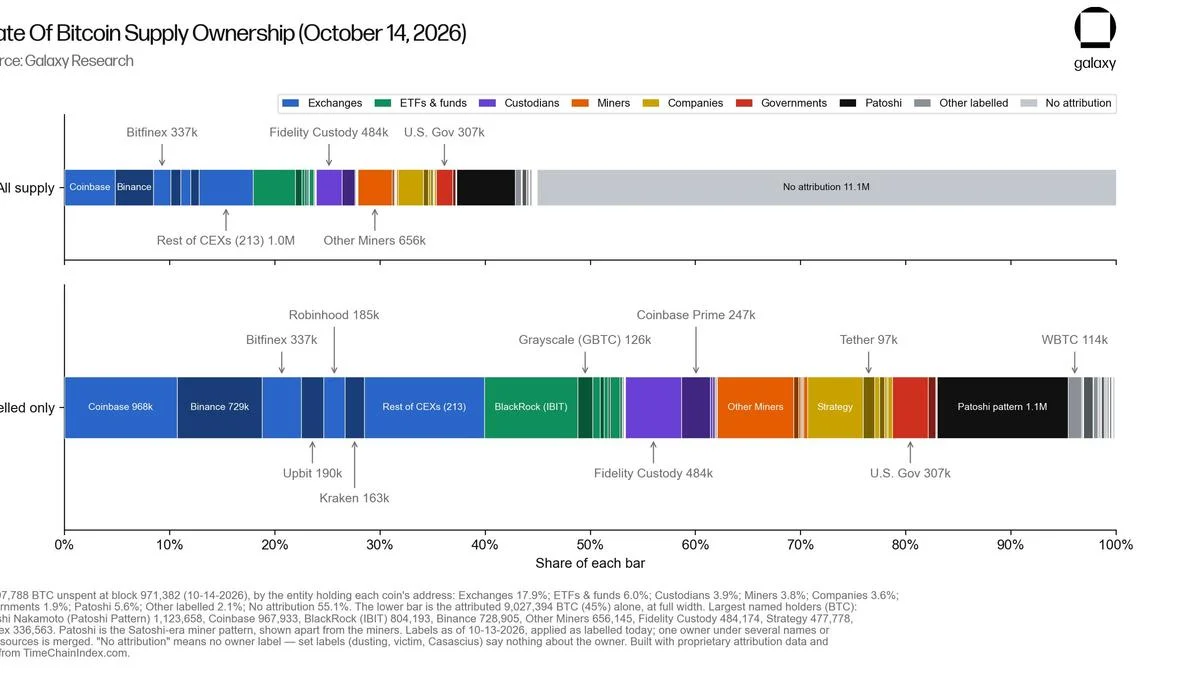



Galaxy Research's October snapshot classified about 11.1 million BTC, or 55% of the roughly 20.1 million bitcoin mined, as unattributed. The firm could not link those coins to an exchange, fund, government or other known entity. The figure suggests individuals using self-custody still control a large share of Bitcoin's supply, even as institutional adoption expands.
Why it matters
Galaxy research chief Alex Thorn said the data indicates that self-custody remains widespread. More than half of BTC supply sits in addresses without known attribution, despite the growth of exchanges, funds and institutional custodians. Xapo Bank similarly argued that the unidentified holdings show retail investors have been in Bitcoin for more than a decade.
A Bitcoin address reveals its balance on the public ledger but not the owner's identity. Research firms therefore classify addresses by linking them to known entities and wallet patterns. Self-custody means holding the private keys directly rather than leaving BTC with an exchange or fund.
Market impact
The 55% figure is not a clean measure of retail ownership. The unidentified pool may include lost coins, wallets whose owners have died or forgotten their keys, early mining holdings, institutions Galaxy has not identified, OTC desks and custody arrangements spread across multiple addresses.
The remaining 45% includes known holdings tied to exchanges, ETFs led by BlackRock, the U.S. government and the Satoshi-era miner pattern, which Galaxy counts separately at 1,123,658 BTC. The key market signal is therefore not that 11.1 million BTC definitely belongs to individuals, but that the largest share of Bitcoin's supply remains difficult to attribute.

Frequently asked questions
-
Why does Galaxy classify 11.1M BTC as unattributed?
Galaxy could not link those coins to an exchange, fund, government or other known entity. Bitcoin addresses show balances publicly but do not reveal the owner's identity.
-
Does the unattributed BTC all belong to retail investors?
No. The pool may include individual self-custody, lost coins, unidentified institutions, OTC desks and custody arrangements spread across multiple addresses.
-
What does self-custody mean for Bitcoin holders?
Self-custody means holding Bitcoin's private keys directly rather than leaving the coins with an exchange, fund or other custodian.
-
What known Bitcoin holdings are counted separately?
Galaxy separately counts holdings tied to exchanges, BlackRock-led ETFs, the U.S. government and the Satoshi-era miner pattern, listed at 1,123,658 BTC.
-
What does the 55% figure say about institutional adoption?
It shows that institutional adoption has grown without making most of Bitcoin's supply identifiable. The largest share remains difficult to attribute, even as exchanges, funds and custodians expand.
 CryptoSlate
 WuBlockchain
 Whale Alert
 Lookonchain
 Glassnode
 WatcherGuru
 Crypto Rank News
 CoinTelegraph