








 CoinDesk

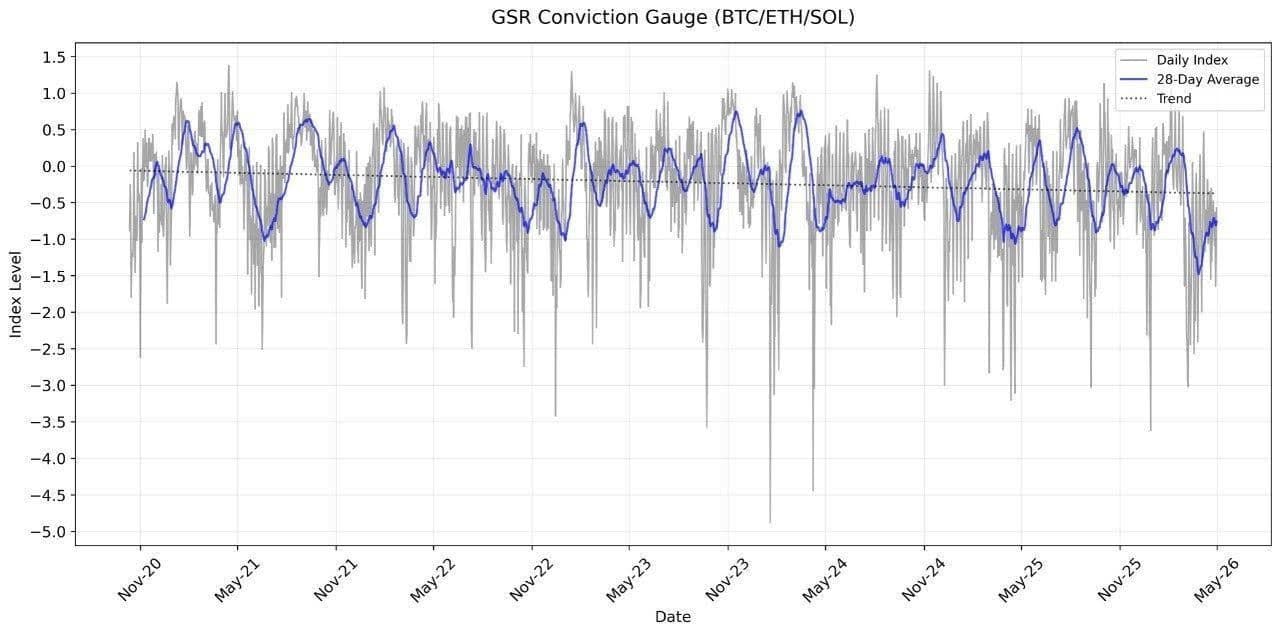

Beneath a stalled crypto market and record-low funding rates, financial advisors and long-term investors are quietly building durable crypto allocations that extend well beyond Bitcoin, according to Andy Baehr, managing director of Asset Management at GSR. Q1 2026 produced what GSR is calling maximum ambivalence on its Conviction/Ambivalence gauge — perpetual funding rates have stayed persistently low or negative, and DeFi borrow rates on Aave drifted toward 3% versus 20%+ in the weeks after the 2024 election. Yet underneath that surface drift, advisors report their clients want exposure to the broader blockchain growth story: tokenization, stablecoins, and layer-one infrastructure that has moved from crypto-native press into top-of-fold business coverage.
Why it matters
GSR's answer is a "power trio" core: BTC framed as the macro asset with defensive characteristics during market contractions, with ETH and SOL added as the layer-ones that carry the on-chain growth thesis. ETH and SOL also generate staking yield that passive holders typically leave on the table, and the firm argues an actively rebalanced basket behaves more like a real product than a static 33/33/33 index. Patrick Velleman, CMO of Valdora, frames the broader shift for advisors as one from "pick winners" to "curate risk profiles" — vetting vault builders, custody arrangements, audit credibility, and stress-test performance before mapping a client's appetite to the actual risk a given strategy carries.
Market impact
The signal here is structural rather than tactical: durable advisor inflows don't show up in funding-rate spikes or X chatter, but they compound. GSR has now launched the Crypto Core3 ETF (BESO), packaging BTC, ETH, and SOL with staking on ETH and SOL and weekly research-driven rebalancing — making the power-trio thesis accessible through a vehicle advisors can actually use. Compare that against a Q2/Q3 2025 rally that had genuine velocity, breadth, and conviction (ETH leading, SOL pushing hard in August and September, the GENIUS Act as fuel), and the read is that this quieter advisor flow may be the more durable leg. Boring, as Velleman puts it, doesn't get you rekt.



Frequently asked questions
-
Why are financial advisors allocating more to crypto in 2026?
Per GSR's Andy Baehr, Q1 2026's "maximum ambivalence" masks a quieter shift: advisors and long-term investors are extending allocations beyond BTC into ETH, SOL, and the broader on-chain growth story as it moves into mainstream business coverage.
-
What is the GSR Crypto Core3 ETF (BESO)?
BESO is GSR's recently launched ETF packaging BTC, ETH, and SOL as a power-trio core, with staking rewards on ETH and SOL and weekly research-driven rebalancing designed to capture crypto market beta with active management built in.
-
Why BTC, ETH, and SOL as a crypto core allocation?
GSR frames BTC as the macro asset with potential defensive characteristics, and ETH and SOL as the layer-ones that carry the blockchain growth thesis. Both ETH and SOL also generate staking yield that passive holders typically leave on the table.
-
How is the advisor's role changing in digital asset investing?
Valdora CMO Patrick Velleman argues the shift is from "pick winners" to "curate risk profiles" — vetting vault builders, custody arrangements, audit credibility, and stress-test performance, then mapping a client's appetite to the actual risk a strategy carries.
-
What signals show the current crypto market is "ambivalent"?
GSR's Conviction/Ambivalence gauge hit maximum ambivalence in Q1 2026, with perpetual funding rates persistently low or negative and Aave DeFi borrow rates drifting toward 3%, compared with 20%+ in the weeks after the 2024 election.
 WuBlockchain
 Altcoin Daily
 WatcherGuru
 CoinTelegraph
 TheBlock
 Crypto News