








 CryptoSlate
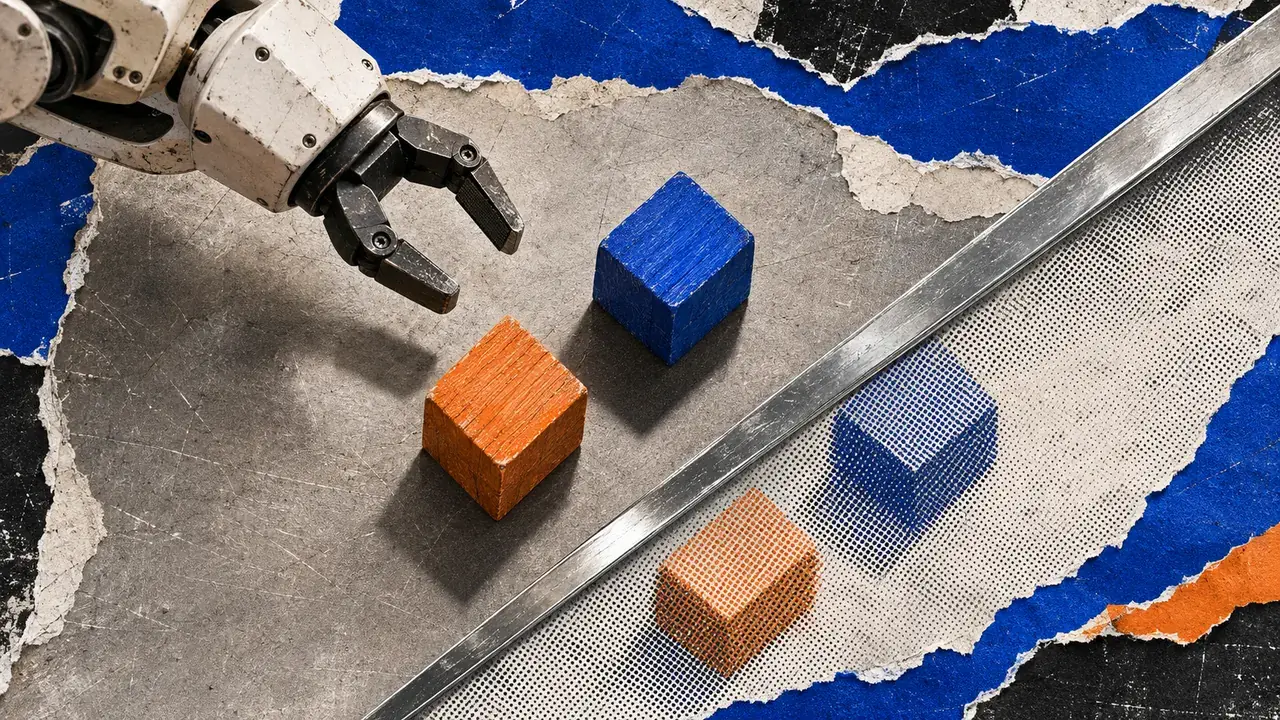

Two AI controllers that each stacked blocks successfully in eight of 10 attempts on a regular surface failed all 10 attempts on a mirrored tabletop. The tests used the same Franka robot arm, cameras, instructions and execution budget across conditions. The findings come from a Nov. 24 preprint by Peking University researchers.
Across four physical tasks, including block stacking and cylinder insertion, π0.5's success rate fell from 77.5% without a mirror to 52.5% with an upright mirror and 27.5% with a mirrored tabletop. FastWAM's corresponding rates were 60%, 30% and 10%.
Why it matters
The tests expose a reliability challenge for AI-controlled robots operating around reflective surfaces. Each controller attempted each task 10 times per condition, using five starting layouts twice.
In the researchers' RoboDojo-Mirror benchmark, all five simulated controllers had lower overall success rates in every mirror setup than in their own mirror-free runs. Comparisons with nonreflective panels also showed additional failures in mirror trials where the robot touched neither surface, indicating that the mirror's presence as a physical obstacle did not explain every failure.
Market impact
The results highlight a practical hurdle for deploying robots in environments with reflective surfaces. The study tested controller performance rather than financial outcomes, and its findings do not establish a market impact.
In a smaller set of matched simulated trials, robots spent a greater share of time touching mirrors than panels when they succeeded with panels but failed with mirrors. Researchers said the pattern was consistent with attempts to reach a reflection.
Frequently asked questions
-
How did the controllers perform across all four physical tasks?
π0.5 succeeded in 77.5% of trials without a mirror, 52.5% with an upright mirror and 27.5% with a mirrored tabletop. FastWAM's respective rates were 60%, 30% and 10%.
-
Did an upright mirror also affect the robots?
Yes. Across the four physical tasks, both controllers had lower success rates with an upright mirror than without a mirror.
-
How did the researchers control the physical robot tests?
They used the same Franka arm, camera setup, instructions and execution budget across conditions. Each controller attempted each task 10 times per condition using five starting layouts twice.
-
What happened to the controllers in simulated mirror setups?
All five simulated controllers had lower overall success rates in each mirror setup than in their own mirror-free runs.
-
Were the extra failures caused only by robots hitting mirrors?
No. Simulated comparisons with nonreflective panels showed extra failures in mirror trials even when the robot touched neither test surface.
 WuBlockchain
 WatcherGuru
 CoinDesk
 Altcoin Daily
 CoinTelegraph