








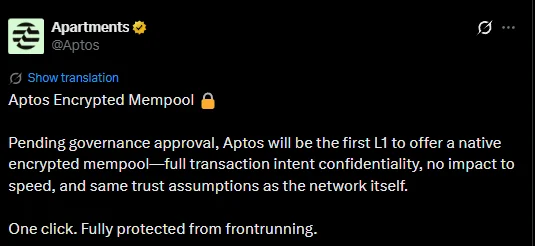

Aptos said it will launch a native Encrypted Mempool to protect user transaction intent at the protocol layer, targeting frontrunning, censorship, and order-flow leakage. The mechanism keeps transaction details hidden during block ordering and decrypts them before execution, while confirmed transactions still land on-chain as normal.
Aptos Labs said its batched threshold encryption design is built to deliver the feature with minimal impact on network latency and trust assumptions — keeping the trust model inside the validator set rather than outsourcing it to a sequencer or third-party relayer.
Why it matters
Mempool encryption has been an open problem in public chains: on Ethereum it has mostly been tackled at the application layer via MEV-block auctions and private order flow (Flashbots-style). Aptos is moving the privacy boundary to the protocol itself, which means every DEX, bridge, and aggregator deployed on the chain inherits the protection by default — there is nothing the dApp has to opt into. For users, the practical effect is that a searcher cannot read a pending swap, liquidate, or bridge transaction in cleartext before it is finalized.
Market impact
The announcement lands as L1 competition is increasingly fought on execution quality rather than raw throughput, and MEV economics are a growing share of the narrative across Solana, Ethereum L2s, and alternative L1s. If Aptos can ship the feature without bloating confirmation latency, it is a real differentiator against EVM-compatible chains where encrypted mempools remain a research item. APT traders will watch for a mainnet activation date — the announcement frames the design, not a shipped product.

Frequently asked questions
-
What is the Aptos Encrypted Mempool?
It is a protocol-level feature that keeps the contents of pending transactions hidden during block ordering and decrypts them right before execution, while confirmed transactions still record on-chain as normal. Aptos Labs said it is built on a batched threshold encryption design.
-
How does this differ from Ethereum-style MEV protection?
On Ethereum, encrypted-order protection largely lives at the application layer through private order flow and MEV-block auctions. Aptos is moving the privacy boundary to the L1 itself, so every DEX, bridge, and aggregator on the chain inherits the protection by default.
-
Does the Encrypted Mempool slow down Aptos?
Aptos Labs said the batched threshold encryption design is built to deliver the feature with minimal impact on network latency and trust assumptions. Specifics will depend on the mainnet implementation.
-
Can validators still see transactions before they execute?
The design is built to keep transaction details hidden from block producers during the ordering step, with decryption happening only at execution. The trust model stays inside the validator set rather than being outsourced to a third-party relayer.
-
When does the Encrypted Mempool launch on Aptos?
The announcement describes the design, not a shipped product. Aptos has not published a firm mainnet activation date, and traders will be watching for a launch timeline.

 WatcherGuru
 Crypto Capital Venture
 CoinTelegraph
 CoinDesk
 Crypto Rank News
 Benjamin Cowen
 CryptoSlate
 Crypto News