








 CoinDesk
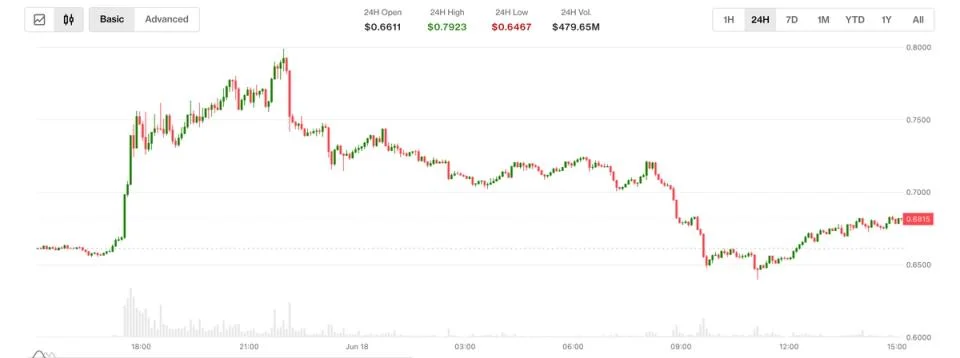



Decentralized perpetuals exchange Aster's native ASTER token surged more than 10% to 80 cents on Wednesday, hitting its highest level since January, after the protocol unveiled a tokenomics overhaul committing 99% of daily platform fees to an automated buyback program. All repurchased tokens are distributed as rewards to veASTER holders, and every buyback triggers an equal burn from the protocol's reserve, with bi-weekly burns continuing until total supply reaches a 3 billion target. Current supply sits at 7.82 billion.
The rally faded fast. A hawkish Federal Reserve decision pushed the dollar higher and dragged risk assets lower, leaving ASTER near 68 cents at press time — down about 5% on the day despite the protocol-level catalyst.
Why it matters
The upgrade is a sharp break from Aster's previous linear vesting model, which auto-released tokens to market regardless of demand and concluded in January 2026. Under the new framework, the platform's own trading activity — not a pre-set emission schedule — drives both the buyback and the burn, and rewards are settled on-chain with what the protocol calls "no discretionary reserve." veASTER, the non-transferable governance and reward token obtained by locking ASTER, captures platform fee revenue, voting power, and trading discounts on the Aster DEX. The mechanism aligns with a broader DEX-sector pattern of routing protocol revenue back to holders rather than to insiders or treasuries.
Market impact
The session was a clean two-way test of how much protocol-specific good news can stand up to a hawkish macro shock. ASTER printed its highest price since January on the announcement, then gave back all of the intraday gain and more once the Fed decision hit — a reminder that even credible tokenomics overhauls trade with beta when the dollar catches a bid. For the broader perpetuals-DEX sector, the bigger read is structural: the 99% fee-to-buyback commitment sets a high bar for competing venues still running inflationary emissions, and a successful 6.82 billion-token burn path would be a meaningful supply-side event if executed on cadence.

Frequently asked questions
-
What changed in Aster's tokenomics on Wednesday?
The protocol committed 99% of daily platform fees to an automated buyback program, with all repurchased tokens distributed as rewards to veASTER holders. Every buyback also triggers an equal burn from the protocol's reserve, with bi-weekly burns continuing until total supply reaches a 3 billion target.
-
Why did ASTER's price reverse after the announcement?
ASTER initially surged more than 10% to 80 cents on the news, but a hawkish Federal Reserve decision strengthened the dollar and weighed on risk assets. By press time, the token traded near 68 cents, down about 5% on the day, giving back the full intraday gain.
-
What is veASTER and what does it do?
veASTER is a non-transferable governance and reward token obtained by locking native ASTER. It grants holders platform fee revenue, voting power, and trading discounts on the Aster DEX, and is the recipient of all tokens repurchased under the new fee-to-buyback mechanism.
-
How much supply could the burn program remove from circulation?
ASTER's current total supply is 7.82 billion tokens, and bi-weekly burns continue until the protocol reaches a 3 billion target. That implies a supply-side path of roughly 4.82 billion tokens if executed on cadence.
-
How is this different from Aster's previous token model?
The upgrade replaces a linear vesting model that auto-released tokens to market regardless of demand — a schedule that concluded in January 2026. Under the new framework, the platform's own trading activity, not a pre-set emission schedule, drives both the buyback and the burn.
 TheBlock
 Lookonchain
 CryptoSlate
 Crypto Rank News
 CoinTelegraph
 WuBlockchain
 Crypto News