


 WuBlockchain

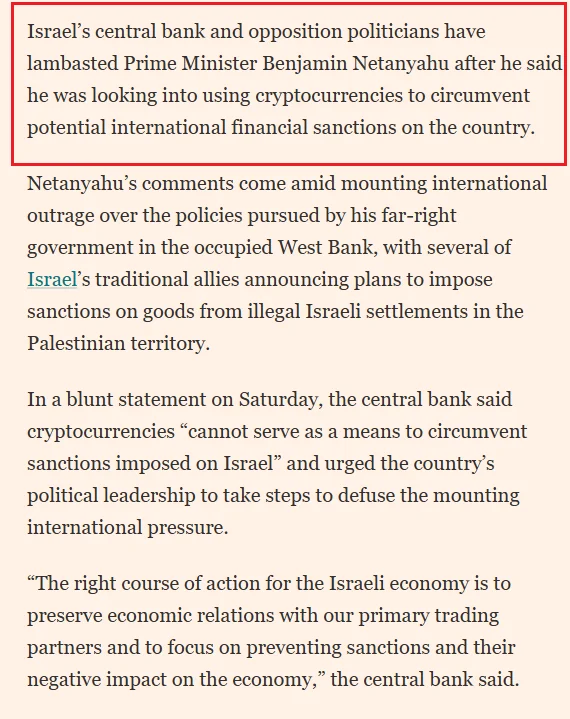
The Bank of Israel has publicly rejected Prime Minister Benjamin Netanyahu's proposal to use cryptocurrencies to circumvent potential international financial sanctions, the Financial Times reported. In a statement issued October 24, the central bank said crypto could not serve as a means of bypassing sanctions and urged the government to preserve economic ties with major trading partners to prevent further restrictions.
The rejection came a day after Netanyahu warned in an October 23 television interview that Israel could face international banking sanctions, and said he had ordered plans drawn up exploring alternative financial systems, including blockchain and cryptocurrencies.
Why it matters
The exchange puts Israel's central bank and its prime minister on opposite sides of a question governments rarely debate in public: whether state-level crypto rails can function as sanctions insurance. The Bank of Israel's answer was an unambiguous no, framing the proposal as a threat to the trade relationships that matter far more than any emergency workaround.
Market impact
No specific tokens were named and no policy has changed, so the direct market effect is limited. What traders should watch is the precedent: a sitting head of government openly floating state crypto adoption as a sanctions hedge, and a G20-aligned central bank killing the idea on the record. The episode feeds the broader regulatory debate over whether crypto rails can realistically be used to evade sovereign financial restrictions.
Frequently asked questions
-
Why did the Bank of Israel reject Netanyahu's crypto proposal?
The central bank said cryptocurrencies could not serve as a means of bypassing international financial sanctions and urged the government instead to preserve economic ties with major trading partners to prevent further restrictions.
-
What did Netanyahu propose regarding cryptocurrencies?
In an October 23 television interview, Netanyahu warned that Israel could face international banking sanctions and said he had requested plans exploring alternative financial systems, including blockchain and cryptocurrencies.
-
When did the Bank of Israel issue its rejection?
The central bank publicly rejected the proposal on October 24, one day after Netanyahu's television interview, according to the Financial Times.
-
Does this mean Israel will adopt crypto as a state financial tool?
No policy has changed. The central bank's public statement opposes the idea, and no specific tokens or implementation plans were named in the proposal's rejection.
-
Why does this debate matter for crypto markets?
It puts a sitting head of government and a G20-aligned central bank on opposite sides of whether state-level crypto rails can work as sanctions insurance, feeding the broader regulatory debate over crypto's role in evading sovereign financial restrictions.
 CoinTelegraph
 TheBlock
 CryptoSlate
 CoinDesk
 Altcoin Daily
 WatcherGuru