








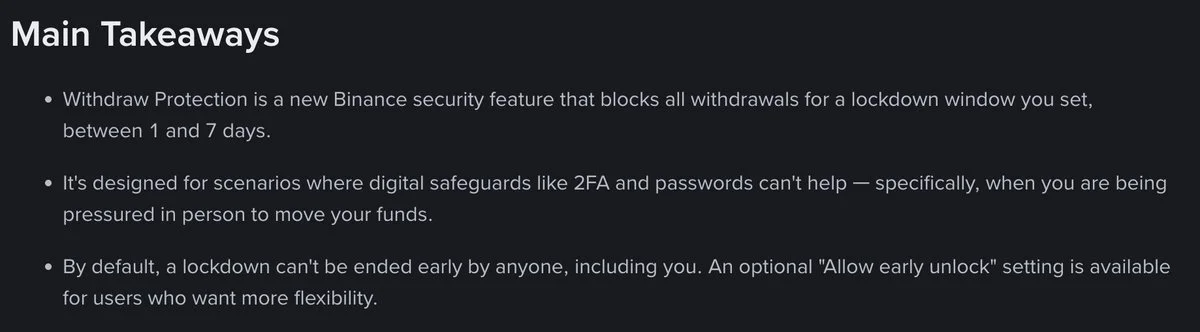
Binance announced a new "Withdraw Protection" feature that lets users set a 1–7 day lock period on on-chain withdrawals. The opt-in control is designed to mitigate a broader range of security risks beyond external attacks, giving users more direct control over the movement of their assets.
Why it matters
Phishing, address-poisoning, and malware-driven clipboard swaps remain the dominant vector for off-exchange losses, and the industry response has mostly been reactive: address-book whitelists, anti-phishing codes, and post-hoc fund-tracing partnerships. A user-controlled time lock pushes the response earlier in the timeline — before the signed transaction hits the chain — and is the kind of UX friction exchanges have historically avoided because it complicates active trading flows.
Market impact
The protection is opt-in, so the read-through depends on adoption. A 1–7 day window gives a meaningful window for a user to recognise a compromised session and intervene, but it also locks out the very users most likely to enable it — long-term holders who already self-custody. Binance's decision to ship the feature on the centralised exchange itself signals that the industry's risk-perimeter argument is shifting: the threat model is no longer just the exchange's hot wallet, it's the user's own signed transaction.

Frequently asked questions
-
What is Binance's new Withdraw Protection feature?
It is an opt-in control that lets Binance users set a 1–7 day lock period on on-chain withdrawals, giving them a window to recognise and intervene in a compromised session before funds leave the exchange.
-
Does Withdraw Protection block all withdrawals?
No. It is an opt-in setting, so it only applies to users who enable it. Accounts that do not turn it on continue to process withdrawals without any delay.
-
What kinds of attacks does the feature target?
Binance framed it as protection against a broader range of risks beyond external attacks, including phishing, address-poisoning, and malware that swaps the destination address at the moment a user signs a transaction.
-
Why is the feature opt-in instead of default-on?
A withdrawal delay complicates active trading flows, where users move funds frequently. Opt-in lets Binance offer the protection without forcing a friction cost on users who do not want it.
-
Will the time lock protect users who are already compromised?
Only if it was enabled before the compromise. Once an attacker controls a session, the lock window gives the legitimate user a chance to detect the intrusion and contact support before the delay expires.

 WatcherGuru
 CoinTelegraph
 CryptoSlate
 CoinDesk
 TheBlock