








 CryptoSlate
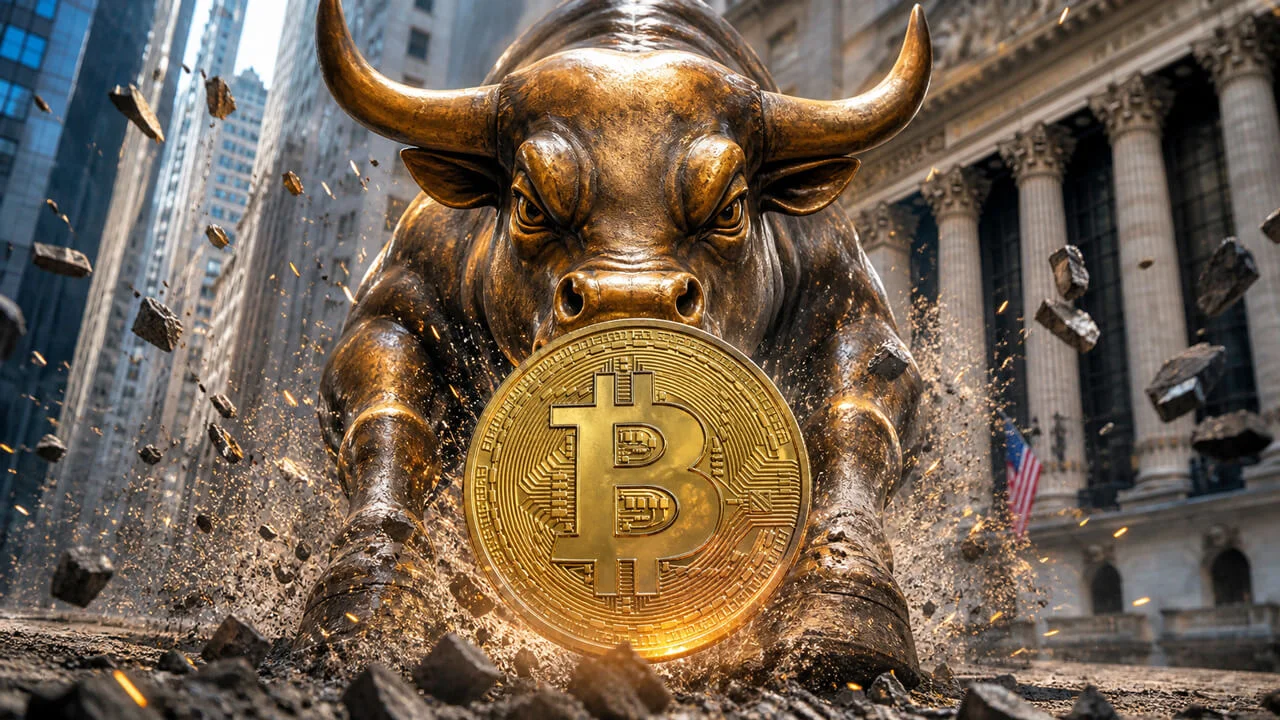
Bitcoin briefly reclaimed the $80,000 level during early Asian trading on May 4, touching an intraday high of $80,529 before slipping back toward $79,621 — its first return to that threshold since February. The move marks a quiet upward march that has bulls now targeting $90,000.
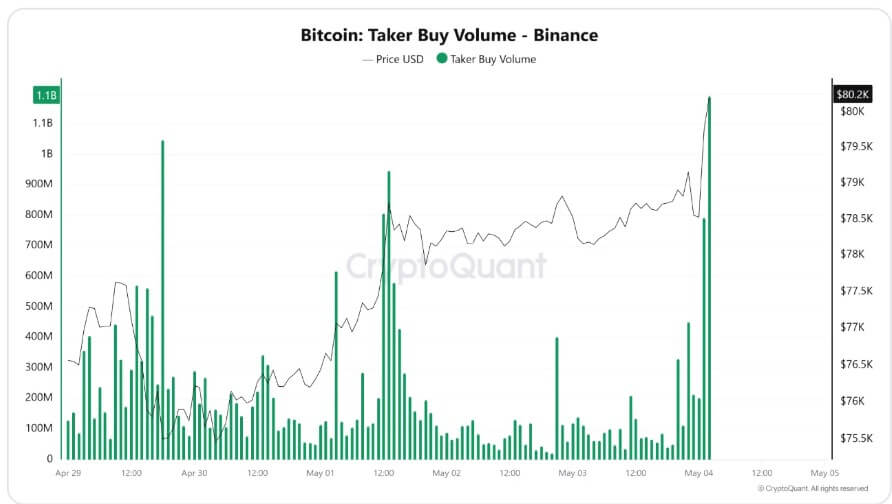
Yet the structure underneath is conflicted. CryptoQuant data shows the thrust through $80K was concentrated on offshore venues, with Binance alone recording $1.98 billion in taker-buy volume within a two-hour window across two surges of roughly $1.19 billion and $792 million. That kind of aggressive, momentum-chasing flow at a major resistance zone typically signals fragile breakout conditions — analyst JA Maartunn noted BTC must hold above $79,000 on a closing basis or risk having the weekend surge written off as a short squeeze.
Why it matters
The derivatives tape confirms the tension. Deribit shows $1.7 billion in notional value locked into the $80,000 call strike, with massive clusters stacked at $90,000 and $100,000 — yet the Fear & Greed index dropped 10 points to 43 (Fear) in under a week. Perpetual funding rates remain positive at +0.51%, meaning leveraged traders are still paying to stay long even as spot conviction cools. Historically, this spot-fear-plus-long-leverage divergence marks a volatile stress phase vulnerable to sharp long liquidations.
The offsetting force is structural. US spot Bitcoin ETFs have now posted two consecutive months of net inflows totaling $3.29 billion — the first back-to-back inflow pair since September and October, when the funds pulled in nearly $7 billion. Ecoinometrics noted a nine-day streak of net inflows, the longest consistent demand stretch of this bear market, with the last comparable run in October 2025 right before BTC's prior all-time high.
Market impact
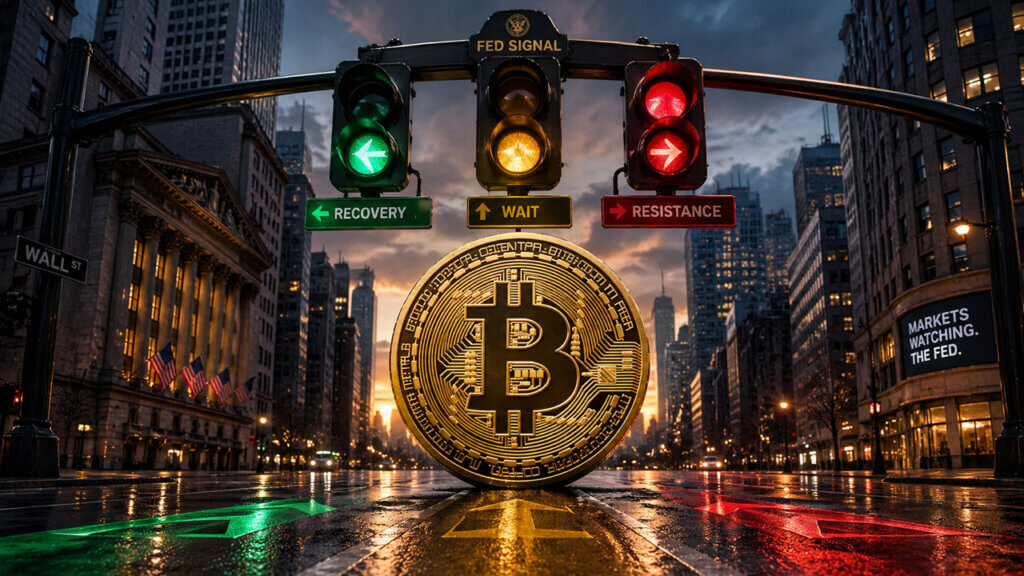
Macro headwinds remain live. Oil sits above $100 per barrel on Middle East tensions, with Iran warning US forces away from the Strait of Hormuz even as President Trump signaled intervention to assist stranded commercial vessels. Sticky energy-driven inflation has Barclays now forecasting zero Fed rate cuts for all of 2026.

Frequently asked questions
-
Why did Bitcoin briefly drop back below $80,000 after reclaiming it?
The push through $80,000 was driven by aggressive taker-buy volume on offshore venues — Binance logged $1.98 billion in two hours — rather than organic spot accumulation. CryptoQuant analyst JA Maartunn noted BTC needs to hold above $79,000 on a closing basis, otherwise the weekend move risks being classified as a…
-
What does the derivatives market signal about Bitcoin's next move?
Deribit shows $1.7 billion in notional value locked into the $80,000 call strike, with massive clusters at $90,000 and $100,000. Yet perpetual futures funding rates remain positive at +0.51%, meaning leveraged traders are paying a premium to stay long even as the Fear & Greed index dropped 10 points to 43 (Fear) in…
-
How significant are the recent spot Bitcoin ETF inflows?
US-listed spot Bitcoin ETFs recorded two consecutive months of net inflows totaling $3.29 billion, according to SoSoValue — the first back-to-back inflow pair since September and October. Ecoinometrics flagged a nine-day streak of net inflows, the longest consistent demand stretch of the current bear market.
-
What macro risks could derail the move toward $90,000?
Oil is holding above $100 per barrel on Middle East tensions, with Iran warning US forces away from the Strait of Hormuz. Sticky energy-driven inflation has Barclays forecasting zero Fed rate cuts for 2026. Powell's term expires May 15 and Kevin Warsh's confirmation vote is expected the week of May 11 — institutional…
-
Why is the spot-fear-plus-long-leverage divergence considered a stress phase?
Historically, when spot holders cool while leveraged traders remain stubbornly long, the structure becomes top-heavy and vulnerable to violent long liquidations. The current Fear & Greed reading of 43 alongside +0.51% positive funding rates fits this pattern — any macro shock could trigger a cascading flush of…
 Crypto News
 WatcherGuru
 Lookonchain
 Benjamin Cowen
 CoinDesk
 CoinTelegraph