








 CoinDesk
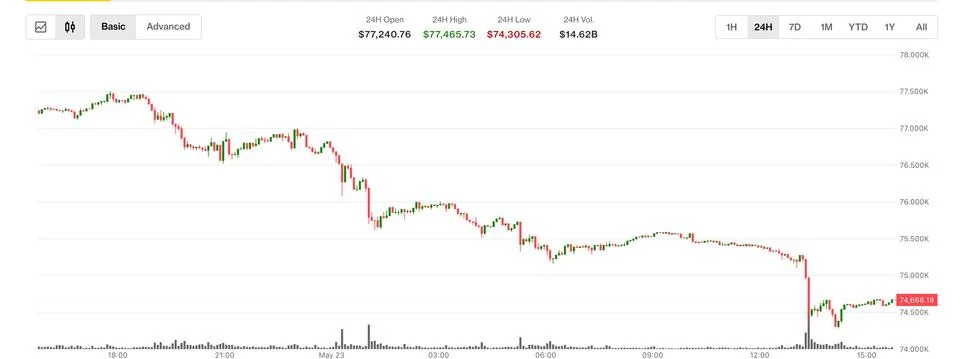



Bitcoin fell to about $74,300 in early Saturday trading, its lowest level since April 20, down more than 3% over 24 hours and roughly 10% below the $82,500 high set on May 6. The sell-off comes as U.S. Treasury yields and parallel government bond yields across developed markets climb, draining appetite for high-risk, zero-yielding assets.
U.S.-listed spot Bitcoin ETFs have now shed more than $2.26 billion over the past two weeks — $1.26 billion this week alone, the largest single-week outflow since January, on top of roughly $1 billion the prior week. The redemption streak is the cleanest signal yet that the marginal institutional buyer is stepping back as the global rate curve re-prices higher.
Why it matters
The move is not a crypto-specific story — it is a global yield story with crypto as the casualty. Rising bond yields raise the opportunity cost of holding a non-yielding asset, and BTC is the purest expression of that trade in the digital-asset complex. The fact that the drawdown is happening while the macro bid rotates into commodities (oil, copper, sulfur) on Strait of Hormuz risk and into SpaceX pre-IPO exposure tells you the capital is not leaving risk — it is leaving zero-yield risk.
Market impact
The ETF tape is the cleanest read on positioning. A $2.26 billion two-week redemption is not a panic-flow number, but it is large enough to confirm that the bid that carried spot BTC through the spring has thinned. Watch the 10-year Treasury yield and DXY as the leading indicators: until those stop climbing, every reflexive BTC bounce is a fade candidate. A reclaim of $78,000–$80,000 with concurrent ETF inflows would be the first signal the bid is returning; a break below $72,000 opens the path to the spring lows.

Frequently asked questions
-
Why is Bitcoin falling to $74,300?
Bitcoin slid to about $74,300 as climbing U.S. and global bond yields raised the opportunity cost of holding a zero-yielding asset. The drawdown is roughly 10% from the May 6 high near $82,500.
-
How much have spot Bitcoin ETFs lost recently?
U.S.-listed spot Bitcoin ETFs have shed more than $2.26 billion over the past two weeks, including a $1.26 billion outflow this week — the largest single-week redemption since January — on top of roughly $1 billion the prior week.
-
Is the Bitcoin sell-off a crypto-specific problem?
No. The move is a global yield story with Bitcoin as the casualty. Capital is not leaving risk outright — it is rotating into commodities like oil, copper, and sulfur on Strait of Hormuz disruption risk, and into SpaceX pre-IPO exposure, while draining out of zero-yielding assets.
-
What macro indicators should traders watch next?
Watch the 10-year U.S. Treasury yield and the U.S. dollar index (DXY). Until those stop climbing, every reflexive Bitcoin bounce is a fade candidate. A reclaim of $78,000–$80,000 with concurrent ETF inflows would signal the bid is returning.
-
What level would signal further downside for Bitcoin?
A break below $72,000 would open the path to the spring lows. The $78,000–$80,000 zone is the near-term reclaim level to watch for a trend reversal.
 Crypto Capital Venture
 CryptoSlate
 Crypto News
 Glassnode
 CoinTelegraph
 WuBlockchain
 TheBlock