








 CoinDesk

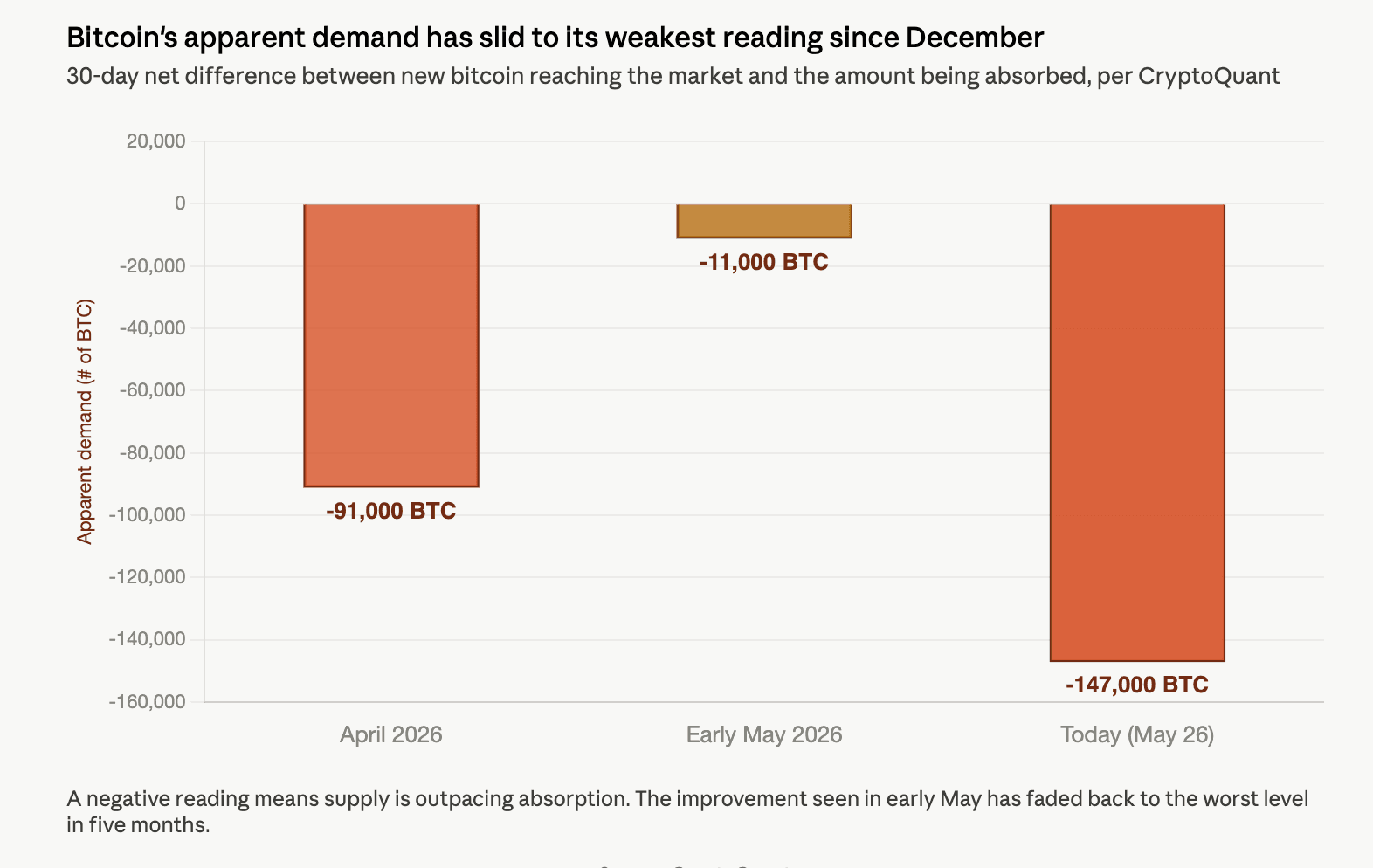


Bitcoin's 30-day apparent demand has slid to minus 147,000 BTC, the weakest reading since December 2025, even as price holds in the mid-$70,000s after bouncing from April lows near $65,000. CryptoQuant's metric compares new miner supply and older coins re-entering circulation against what the market is actually absorbing on-chain — a negative print means more coins are hitting the market than buyers are taking down.
The slide is a sharp reversal from earlier this month, when the gauge had improved from around minus 91,000 BTC in April to roughly minus 11,000 BTC, close to balance. The return to minus 147,000 BTC signals that the brief demand recovery has already faded.
Why it matters
The rebound from $65,000 has been carried mostly by futures, not spot. The Coinbase Premium has stayed negative since late April, showing US spot buyers have been less aggressive than offshore traders, and the price action reflects that: leveraged longs, not committed capital, have done the lifting. That distinction matters because futures-led rallies unwind faster — perpetual positions can close in minutes when funding flips or liquidations cascade, while spot accumulation is stickier since buyers post full capital and take real BTC.
The structural concern is that price is sitting on top of weak absorption. Weak demand can persist under a range for days or weeks, but it leaves the market dependent on fresh spot buying if bulls want to push beyond the current zone.
Market impact
The level to watch is $70,000, which CryptoQuant flags as the short-term trader realized price — the zone where recent buyers' paper gains effectively disappear and the incentive to take profit starts to fade. Without a renewed bid, a retest of that area would test the resolve of every cohort that bought the bounce from $65,000. The asymmetry of the setup is the trade: futures are already long, spot is not, and the next leg depends on whether genuine buyers step in before leverage does the work for them.

Frequently asked questions
-
What is Bitcoin's 30-day apparent demand and why does it matter?
CryptoQuant's 30-day apparent demand compares new miner supply and older coins re-entering circulation against what the market is actually absorbing on-chain. A negative reading means more coins are hitting the market than buyers are taking down, leaving price vulnerable to selling pressure.
-
How weak is the current Bitcoin demand reading?
The gauge has fallen to minus 147,000 BTC, the weakest level since December 2025. That is a sharp reversal from earlier this month, when the metric had improved to roughly minus 11,000 BTC, close to balance.
-
Why is a futures-led Bitcoin rally considered more fragile?
Futures-led rallies depend on leveraged positioning that can unwind in minutes when funding flips or liquidations cascade. Spot accumulation is stickier because buyers post full capital and take actual BTC, making that demand less likely to disappear on the first pullback.
-
What does the negative Coinbase Premium signal?
The Coinbase Premium has stayed negative since late April, showing US spot buyers have been less aggressive than offshore traders. It confirms that offshore futures, not US spot demand, have been driving the bounce from $65,000.
-
Why is the $70,000 level important for Bitcoin?
CryptoQuant identifies $70,000 as the short-term trader realized price — the zone where recent buyers' paper gains effectively disappear and the incentive to take profit starts to fade. A retest of that area would test the resolve of every cohort that bought the bounce.
 WuBlockchain
 Crypto News
 Lookonchain
 Benjamin Cowen
 Crypto Capital Venture
 CryptoSlate
 WatcherGuru
 Glassnode