








 CoinDesk

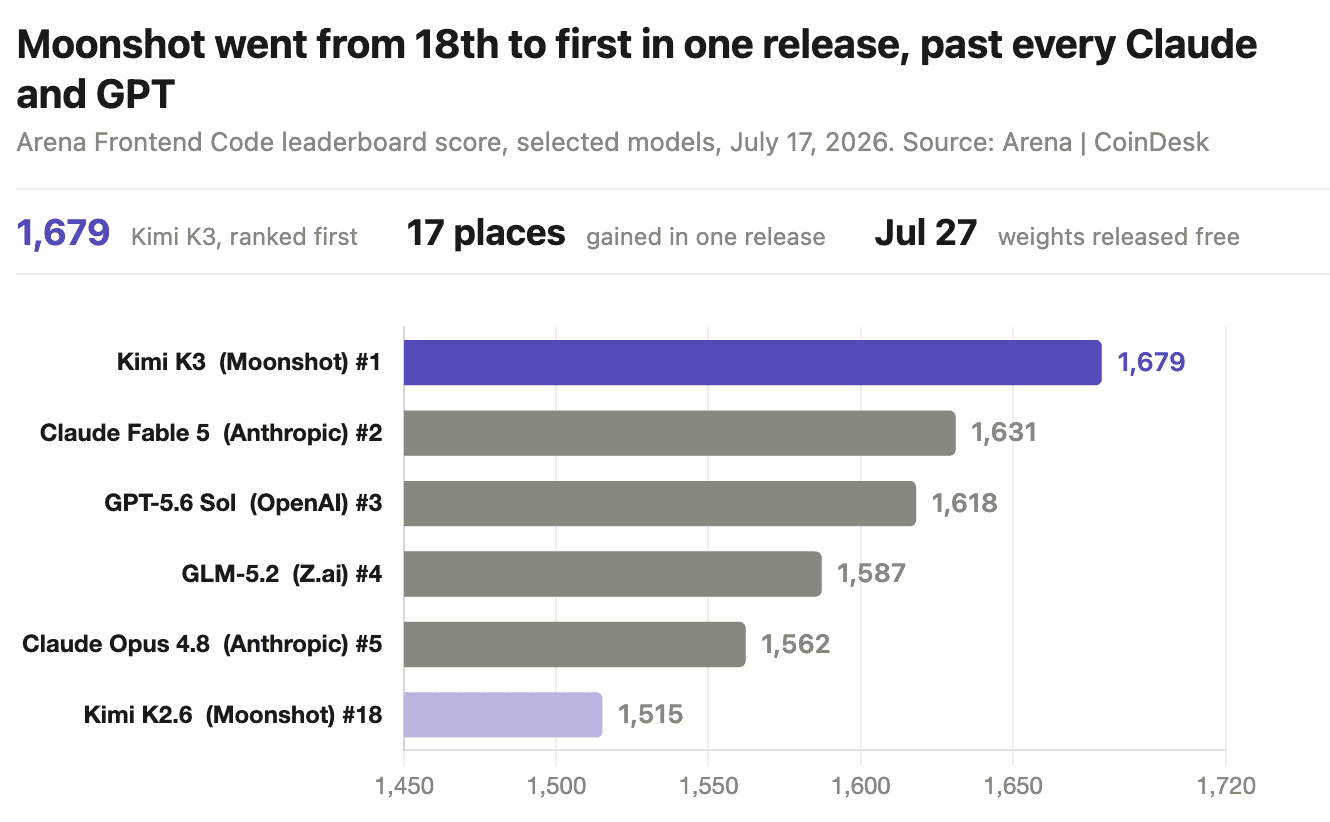


Beijing-based Moonshot AI released Kimi K3, an open-weight coding model that took first place on Arena’s Frontend Code leaderboard with a score of 1,679. Anthropic’s Claude Fable 5 scored 1,631 and OpenAI’s GPT-5.6 scored 1,618. Bitcoin, ether and AI-related stocks fell as traders reassessed the scarcity assumptions supporting technology valuations.
Kimi K3 is a 2.8 trillion-parameter mixture-of-experts model with a one-million-token context window. It activates 16 of its 896 experts for each task, and Moonshot says architectural changes deliver roughly 2.5 times the scaling efficiency of its predecessor.
Why it matters
K3’s benchmark result is specific rather than universal. The model ranks behind the strongest Claude and OpenAI configurations on broader knowledge-work tests, but it jumped 17 places from Moonshot’s previous model and led six of seven categories on the frontend coding leaderboard.
The pressure on valuations comes from its open-weight license. Moonshot plans to release the full model publicly on July 27, allowing users to download and operate it on their own hardware without paying a model-access fee. That challenges the assumption that frontier AI capability will remain scarce, expensive and controlled by U.S. developers.
Market impact
AI and semiconductor shares sold off across Asia. Chinese rivals Z.ai and MiniMax dropped about 27% and 16%, respectively, while Bitcoin and ether moved lower with the technology trade rather than on crypto-specific developments.
Bitcoin’s growing sensitivity to the AI capital cycle also exposes miners that have repositioned as data-center landlords. Those businesses have signed long-term leases on the premise that demand for training and inference compute will keep rising. More efficient open-weight models weaken that scarcity thesis, putting the July 27 release and real-world performance of K3’s weights in focus.


Frequently asked questions
-
Why did an AI coding model put pressure on Bitcoin?
Bitcoin has increasingly moved with semiconductor and AI infrastructure sentiment. Kimi K3’s release prompted traders to reassess the scarcity and spending assumptions supporting the broader AI capital cycle.
-
Which benchmark did Kimi K3 lead?
Kimi K3 led Arena’s Frontend Code leaderboard with 1,679 points, ahead of Claude Fable 5 at 1,631 and OpenAI’s GPT-5.6 at 1,618.
-
Does Kimi K3 outperform Claude and OpenAI across all tasks?
No. Kimi K3 led the frontend coding benchmark and ranked first in six of seven categories, but it remained behind the strongest Claude and OpenAI configurations on broader knowledge-work tests.
-
Why does Kimi K3’s open-weight license matter?
Moonshot plans to release the full model publicly on July 27. Users will be able to download and run it on their own hardware without paying a model-access fee, challenging the idea that frontier capability must remain scarce and expensive.
-
How are Bitcoin miners exposed to cheaper AI models?
Some Bitcoin miners have repositioned as AI data-center landlords and signed long-term leases based on rising compute demand. Efficient open-weight models could weaken the scarcity assumptions supporting that strategy.
 TheBlock
 CoinTelegraph
 Crypto Rank News
 WatcherGuru
 WuBlockchain