


 CryptoSlate


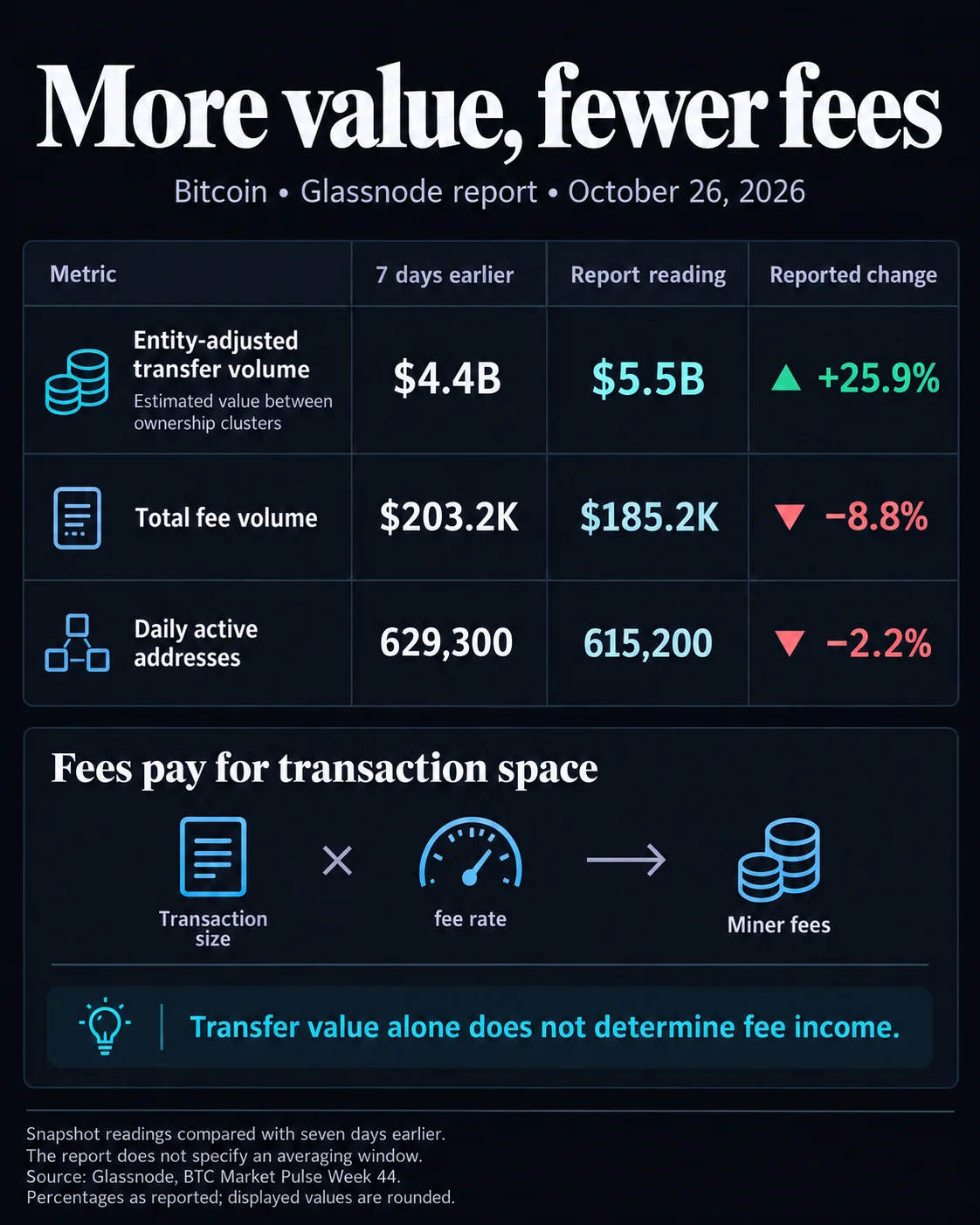
Bitcoin's entity-adjusted transfer volume jumped 26% to $5.5 billion last week, up from $4.4 billion, while transaction fees paid to miners fell 8.8% to $185,200 from $203,200. Glassnode's Oct. 26 report also showed daily active addresses declining 2.2% to 615,200. The data points to a widening gap between the value moving across Bitcoin and the activity generating revenue for miners.
Why it matters
Bitcoin miners earn from newly issued BTC block subsidies and transaction fees. Fees rise when users compete for limited blockspace, not necessarily when large amounts of value move across the network. The latest figures show that transfer volume alone is not creating meaningful fee demand.
Miners recently generated more than $40 million per day, but transaction fees contributed less than 1% of that income. Pool BTC recorded 158 blocks and about 494 BTC in subsidies worth $39.5 million over a 24-hour period through Oct. 25, while fees added only 1.88 BTC, or roughly $150,000.
Market impact
The fee shortfall leaves mining economics heavily dependent on BTC prices and block subsidies. That dependence becomes more important ahead of Bitcoin's expected 2028 halving, when the subsidy will fall from 3.125 BTC to 1.5625 BTC per block.
Unless competition for blockspace strengthens enough to lift fees, miners will need higher BTC prices or lower operating costs to absorb the reduction in newly issued coins. Fees remained below 1% of miner revenue for much of the past year, making the network's long-term security economics a key metric to watch.

Frequently asked questions
-
Why did Bitcoin fees fall while transfer value rose?
Fees depend on competition for limited blockspace, not directly on the dollar value transferred. Bitcoin's transfer volume rose 26%, but activity generating fee demand weakened.
-
How much of miner revenue comes from transaction fees?
Transaction fees contributed less than 1% of miner revenue. Pool BTC recorded 1.88 BTC in fees against about 494 BTC in block subsidies over a 24-hour period.
-
What happened to Bitcoin's daily active addresses?
Daily active addresses declined 2.2% to 615,200, highlighting the divergence between rising transfer value and the network activity producing miner revenue.
-
How will the 2028 Bitcoin halving affect miners?
The expected 2028 halving will reduce the block subsidy from 3.125 BTC to 1.5625 BTC per block, cutting the newly issued BTC miners receive.
-
What could help miners offset lower block subsidies?
Stronger competition for Bitcoin blockspace could raise transaction fees. Otherwise, miners will need higher BTC prices or lower operating costs to absorb the subsidy reduction.
 Lookonchain
 CoinTelegraph
 WatcherGuru
 WuBlockchain
 CoinDesk
 TheBlock