








 CoinDesk
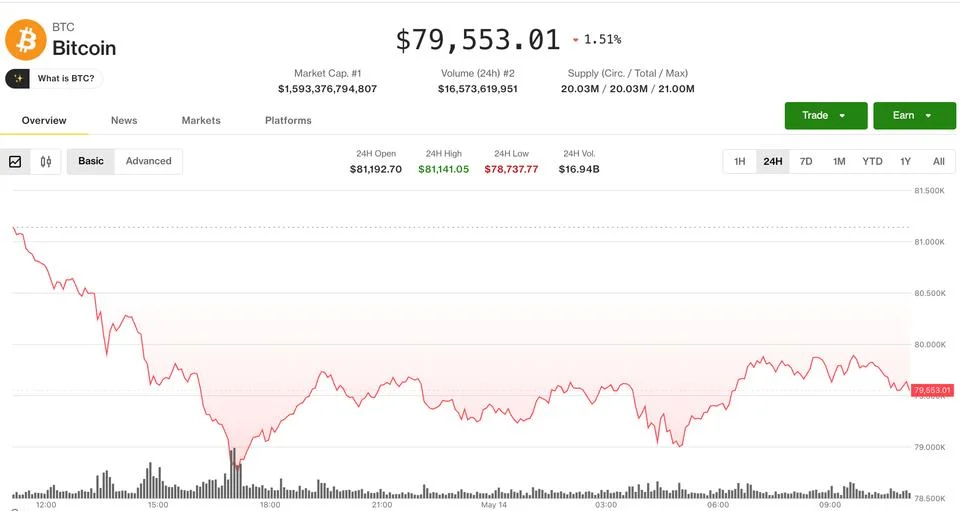



Bitcoin traded below $80,000 on Thursday, slipping to as low as $78,720 after hotter-than-expected U.S. producer price inflation data triggered a broad risk-off move across crypto. The largest token was last changing hands around $79,800, still under the weekly open of $82,500 and below the 200-day moving average sitting just above $82,000 — a level leveraged bulls had been positioning to break.
The PPI print — up 6% annually, its highest reading since 2022 — was the macro trigger, but the leverage unwind is the story. Liquidations across crypto derivatives surged 68% to nearly $400 million, with the overwhelming majority on the long side. Bitcoin alone saw $117 million wiped in 24 hours, of which $102 million were longs, a one-sided positioning that left the market exposed the moment the tape turned.
Why it matters
The cleanest read on positioning came from derivatives, not spot. BTC open interest inched higher to 750K BTC from 745K a day earlier even as prices fell — capital kept flowing into the derivatives complex, but the 24-hour cumulative volume delta turned negative, meaning sell orders dominated buy limit orders. Ethereum's open interest hit a record 15.42 million ETH, surpassing the July peak of 15.33 million, as traders kept adding leverage into a $2,200–$2,450 range that has held for four weeks. That kind of one-sided OI build into a macro catalyst is the textbook setup for the kind of flush just delivered.
Inflation is the macro thread tying it together. The 6% PPI — the highest annual print since 2022 — repriced rate-cut expectations and pushed risk assets lower, and crypto traded as a high-beta proxy for that move. The "Altcoin Season" index dropped back to 43/100 after briefly touching 50/100 on Monday, a clean signal that the rotation trade is off and the bid has gone defensive.
Market impact
The damage was concentrated in the high-beta tail. CoinDesk's Memecoin Select Index (CDMEME) fell 4% since midnight UTC and 10% over 24 hours — the worst-performing benchmark. The DeFi Select Index (DFX) lost 1%, while the bitcoin-heavy CoinDesk 20 (CD20) held up better at -0.16%.




Frequently asked questions
-
Why did Bitcoin drop below $80,000 this week?
A hotter-than-expected U.S. Producer Price Index reading — up 6% annually, its highest since 2022 — repriced rate-cut expectations and hit risk assets. The macro shock then triggered a flush of one-sided leveraged long positioning in crypto derivatives.
-
How much was liquidated in the crypto derivatives move?
Total liquidations surged 68% to nearly $400 million, with the overwhelming majority on the long side. Bitcoin alone saw $117 million wiped in 24 hours, of which $102 million were longs.
-
What does the Ethereum open interest record signal?
Ethereum open interest hit a record 15.42 million ETH on Thursday, surpassing the previous peak of 15.33 million set in July. It reflects persistent demand for leverage even as ETH has traded in a $2,200–$2,450 range for four weeks.
-
Which crypto sectors were hit hardest?
Memecoins led the decline, with CoinDesk's Memecoin Select Index (CDMEME) falling 10% over 24 hours. The DeFi Select Index lost 1%, while the bitcoin-heavy CoinDesk 20 held up better at -0.16%. Restaking token ETHFI fell 7.5% over 24 hours.
-
What is the options market signaling about further downside?
The $75,000 strike BTC put expiring May 29 became the most actively traded contract on Deribit, with the rest of the top five still calls. That skew suggests hedgers are paying up for downside protection even as directional traders remain long gamma, while 30-day implied volatility stayed subdued despite the move.
 Crypto News
 Lookonchain
 CryptoSlate
 Crypto Rank News
 Altcoin Daily