








 CoinDesk

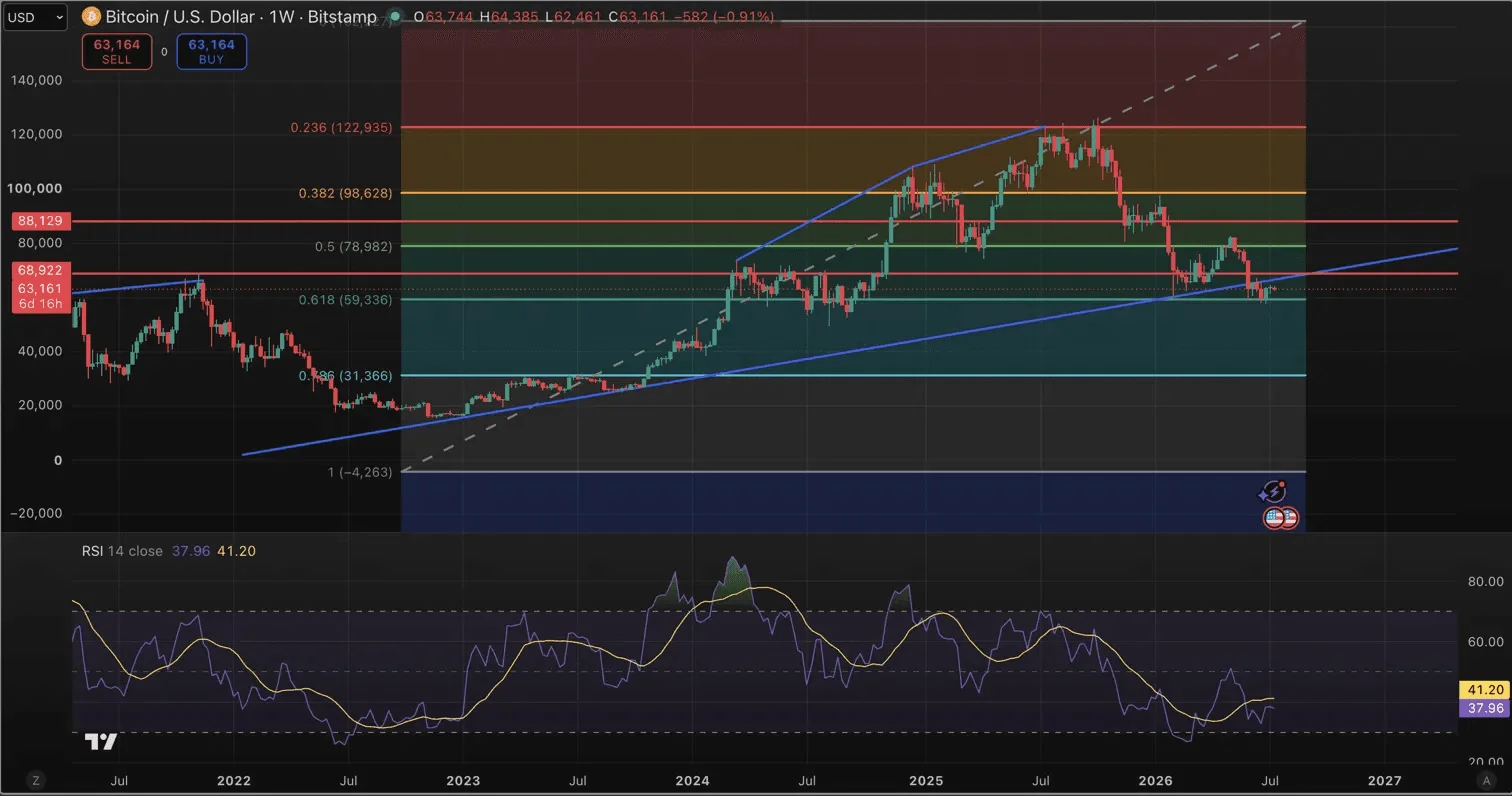


Bitcoin hovered near $63,000 in early Asian trade on Monday, down more than 1% since midnight UTC, after mutual U.S. and Iran airstrikes over the weekend reignited a risk-off wave across global markets. Brent crude futures climbed more than 3% to approach $79 a barrel as traders repriced the chance of disruption to shipping through the Strait of Hormuz, the chokepoint that moves a fifth of world oil.
The macro link is the familiar one: higher energy prices feed inflation expectations and narrow the runway for easier monetary policy. Higher oil has historically been a drag on bitcoin through that channel even when the digital-asset narrative is intact, and the early-session move fits the pattern.
Why it matters
"This week, crypto markets will experience a 'tug-of-war' between macro and geopolitics," Taran Dhillon, head of digital assets at Kula, told CoinDesk. The contest is unusually live: geopolitical shock is hitting price now, while the structural bid from regulated US vehicles is quietly turning over underneath.
Spot bitcoin and ether ETFs both broke eight-week streaks of outflows last week, a sign that demand for the two largest cryptocurrencies is reasserting itself even as price wobbles. Dhillon framed regulatory progress, including advances in the Clarity Act, as an additional tailwind. "Markets have been pricing in regulatory uncertainty for years; every step toward clarity on how digital assets are classified and overseen reduces that discount and makes the asset class easier for institutional capital to underwrite," he said.
Market impact
Traders this week are anchored on Tuesday's CPI release and Wednesday's PPI for the next read on the Fed's path, with energy the wildcard that can swing the inflation print either way. Technically, bitcoin has bounced off the $58,000 floor, the 0.618 Fibonacci retracement, but remains inside a broader downtrend of lower highs, with resistance at $66,000 and $68,900 and RSI near 38.
For all the risk-off headline, CEX activity tells a different story: June spot volumes climbed 15.3% to $1.11 trillion, the first monthly rise in five, and RWA perpetual volumes hit a record $311 billion.


Frequently asked questions
-
Why is bitcoin falling on July 13, 2026?
Bitcoin slipped below $63,000 after mutual U.S. and Iran airstrikes over the weekend reignited risk-off sentiment. Brent crude jumped more than 3% toward $79 a barrel as traders repriced the chance of disruption to shipping through the Strait of Hormuz.
-
How are spot bitcoin and ether ETFs behaving right now?
Spot BTC and ETH ETFs both broke eight-week streaks of outflows last week, a sign that demand for the two largest cryptocurrencies is quietly reasserting itself even as price wobbles on geopolitical headlines.
-
What macro data matters this week for crypto?
Traders are anchored on Tuesday's U.S. CPI release and Wednesday's PPI for the next read on the Fed's rate path. Energy prices are the wildcard that can swing either inflation print materially.
-
What is the technical picture for bitcoin?
Bitcoin has bounced off the $58,000 floor, the 0.618 Fibonacci retracement, but remains inside a broader downtrend of lower highs. Key resistance sits at $66,000 and $68,900, with RSI near 38, weak but without a meaningful bullish divergence.
-
Could regulatory progress support crypto prices this week?
Yes. Taran Dhillon of Kula told CoinDesk that advances in the Clarity Act act as a tailwind, since each step toward classification and oversight clarity reduces the regulatory discount and makes the asset class easier for institutional capital to underwrite.
 WuBlockchain
 Crypto Rank News
 CoinTelegraph