








 CoinDesk


Bitcoin traded around $79,300 on Monday, down 1.3% since midnight UTC, after spending the weekend trapped below $81,400 in a narrow range that failed to break out. The pullback landed as Nasdaq 100 futures edged up 0.3%, extending the divergence between crypto and US equities that defined last week while markets were closed for the Labor Day holiday.
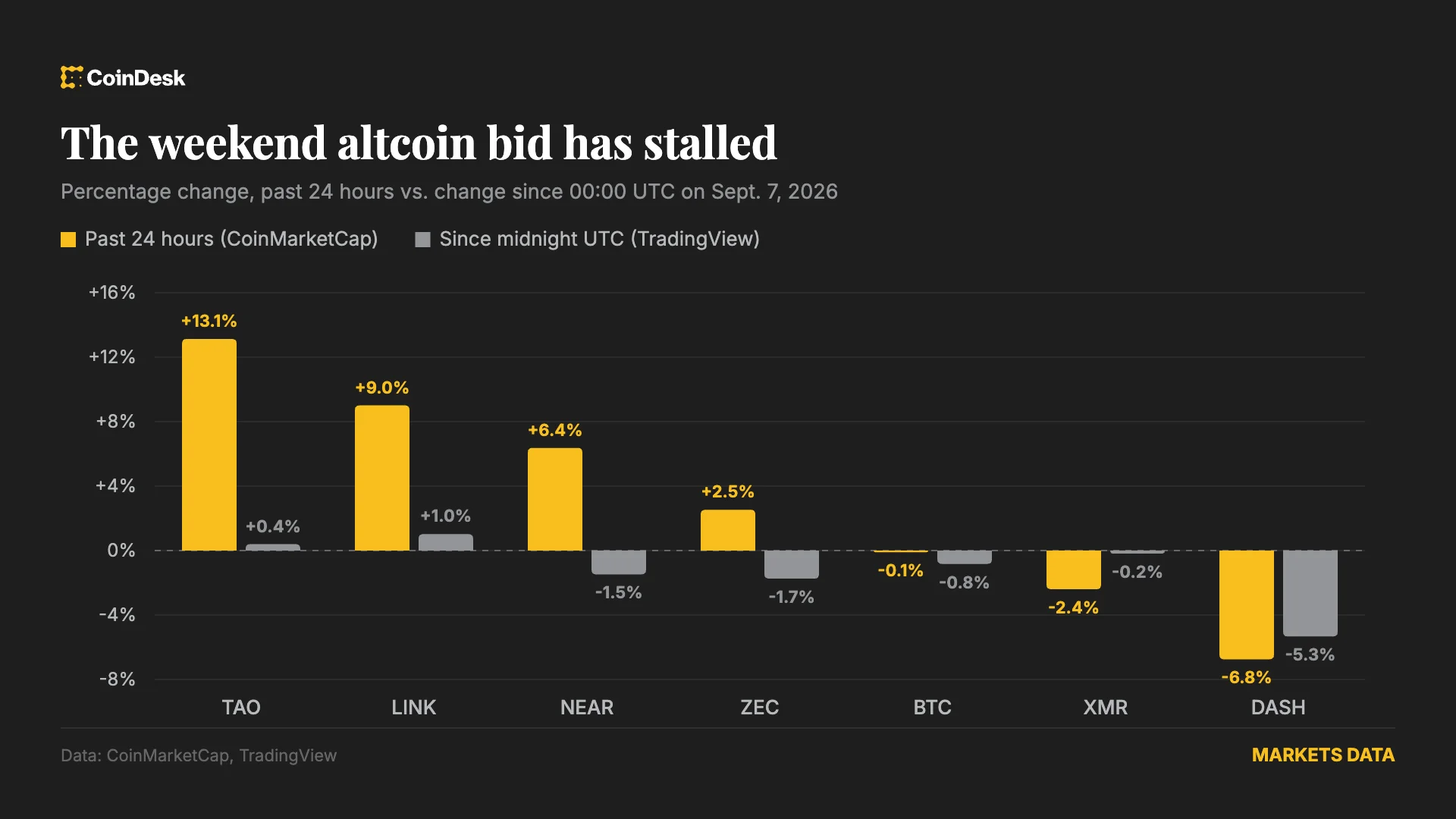
Altcoins did the heavy lifting over the weekend and have started handing gains back. Bittensor (TAO), Kaspa (KAS), Internet Computer (ICP) and Celestia (TIA) each rose more than 12% in 24 hours, but most of that move landed before midnight UTC. Since then, TAO is up just 0.4%, Chainlink (LINK) is up 1%, and NEAR Protocol has slipped 1.5%.
Why it matters
The taker buy-sell ratio in crypto futures has flipped short, with bearish bets at 51.6% of flow, a shift from Friday's bullish reading. The likely trigger is the weekend escalation of US-Iran tensions combined with Fed rate-hike fears, though the move looks overdone given that implied volatility on both BTC and ETH continues to hover near recent lows.
Capital is steadily leaving bitcoin futures. Open interest has dropped to 670K BTC from 709K on Friday, the lowest since March 23, according to Coinglass. Annualized perpetual funding rates have fallen from 8% to 10% and are fast approaching zero, losing the bullish bias that marked the start of the month. Ether and Solana are mirroring the same dynamic.
Market impact
XRP futures open interest has cooled to 2.29 billion tokens, the lowest since August 7, leaving price choppy between $1.35 and $1.45. Smaller tokens are bucking the trend: Worldcoin (WLD) open interest rose 11% alongside a 13% spot gain, a combination that typically confirms an uptrend, with WLD posting the highest 24-hour OI-adjusted cumulative volume delta among smaller caps.
The put-call split tells the same story. Deribit's 24-hour BTC options volume rankings put the $78,000 and $80,000 September 25 puts at the top, with calls filling the rest of the top five, a clear hedge bid against further downside. ETH options show the inverse, with calls dominating, suggesting traders are paying up for upside on the relative loser of the past week.




Frequently asked questions
-
Why is bitcoin falling while US equity futures are rising?
Bitcoin slipped to around $79,300, down 1.3% since midnight UTC, while Nasdaq 100 futures rose 0.3% on the Labor Day holiday. The split extends a divergence between crypto and US equities that ran through last week, with the move likely tied to weekend US-Iran tensions and Fed rate-hike fears.
-
What does the drop in bitcoin futures open interest signal?
BTC futures open interest fell to 670K from 709K on Friday, the lowest since March 23 per Coinglass. Combined with annualized perpetual funding rates sliding from 8% to 10% toward zero, the data points to capital exiting leveraged long positions rather than adding new exposure.
-
Why are altcoins giving back their weekend gains?
TAO, KAS, ICP and TIA each rose more than 12% over 24 hours, but the bulk of those moves landed before midnight UTC. Since then, TAO is up just 0.4%, LINK is up 1%, and NEAR has slipped 1.5%, suggesting the weekend rally lost follow-through as liquidity thinned.
-
What does the taker buy-sell ratio tell us about market sentiment?
The taker buy-sell ratio in crypto futures has flipped short, with bearish bets at 51.6% of flow compared to a bullish reading on Friday. The shift coincides with weekend US-Iran escalation and Fed rate-hike concerns, though BTC and ETH implied volatility near recent lows suggests traders see the move as overdone.
-
Which tokens are bucking the broader derivatives trend?
Worldcoin (WLD) saw open interest rise 11% alongside a 13% spot gain, a combination that typically confirms an uptrend. WLD also posted the highest 24-hour OI-adjusted cumulative volume delta among smaller tokens, signaling aggressive market-order buying rather than passive limit orders.
 TheBlock
 Whale Alert
 WuBlockchain
 WatcherGuru
 Crypto Rank News
 Crypto News