








 CryptoSlate


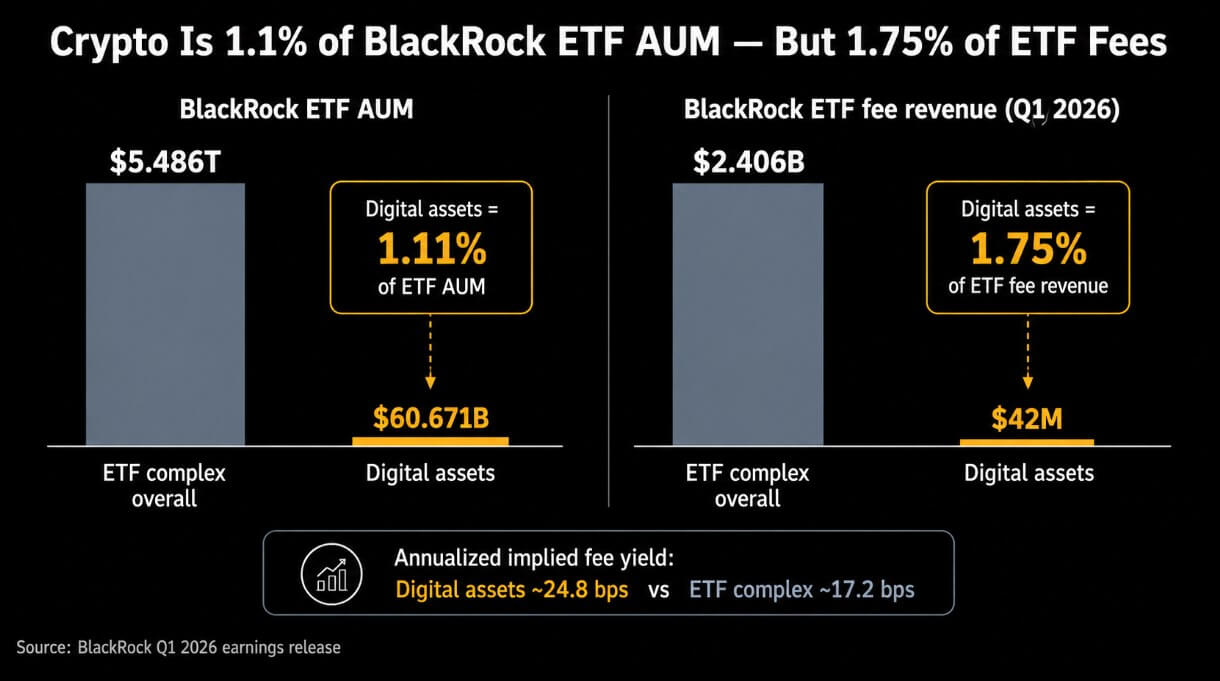

BlackRock's digital-assets franchise generated $42 million in investment-advisory, administration, and securities-lending revenue in Q1 2026, according to the firm's quarterly disclosure. The unit oversees roughly $60.7 billion in ETF assets — about 1.11% of BlackRock's $5.48 trillion in ETF AUM — yet captures 1.75% of ETF fee revenue. The math is striking: crypto runs at an annualized 24.8 basis points versus 17.2 bps for the rest of the ETF complex, making it a higher-yielding product living inside a lower-yielding machine.
Why it matters
The fee gap is the real story, not the dollar figure. IBIT alone held roughly $61.7 billion in net assets as of Apr. 29 at a 0.25% sponsor fee, implying about $152.9 million in annualized sponsor revenue, while ETHA topped $7 billion and the newer ETHB staked-ETH product has already pulled in $594.5 million since its Feb. 18 launch. Together, the three flagship US products held roughly $68.8 billion by late April — about 13.4% above the Mar. 31 digital-assets AUM number. The franchise is scaling in product diversity, not just in flagship weight.
Market impact
The line is also small enough to be price-beta, not flow-driven. BlackRock's digital-assets category absorbed an $18.7 billion negative market move in Q1, pulling AUM from $78.4 billion at year-end 2025 to $60.6 billion by Mar. 31; against that backdrop, $935 million in net inflows — 0.71% of BlackRock's total ETF inflows — was the smaller variable. Competitors are circling on price: Morgan Stanley's MSBT launched Apr. 8 at 0.14%, eleven basis points under IBIT; Charles Schwab began direct BTC and ETH trading Apr. 16 at 75 bps per trade while already holding roughly 20% of spot-crypto ETP market share; Goldman filed a Bitcoin Premium Income ETF that wraps options-based yield around the underlying. To hit 5% of BlackRock's current ETF fee base, the digital-assets line would need average AUM of roughly $194 billion at 24.8 bps — or $240.6 billion if fee compression drags realized yield to 20 bps. The bull case ($140B average AUM, ~$84M quarterly revenue) and the bear case ($50B, ~$27.5M) are both still mostly a function of where BTC trades next quarter.


Frequently asked questions
-
How much fee revenue did BlackRock's crypto ETFs generate in Q1 2026?
BlackRock's digital-assets franchise generated $42 million in investment-advisory, administration, and securities-lending revenue in Q1 2026, on roughly $60.7 billion in average ETF AUM.
-
What is the fee yield on BlackRock's crypto ETFs versus the rest of the complex?
The digital-assets line ran at roughly 24.8 basis points annualized in Q1 2026, compared with about 17.2 basis points for BlackRock's broader ETF complex — a higher yield on a much smaller asset base.
-
How large are BlackRock's flagship spot Bitcoin and Ethereum ETFs?
IBIT held roughly $61.7 billion in net assets as of Apr. 29 at a 0.25% sponsor fee; ETHA held over $7 billion at the same fee; and ETHB, the staked-ETH product, had raised $594.5 million since its Feb. 18 launch.
-
How are competitors pressuring fees on US spot Bitcoin ETPs?
Morgan Stanley's MSBT launched Apr. 8 at 0.14% — 11 bps under IBIT. Charles Schwab began direct BTC and ETH trading Apr. 16 at 75 bps per trade while already holding about 20% of spot-crypto ETP market share. Goldman Sachs filed a Bitcoin Premium Income ETF wrapping options-based yield around BTC exposure.
-
How big would BlackRock's crypto AUM need to be to hit 5% of the firm's ETF fee base?
At the current 24.8 bps yield, digital-assets AUM would need to reach roughly $194 billion on average. If fee compression pulls realized yield to 20 bps, the required AUM rises to about $240.6 billion — roughly triple the current base.
 Altcoin Daily
 CoinDesk
 TheBlock
 Crypto News
 WuBlockchain
 Lookonchain
 CoinTelegraph
 Crypto Rank News