








 CoinDesk



BlackRock is rolling out the iShares Bitcoin Premium Income ETF (BITA), a covered-call fund built on top of its existing spot bitcoin ETF, IBIT. BITA generates income by systematically selling call options against its IBIT holdings — the wilder bitcoin's price swings, the richer the premiums it collects, with Tagus Capital putting the target yield at 15% annually and capital appreciation participation around 70%.
The trade is a classic yield-for-upside swap: holders give up the burst of gains above the strike in exchange for steadier cash flow. But the structure is also designed to be deployed at institutional scale, and that's where the broader market read begins.
Why it matters
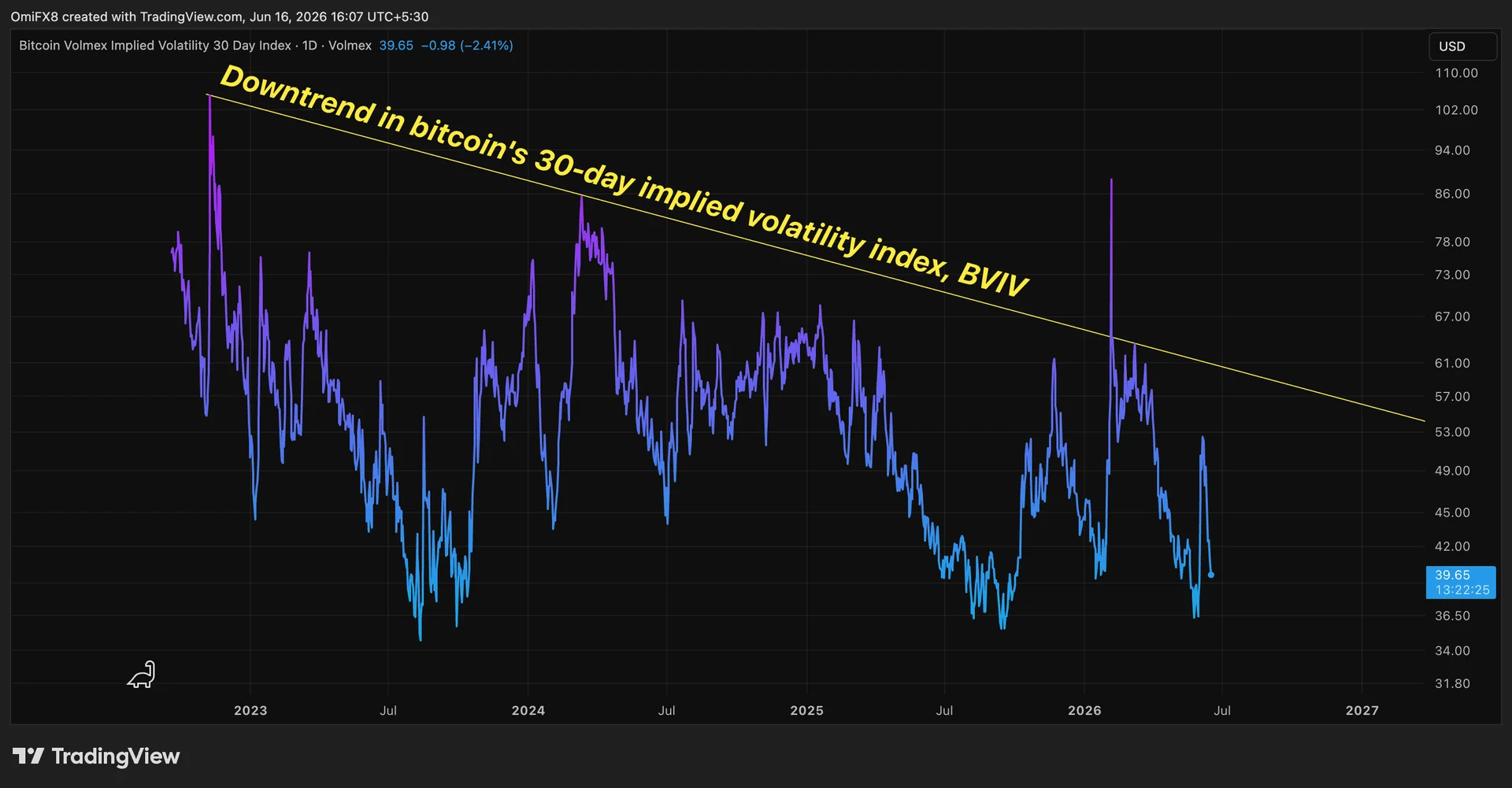
Call overwriting suppresses implied volatility by design — every option sold adds supply to the market, and that supply caps how expensive options become. Bitcoin's 30-day implied volatility has been on a downward trend since 2022, and systematic call-selling by yield-hungry holders is a major reason. BlackRock is now institutionalising that trade at scale, which means more option supply hitting the market and more structural pressure keeping bitcoin's realised and implied volatility compressed.
For a maturing asset trying to behave like collateral, that is a legitimising signal. For traders running directional volatility books, it is a slow-moving headwind that just got a larger and more persistent counterparty.
Market impact
The launch lands on an already cooling tape. Spot bitcoin ETFs in the U.S. registered a $64 million outflow on Monday, pushing June's net withdrawals to $2.10 billion, and bitcoin's recent bounce from under $59,000 to over $66,000 still lacks the institutional bid needed to sustain it. A covered-call wrapper gives allocators a reason to add exposure without taking on the full directional risk — but the income comes precisely from selling the volatility that a stronger spot rally would need to break higher.
In effect, BITA pays holders to dampen the very swings that drive a sustained move, lowering the ceiling on upside while softening the floor on the way down.

Frequently asked questions
-
What is BlackRock's BITA bitcoin ETF?
BITA — the iShares Bitcoin Premium Income ETF — is a covered-call fund that holds shares of BlackRock's spot bitcoin ETF, IBIT, and generates income by systematically selling call options against those holdings. Tagus Capital puts the target yield at 15% annually, with around 70% participation in capital appreciation.
-
How does BITA generate income from bitcoin volatility?
BITA sells call options on its IBIT holdings. The more bitcoin's price swings, the more expensive those options become, and the larger the premium the fund collects. In calm conditions, bitcoin's baseline volatility is still high enough to make the strategy viable.
-
What do investors give up by holding BITA?
Holders trade capped upside above the option strike for a steadier income stream. If bitcoin rallies, the ETF benefits from its IBIT exposure but must pay out on the calls it sold, limiting the gain. In a flat or falling market, the call-writing premium offsets some of the decline.
-
How could BITA affect bitcoin's overall volatility?
Systematic call overwriting adds option supply to the market, which suppresses implied volatility over time. Bitcoin's 30-day implied volatility has been trending lower since 2022, with call selling identified as a major driver. BlackRock scaling that trade at institutional size extends the same dynamic.
-
What is the current state of spot bitcoin ETF flows?
U.S. spot bitcoin ETFs registered a $64 million outflow on Monday, taking June's net withdrawals to $2.10 billion. Bitcoin's recent bounce from under $59,000 to over $66,000 has so far lacked the institutional buying needed to sustain a higher move.
 CoinTelegraph
 Crypto News
 TheBlock
 WuBlockchain
 CryptoSlate
 Crypto Capital Venture