








 CoinDesk



Bitcoin and ether traders are hedging rather than chasing the rebound. On Deribit, BTC's one-week 25-delta put-call skew sits around 16% vol points, with puts trading at a premium to calls. That is well off the 25% peak from 10 days ago, but the one-, three-, and six-month skews all still show put premiums of 10% or more, and the same pattern is showing in ether.
The message: downside insurance is still in demand even as spot ETF flows just turned positive and long-term holders appear to be accumulating again. Traders paying up for puts are not convinced the bounce is a real bottom.
Why it matters
The split tape matters because it exposes who is leaning which way. ETF allocators and long-term holders, the cohort that survived multiple drawdowns, are quietly adding. Options traders, who pay real money for downside protection, are still pricing in a meaningful chance of another leg lower. When spot demand says one thing and volatility surface says another, the volatility surface tends to win on trader's P&L.
Block flows reinforce the read. A large BTC long call condor booked for July 17 expiry profits most if BTC trades between $66,000 and $68,000 on that date, a range-bound structure, not a directional bullish bet.
Market impact
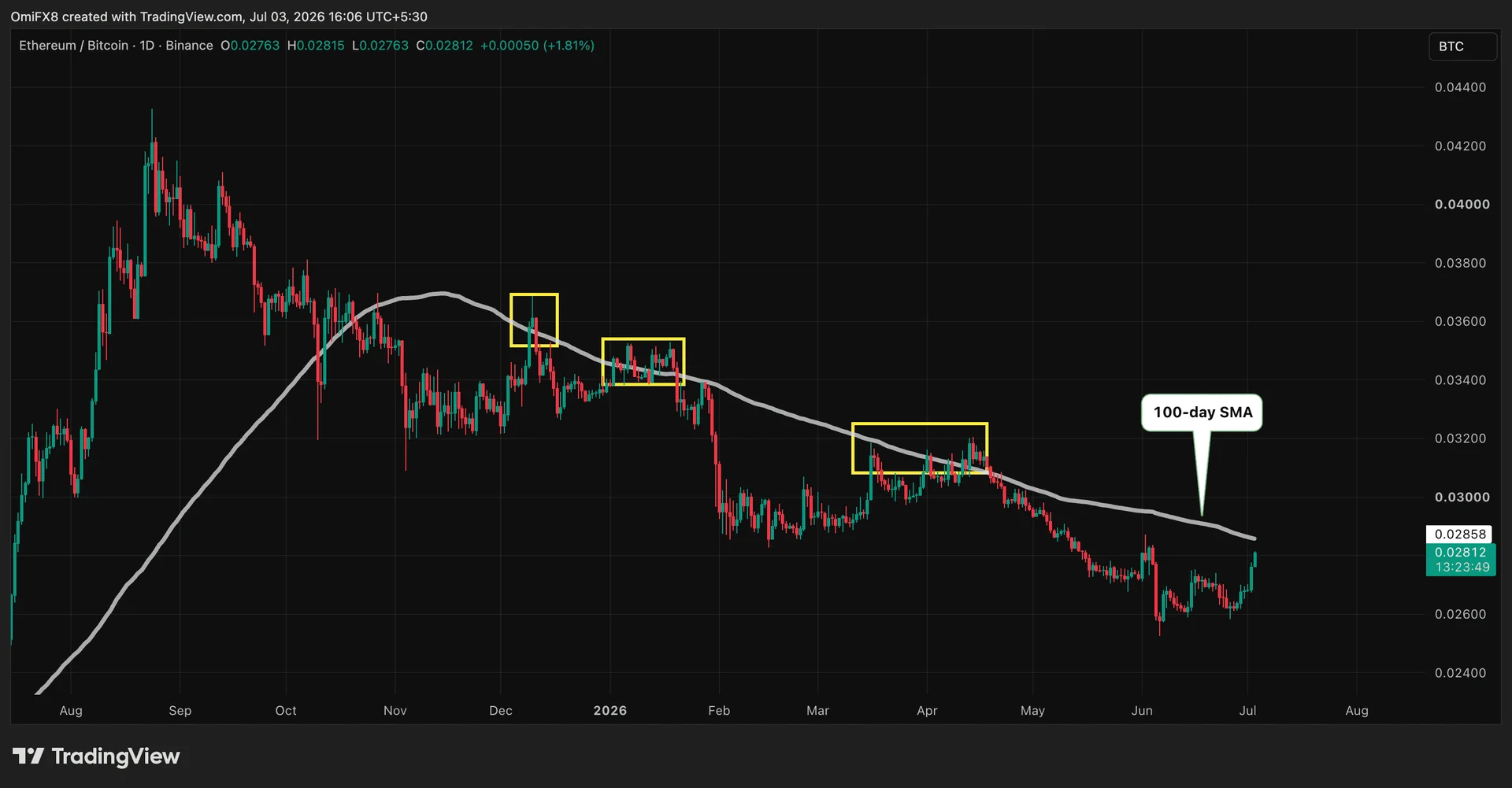
The setup for the extended U.S. holiday weekend adds a second layer of risk. U.S. markets are closed Friday for Independence Day, and thin liquidity tends to amplify moves in either direction on holiday sessions. Watch the ETH/BTC ratio as well: it is rising fast toward its 100-day SMA, a level that has rejected every recovery attempt since December. A clean break above it would be the strongest signal yet that ether is bottoming relative to bitcoin; rejection there would echo the put-skew warning.


Frequently asked questions
-
What is the current BTC put-call skew on Deribit?
BTC's one-week 25-delta put-call skew sits around 16% vol points, with puts trading at a premium to calls. That is well below the 25% peak from 10 days earlier, but the one-, three-, and six-month skews still show put premiums of 10% or more.
-
Why does elevated put skew matter if BTC ETFs are seeing inflows?
Put skew means options traders are still paying up for downside protection, even as spot ETF allocators and long-term holders appear to be adding. The split signals that hedgers do not yet view the bounce as a confirmed bottom.
-
What does the large BTC call condor block flow suggest?
The condor, struck at the $64,000 and $70,000 longs and $66,000 and $68,000 shorts for July 17 expiry, profits most if BTC settles between $66,000 and $68,000. That is a range-bound bet, not a directional bullish one.
-
How does the U.S. holiday weekend affect BTC and ETH markets?
U.S. markets are closed Friday for Independence Day. Thin holiday liquidity tends to amplify moves in either direction, which is why the existing downside skew is worth pricing in.
-
Why is the ETH/BTC ratio worth watching right now?
The ratio is rising fast toward its 100-day SMA, a level that has rejected every recovery attempt since December. A clean break above it would be the strongest signal yet of an ether bottom versus bitcoin; rejection would echo the put-skew warning.
 TheBlock
 Crypto News
 Glassnode
 WatcherGuru
 Altcoin Daily
 Whale Alert