








 CoinDesk
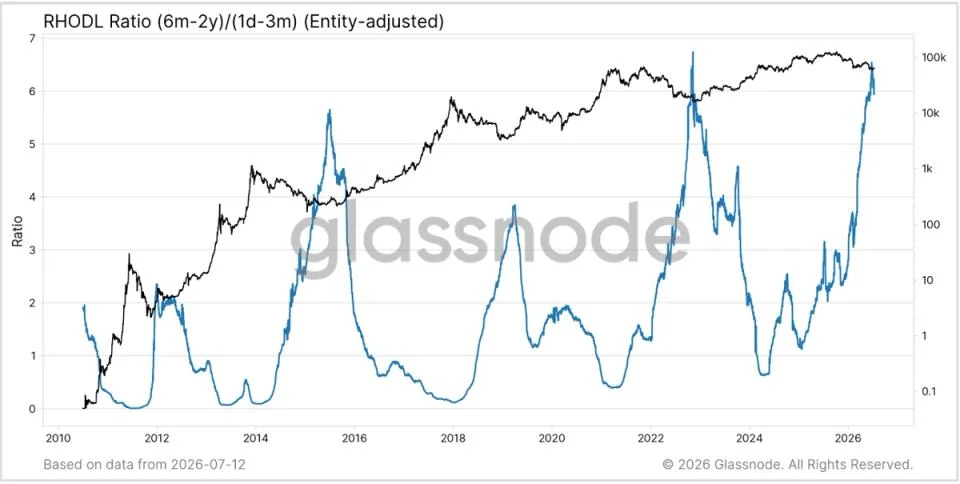



Bitcoin is grinding through one of its longest quiet stretches in recent memory. The asset has consolidated between $60,000 and $80,000 for five straight months, currently trading near $62,000, roughly 50% below its October 2025 all-time high of approximately $124,000. Yet beneath the surface apathy, a significant transfer of supply is underway.
Glassnode's RHODL Ratio, which compares the wealth held by long-term holders against that of newer market participants, reached 6.5 in early July, the second-highest reading in Bitcoin's history. It has since declined below 6, and crucially, this compression is happening while price stagnates rather than collapses. Long-term holders who accumulated throughout 2023 and 2024 appear to be distributing coins to a fresh cohort of buyers treating current levels as a discount.
Why it matters
The setup echoes a Wyckoff distribution phase, where informed sellers offload into eager buyers at the start of a bear market's middle leg, before the cycle transitions into accumulation. Extended consolidations near the 2015, 2019, and 2023 lows each preceded meaningful recoveries, with the RHODL Ratio compressing before price eventually broke higher. The current five-month standoff without a capitulation event breaks from the 2022 template, when the ratio rolled over alongside FTX-driven carnage that sent Bitcoin to roughly $15,000.
Market impact
Centralized exchange activity is quietly reawakening. CEX spot trading volume climbed 15.3% in June to $1.11 trillion, the first monthly increase in five months, while RWA perpetual volumes hit a record $311 billion. The remaining risk is monetary: markets are pricing in roughly 50 basis points of Federal Reserve tightening over the next six months, a shock that could force the capitulation bulls have been waiting to buy. Until then, the baton keeps passing, coin by coin, from the original holders to the next cycle's participants.

Frequently asked questions
-
What is the RHODL Ratio and why does it matter now?
Glassnode's RHODL Ratio compares the wealth held by long-term Bitcoin holders against that of newer participants. It recently hit 6.5, its second-highest reading in history, then began compressing while price stayed flat, historically a precursor to major directional moves.
-
How is Bitcoin's current consolidation different from 2022?
In 2022 the RHODL Ratio rolled over alongside a violent FTX-driven selloff that took Bitcoin to roughly $15,000. Today the ratio is also compressing, but price has held a $60,000 to $80,000 range for five months without panic-driven capitulation.
-
Are long-term holders actually selling their Bitcoin?
Yes, but gradually. Glassnode's data shows long-term holders accumulated through 2023 and 2024 are distributing coins to a new cohort of buyers who view current prices as a discount, a pattern consistent with a Wyckoff distribution phase.
-
What role does the Federal Reserve play in the next move?
Markets are pricing in roughly 50 basis points of Fed tightening over the next six months. A rate hike could trigger the broader capitulation bulls have been waiting to buy, potentially forcing Bitcoin to new cycle lows.
-
What are extended Bitcoin consolidations historically followed by?
Consolidations near the 2015, 2019, and 2023 lows each preceded meaningful recoveries, with the RHODL Ratio compressing before price eventually broke higher. The current five-month standoff fits that template, though a Fed shock could change the path.
 Whale Alert
 WuBlockchain
 Crypto Capital Venture
 CoinTelegraph
 Crypto News
 Crypto Rank News
 TheBlock