








 CoinDesk
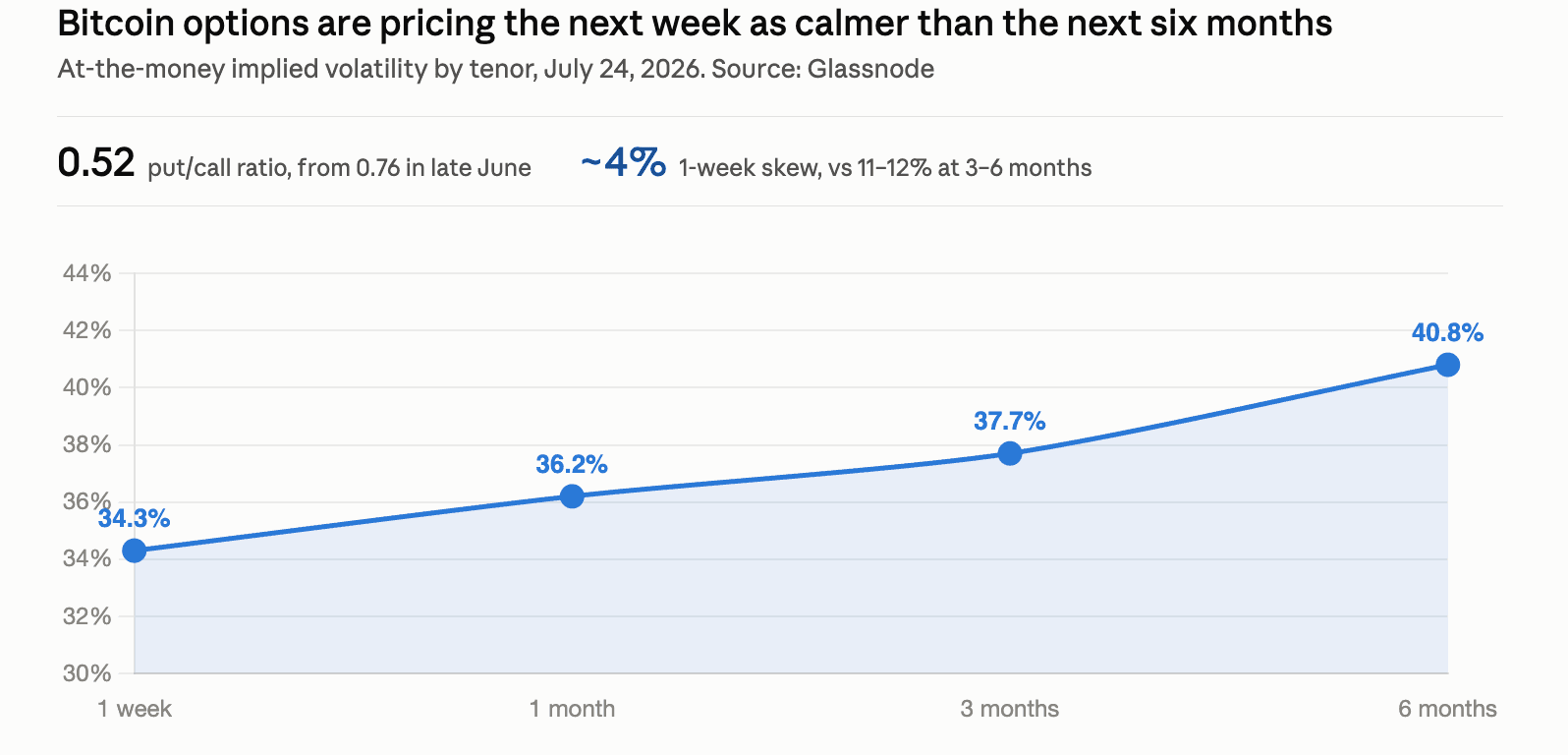


Bitcoin options traders have sharply unwound downside hedges heading into Wednesday's Federal Reserve decision, with the put/call open-interest ratio dropping to roughly 0.52 from about 0.76 in late June, according to Glassnode. Calls are gaining share in a pattern consistent with traders stepping back from protection rather than adding to it, and large accounts have been accumulating $70,000 strike calls and bull call spreads that signal expectations of upside in spot.
Short-dated protection is cheap while longer-dated protection still commands a premium. The 25-delta skew sits around 4% at the one-week tenor against 11% to 12% on three- and six-month contracts, so traders are still paying to insure against turbulence later in the year but have largely stopped paying for it this week. Implied volatility is compressed at 34.3% for one week against 40.8% for six months, leaving the curve upward-sloping in a shape that usually does not appear ahead of a scheduled macro event.
Why it matters
Markets price the base case correctly: Fed funds futures put the odds of a July hike at roughly 15%, so low near-term hedging demand is defensible on the consensus path. But positioning that thin leaves little cushion if the statement, the dot plot, or Powell's press conference surprises, and thin positioning tends to amplify moves rather than absorb them. Bitcoin held near $65,000 through a week that took $797 billion off the largest US technology stocks, two blockchain bankruptcies in Movement Labs and Storj, and wind-down announcements from BitMEX and BitMart, suggesting traders are treating those idiosyncratic shocks as background rather than as reasons to pay for near-term puts.
Market impact
The combination of cheap one-week skew, a steepened vol curve, and heavy $70,000 call accumulation reads as a market that has decided to fade FOMC rather than trade it. If the Fed lands cleanly in line with consensus, that positioning pays off and BTC can extend, with $70,000 acting as the magnet strike large accounts have been buying.

Frequently asked questions
-
What is the current Bitcoin options put/call ratio?
The put/call open-interest ratio on Bitcoin options has fallen to about 0.52 from roughly 0.76 in late June, per Glassnode, meaning calls now dominate open interest and traders have meaningfully trimmed downside hedges.
-
Why are Bitcoin options traders dropping hedges before the Fed meeting?
Fed funds futures price only around a 15% chance of a July rate hike, so the consensus path justifies cheap near-term protection. Traders have instead loaded up on $70,000 strike calls and bull call spreads, signalling expectations of upside rather than defending against a near-term drawdown.
-
What does the Bitcoin options skew say about market positioning?
The 25-delta skew sits near 4% on one-week contracts versus 11-12% on three- and six-month contracts. Traders are still paying for protection later in the year but have largely stopped paying for it this week, leaving the near end unusually light.
-
How does Bitcoin implied volatility look ahead of the FOMC?
One-week implied volatility is compressed at about 34.3%, while six-month implied volatility sits around 40.8%. The upward-sloping curve is atypical ahead of a scheduled macro event and signals the market expects a quieter week than the rest of the year.
-
What happens to Bitcoin if the Fed surprises hawkish?
Short-dated gamma is light and dealers have limited capacity to absorb selling, so a hawkish surprise forces the same accounts that sold one-week puts to buy them back at higher prices just to flatten, amplifying the move. Thin near-term positioning tends to amplify directional reactions rather than cushion them.
 CryptoSlate
 WuBlockchain
 Whale Alert
 Lookonchain