








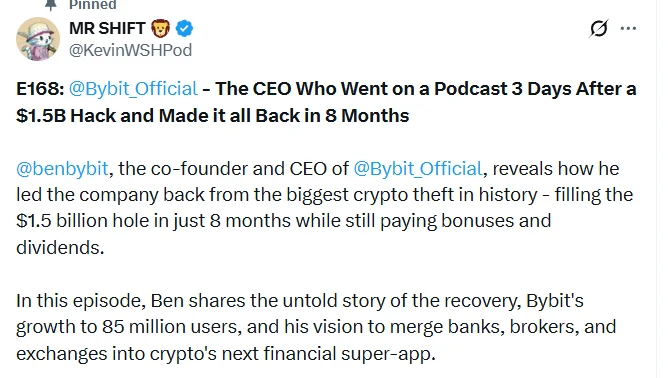
Bybit CEO Ben Zhou said the exchange clawed back the $1.5 billion lost in last year's record-setting hack within roughly eight months, and that 2025 was the firm's highest-grossing year on record.
Speaking on a podcast on April 28, Zhou framed the recovery as evidence that the exchange's post-incident operations held up despite the scale of the breach — the largest exchange hack on record at the time. The original incident forced Bybit into a rapid solvent-restructuring of the affected ETH cold wallet and an industry-wide bridge of liquidity from peers.
Why it matters
A recovery in eight months is the metric other venues will benchmark against. The North Korean-linked Lazarus Group, blamed for the attack, has hit multiple crypto platforms with comparable single-incident hauls, and none of the prior victims have publicly closed the gap this quickly. Bybit's ability to keep operating, absorb the loss, and still post record revenue suggests the underlying franchise was less fragile than sceptics assumed in the immediate aftermath.
Market impact
The $1.5B figure had been treated by analysts as a balance-sheet wound that would compress Bybit's market share for years. Zhou's framing — combined with disclosure that 2025 set an internal revenue record — implies the opposite: trading volumes, derivatives activity, and institutional flows did not materially bleed out, and competitors did not capture the position at scale.


Frequently asked questions
-
How much was stolen in the Bybit hack?
Over $1.5 billion in ETH was stolen in last year's breach, the largest exchange hack on record at the time. The North Korean-linked Lazarus Group has been blamed for the attack.
-
How long did it take Bybit to recover the loss?
CEO Ben Zhou said on an April 28 podcast that Bybit clawed back the $1.5 billion in roughly eight months, with 2025 simultaneously setting an internal revenue record.
-
Did Bybit's market share drop after the hack?
According to Zhou's framing, trading volumes, derivatives activity, and institutional flows did not materially bleed out, and 2025 was Bybit's highest-grossing year on record, implying competitors did not capture the position at scale.
-
What was unique about Bybit's response to the hack?
Bybit executed a rapid solvent restructure of the affected ETH cold wallet and coordinated a bridge of liquidity from peer exchanges, then absorbed the loss without halting core operations.
-
Why is the eight-month recovery timeframe significant?
No prior Lazarus-attributed victim has publicly closed a comparable shortfall this quickly, making the pace a new benchmark for hacked crypto platforms measuring their own post-incident recovery.

 CoinDesk
 Lookonchain
 TheBlock
 CoinTelegraph