








 CoinDesk


Cardano activated its Van Rossem hard fork on Saturday, moving mainnet to protocol version 11 at 21:44 UTC after onchain ratification on July 13. The upgrade unifies Plutus smart-contract capabilities across the platform's three versions, lowers execution costs, and tightens ledger validation rules, including a guarantee that no two stake pools can reuse the same cryptographic identity key. Roughly 93% of block production was already running version 11 before activation, well clear of the 85% stake-pool threshold Cardano's constitution requires.
Why it matters
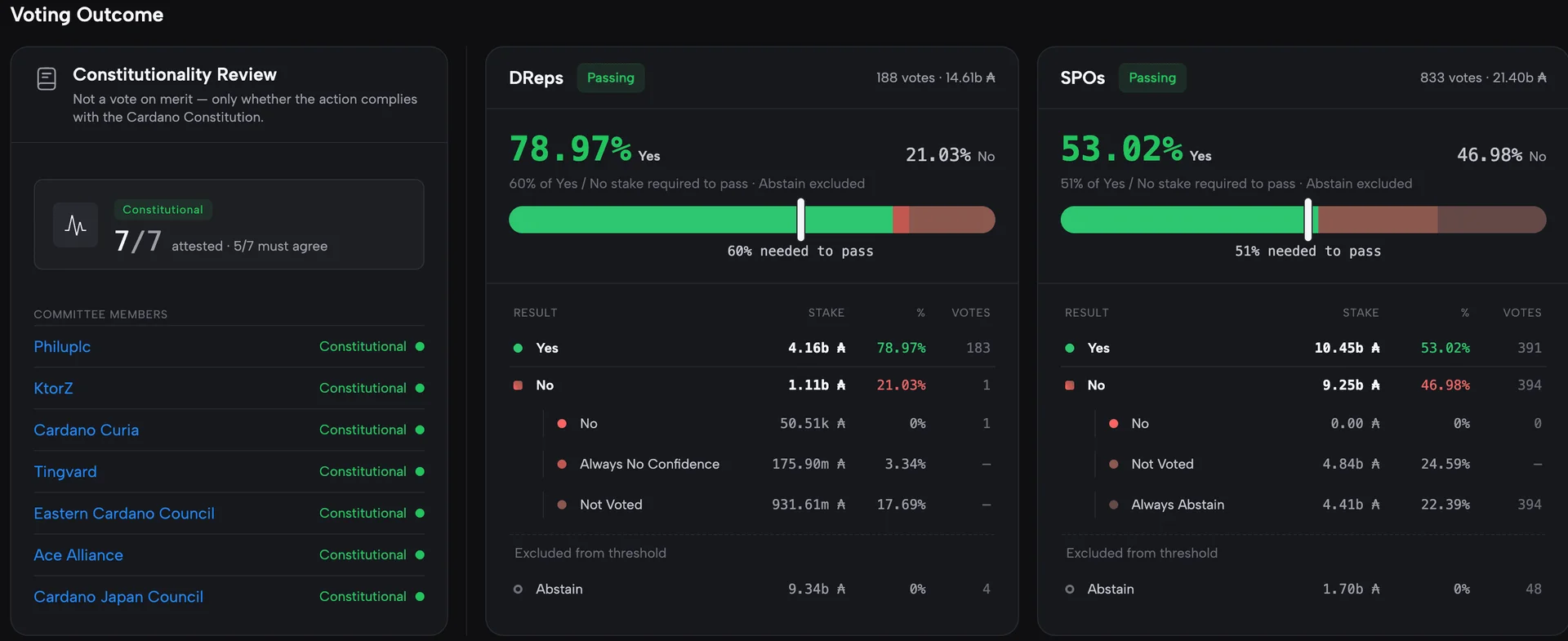
The deeper shift is procedural. Van Rossem is the first Cardano upgrade proposed, debated and ratified entirely through the network's onchain governance system rather than by founding developer Input Output. Delegated representatives approved it 78.97% against a 60% threshold, the constitutional committee cleared it unanimously, and stake pool operators passed it by a far narrower 53.02%, the thinnest of the three margins and a reminder that decentralized governance offers no guarantee of the founders' preferred outcome. Network telemetry from Cardanoscan shows the protocol moved from version 10 in epoch 643 to version 11 in epoch 644.
Market impact
For ADA holders, everyday transactions work the same way: wallets do not need updates, and the per-transaction fee is unchanged. The benefits flow through the apps built on top, where cheaper Plutus execution lets DeFi and NFT protocols eventually charge less per interaction, though those savings only land after developers rebuild their contracts. Van Rossem is also the procedural and technical prerequisite for Ouroboros Leios, the scaling overhaul expected in 2026 that targets a sharp increase in transactions per second without weakening proof-of-stake security. The fork is named for Max van Rossem, a Cardano governance contributor who helped shape the network's constitution and died in October 2025.

Frequently asked questions
-
What is Cardano's Van Rossem hard fork?
Van Rossem is Cardano's hard fork activated on July 18, moving mainnet to protocol version 11. It unifies Plutus smart-contract capabilities, lowers execution costs, and tightens ledger validation rules ahead of the planned Ouroboros Leios scaling upgrade.
-
Why is the Van Rossem fork historically significant for Cardano?
It is the first Cardano upgrade proposed, debated and ratified entirely through the network's onchain governance system rather than by founding developer Input Output, transferring formal control over protocol changes from the founders to ADA stakeholders.
-
How did the onchain vote break down across Cardano's governance bodies?
Delegated representatives approved the upgrade 78.97% against a 60% threshold, the constitutional committee cleared it unanimously, and stake pool operators passed it by a far narrower 53.02%, the thinnest of the three margins.
-
Will the Van Rossem fork change anything for everyday ADA users?
No. Wallets do not need updating, ADA transactions work the same way, and per-transaction fees are unchanged. Savings only land after developers rebuild their smart contracts to capture the cheaper Plutus execution costs.
-
What is Ouroboros Leios and when is it expected?
Ouroboros Leios is Cardano's planned scaling upgrade for its proof-of-stake consensus, designed to sharply increase transactions per second without weakening security. Input Output has targeted a 2026 release, with Van Rossem laying both the procedural and technical groundwork.
 WatcherGuru
 CoinTelegraph
 WuBlockchain
 CryptoSlate
 TheBlock
 Crypto News