








 CoinDesk
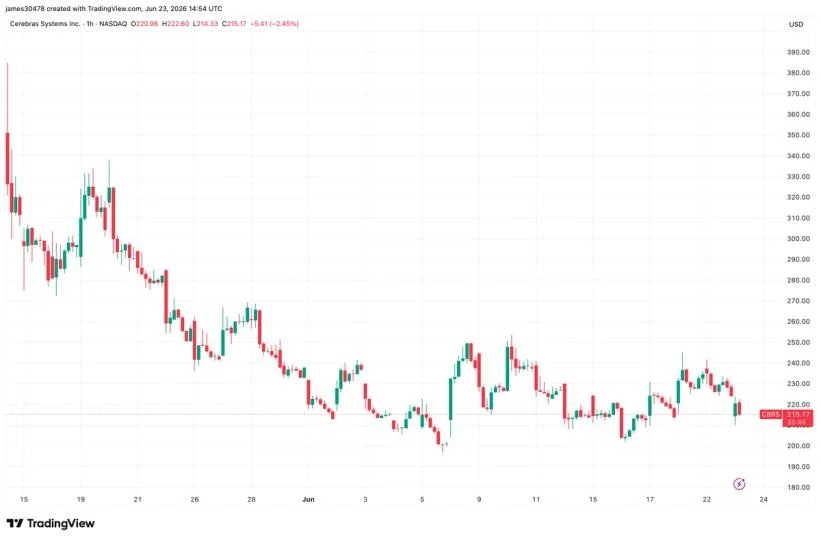



Cerebras Systems fell about 11% in after-hours trading on Wednesday after the AI chipmaker's first earnings report since its May IPO guided to a sharply lower core gross margin for the second quarter. Revenue climbed 92% year-over-year to $193.4 million, and the company's adjusted net loss of $2.5 million came in well ahead of the $36.75 million consensus loss analysts had forecast.
The second-quarter outlook, however, is what drove the after-hours move. Cerebras guided to roughly $194 million in revenue but pegged core gross margin at 36%-38%, down from 46.5% in the just-reported quarter. A nearly 1,000 basis-point swing in margin, against a flat revenue trajectory, resets the math on how much of this year's growth actually drops to the bottom line.
Why it matters
The margin guide is the cleanest window into the cost of scaling Cerebras' wafer-scale chips into hyperscaler and sovereign-AI contracts. Revenue beating estimates would normally be enough to support the post-IPO narrative; here it isn't, because the market is paying for the gross-margin profile, not the top line. A forecast band that implies margin compression even at flat sequential revenue tells investors the company is absorbing unit-cost pressure it can't yet pass through.
For the broader AI-accelerator cohort, the print reframes the question investors will now ask Nvidia, Broadcom, and the Marvell-tier custom-silicon names: how much of the AI compute capex cycle translates into durable gross margin, and how much of it is being competed away as more silicon enters the market.
Market impact
Cerebras raised $6 billion in its May IPO at $185 per share and traded as high as $385 before retreating. After-hours, the stock sits at $201.55, barely above the IPO price, with the first earnings print now pressuring the underwriters' stabilisation window. The reaction sets the bar for the next print: either margin recovers toward the 46% level and the post-IPO thesis re-rates, or two consecutive quarters of guide-down establish a new, lower-margin equilibrium the stock will trade around.
Frequently asked questions
-
Why did Cerebras stock drop after its first earnings report?
Cerebras guided Q2 core gross margin to 36%-38%, down from 46.5% in Q1, a near-1,000 basis-point step-down on roughly flat sequential revenue. The margin outlook outweighed the 92% revenue gain and the smaller-than-expected adjusted loss.
-
What were Cerebras' first-quarter results?
Revenue rose 92% year-over-year to $193.4 million. The adjusted net loss was $2.5 million, well inside the $36.75 million consensus loss analysts had forecast.
-
What is Cerebras' Q2 revenue guidance?
Cerebras guided Q2 revenue to roughly $194 million, broadly in line with the Q1 print, while flagging core gross margin of 36%-38%.
-
When did Cerebras IPO and where is the stock trading now?
Cerebras raised $6 billion in its May IPO at $185 per share. The stock traded as high as $385 shortly after listing and was at $201.55 in after-hours following the earnings release, about 11% below the regular-session close.
-
What does the Cerebras print mean for other AI chip stocks?
Investors are paying AI-accelerator names for gross-margin durability, not just revenue growth. A near-1,000 bp margin step-down at Cerebras will sharpen the questions asked of Nvidia, Broadcom, and the custom-silicon cohort about how much of the AI compute capex cycle translates into durable margin.
 Crypto Rank News
 Crypto News
 Crypto Capital Venture
 TheBlock
 CoinTelegraph
 CryptoSlate