








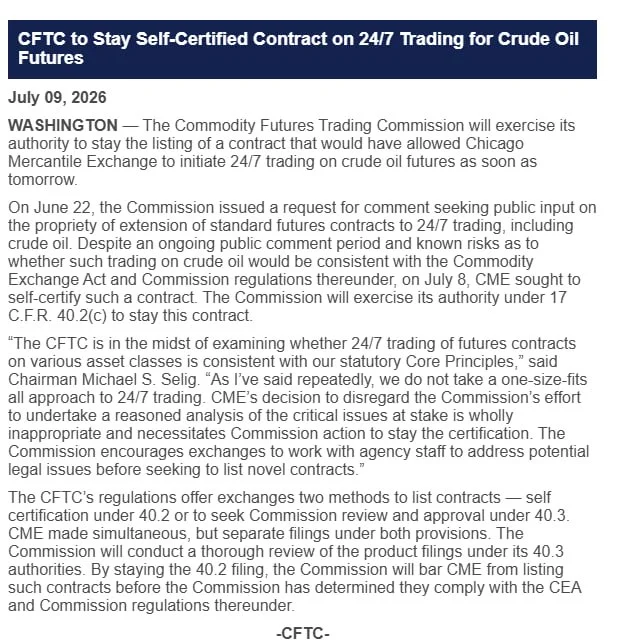

CFTC Chair Mike Selig said CME's move to self-certify around-the-clock trading of crude oil futures is "wholly inappropriate," and the agency will stay the change. The CFTC's action halts CME's self-certified extension of trading hours on the benchmark crude contract before it takes effect.
Why it matters
Self-certification is the shortcut exchanges use to launch new products or rule changes without prior CFTC approval. It is a privilege, not a right, and the chair's rare public rebuke signals that the agency views CME's use of the mechanism on a benchmark oil contract as overreach. Selig's on-the-record language, "wholly inappropriate," is the kind of phrasing that travels through the rest of the industry within hours.
Market impact
For CME, the immediate cost is procedural: the stay forces a formal filing and a public comment window on the hours change rather than a quiet go-live. For other US-registered venues that lean on self-certification for new derivatives, the read is a warning shot. Oil traders keep the existing trading calendar for now, and any repositioning around a 24/7 crude complex is on pause until the CFTC process runs.
Frequently asked questions
-
What did the CFTC Chair actually say about CME's 24/7 crude oil futures plan?
CFTC Chair Mike Selig called CME's self-certified push to extend crude oil futures trading to 24/7 "wholly inappropriate" and said the agency will stay the change.
-
What is self-certification in US derivatives markets?
Self-certification is the mechanism exchanges use to launch new products or rule changes without prior CFTC approval, treating the filing as effective on submission. It is a privilege, not a right, and the CFTC can stay or reject a self-certification after the fact.
-
Why is Selig's language notable for the rest of the derivatives industry?
A sitting CFTC chair publicly calling a systemically important venue's use of self-certification "wholly inappropriate" is rare. It signals that the agency is willing to put a top exchange on a public record over how it uses the rule-making shortcut, and other US-registered venues are likely to read it as a warning…
-
What happens to CME's 24/7 crude oil futures plan now?
The CFTC's stay halts CME's self-certified hours extension before it takes effect. CME will need to go through a formal filing and public comment process at the agency for the change to move forward.
-
Does this affect current crude oil trading on CME?
No immediate change for traders. The existing crude oil futures trading calendar remains in place while the CFTC process on the hours extension runs.

 CoinDesk
 WatcherGuru
 CryptoSlate
 TheBlock