








 CoinDesk
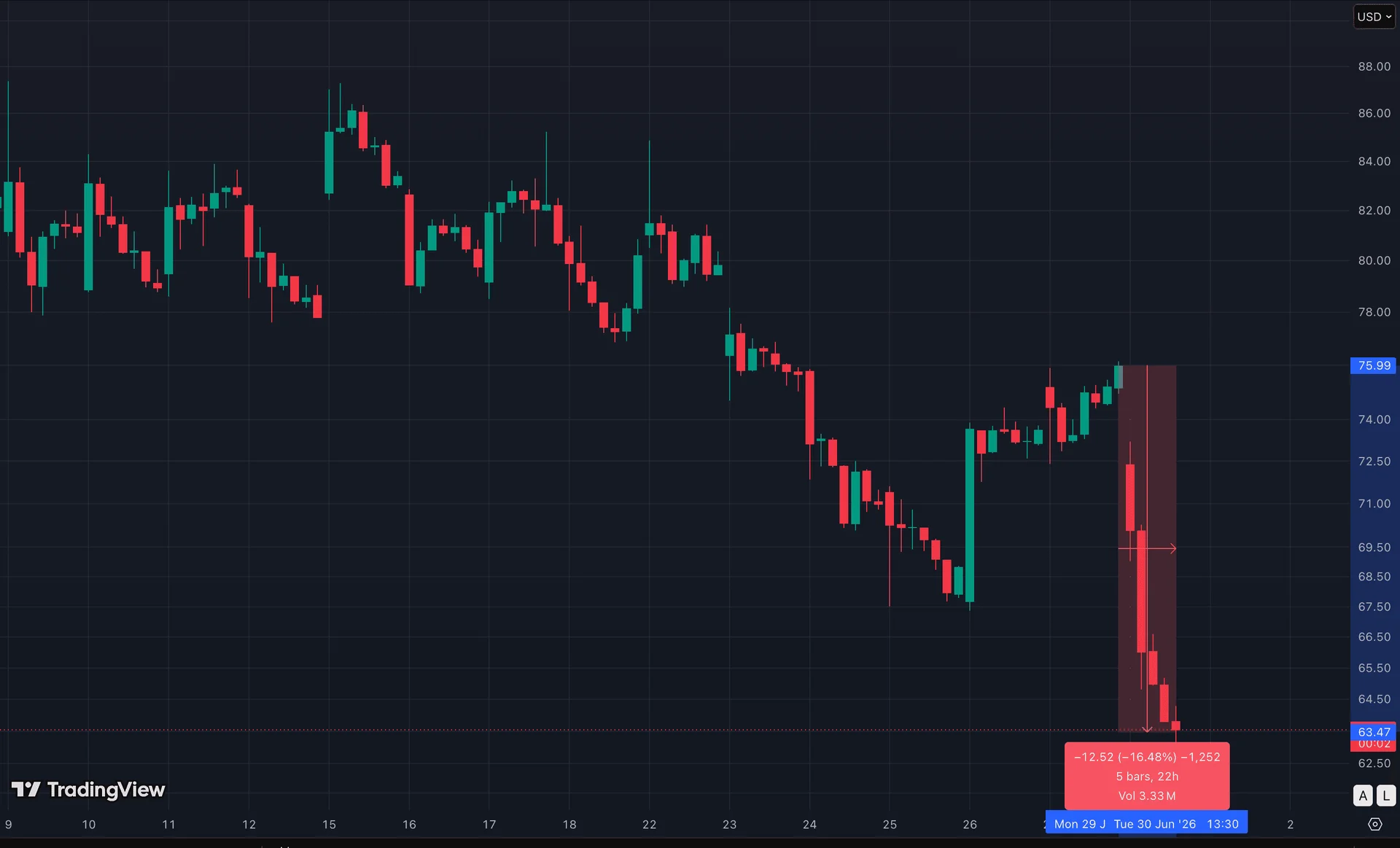


Circle shares fell 16% on Tuesday after the launch of the Open Standard consortium and its Open USD stablecoin, a Stripe- and Coinbase-backed effort aimed squarely at USDC. The consortium now counts more than 140 members, including Visa, Mastercard and BlackRock, and its pitch is direct: OUSD would distribute reserve income to distribution partners rather than concentrating it at the issuer, attacking the economics that have made USDC a $73 billion franchise.
Why it matters
Dragonfly general partner Rob Hadick called the marquee roster a real threat to Circle's business, noting that Stripe's payments stack could let the consortium "uniquely undercut Circle's economics." Clear Street managing director Owen Lau agreed the partner lineup pressures near-term sentiment on CRCL until OUSD actually ships later this year, but argued the magnitude of the selloff went too far.
The historical read supports that caution. Paxos' Global Dollar Network launched in late 2024 with a similar shared-yield structure and has grown to only about $3 billion in supply, a fraction of USDC's $73 billion and Tether's $145 billion. Hadick warned that "consortiums are hard and they break easily" because partner incentives are broad and often misaligned. Noelle Acheson, author of Crypto Is Macro Now, said the announcement is vague on ownership structure, licensing, which chains OUSD will launch on, and how reserve income gets split, all of which have to resolve before the network can scale.
Market impact
The launch also sharpens scrutiny on Circle's relationship with Coinbase. The two jointly founded Centre, the consortium behind USDC issuance, and continue to share reserve economics under a commercial agreement reportedly up for renewal in August. Dragonfly's Omar Kanji said the announcement makes a Circle-Coinbase split more plausible, though he still expects renewal with revised terms and continued overlap.
The bigger read for investors, per Arca CIO Jeff Dorman, is that stablecoin value is migrating up the stack.

Frequently asked questions
-
What is the Open Standard consortium and who backs Open USD?
Open Standard is a stablecoin consortium with more than 140 members including Stripe, Coinbase, Visa, Mastercard and BlackRock. Its Open USD stablecoin is designed to distribute reserve income to distribution partners rather than concentrating it at the issuer.
-
Why did Circle stock drop 16% on the Open USD announcement?
Circle shares fell 16% on Tuesday because Open USD directly challenges USDC's economics by sharing reserve yield with partners. Investors read the 140-member roster, including Stripe, Visa and Mastercard, as a credible threat to USDC's $73 billion franchise.
-
How does Open USD compare to USDC and Tether in market size?
Open USD has not launched yet, while USDC sits at roughly $73 billion in supply and Tether at about $145 billion. The closest comparable, Paxos' Global Dollar Network, launched in late 2024 with a similar shared-yield model and has reached only about $3 billion.
-
What are analysts' biggest concerns about Open USD?
Analysts flag unresolved questions around ownership structure, licensing framework, chain support and how reserve income gets split among partners. They also point to the historical difficulty of scaling consortium-backed stablecoins, with incentives often misaligned across members.
-
Could Open USD affect Circle's partnership with Coinbase?
The announcement puts fresh focus on Circle's relationship with Coinbase, which jointly runs the Centre Consortium behind USDC. Their commercial agreement is reportedly up for renewal in August, and analysts now see a potential split as more plausible, though a renewal on revised terms remains the base case.
 Crypto News
 CoinTelegraph
 TheBlock
 WatcherGuru
 CryptoSlate