








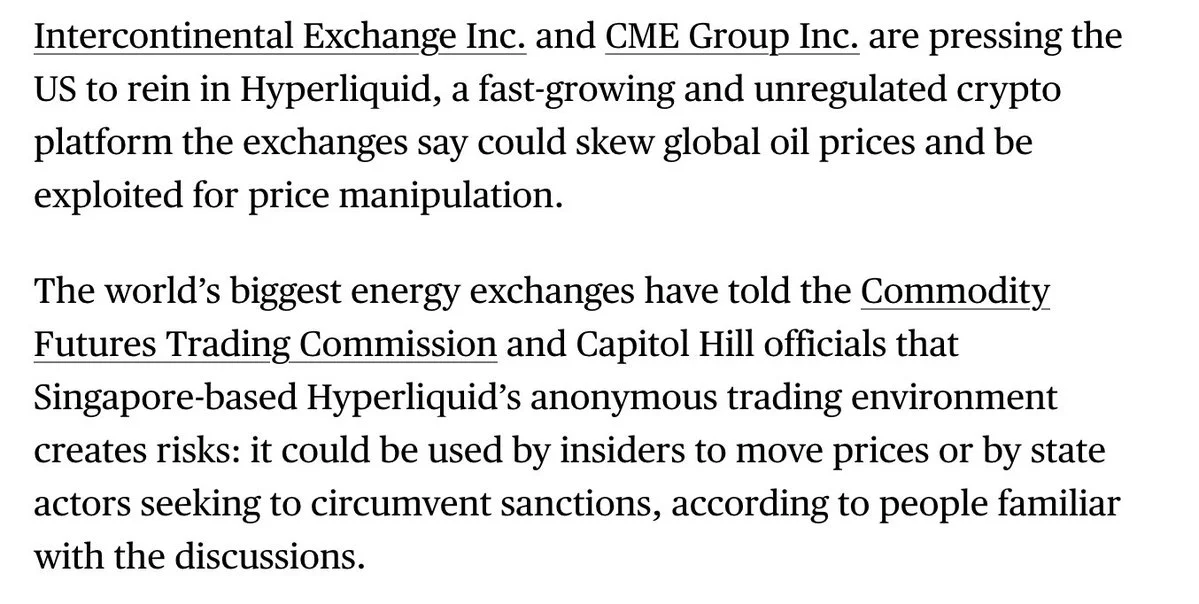

CME Group and Intercontinental Exchange (ICE) are pushing U.S. regulators to tighten oversight of crypto trading platform Hyperliquid, warning that its anonymous trading environment could distort global oil prices and enable market manipulation.
The exchanges raised concerns with the CFTC and U.S. lawmakers that the Singapore-based platform could be exploited by insiders or sanctioned state actors, Bloomberg reported. The fear is that a large, uncollateralized position on Hyperliquid could move oil futures on CME and ICE, transmitting crypto-native risk into the world's most-traded commodity complex.
Why it matters
CME and ICE don't usually lobby regulators over a single crypto venue — they do it when they see a channel through which their own markets can be moved from outside. Anonymous on-chain perps trading oil-linked exposure at scale is exactly that channel, and the two exchanges are effectively asking Washington to close it before a position does the closing.
Frequently asked questions
-
Why are CME and ICE worried about Hyperliquid specifically?
The two exchanges warned the CFTC and U.S. lawmakers that Hyperliquid's anonymous trading environment could be exploited by insiders or sanctioned state actors to manipulate oil prices.
-
Could a crypto platform actually move global oil prices?
CME and ICE fear that a large uncollateralized position on Hyperliquid could move oil futures on their own venues, transmitting crypto-native risk directly into the world's most-traded commodity complex.
-
Which U.S. regulators are being asked to step in?
CME Group and Intercontinental Exchange raised their concerns with the CFTC and with U.S. lawmakers, per Bloomberg's reporting.
-
Where is Hyperliquid based, and does that change the regulatory calculus?
Hyperliquid is Singapore-based, which puts it outside the CFTC's direct jurisdiction and is part of why CME and ICE are pressing U.S. regulators to act rather than relying on the venue to self-police.
-
What would tighter oversight of Hyperliquid actually look like?
The exchanges want tighter KYC, position limits, or surveillance sharing so that large anonymous positions on Hyperliquid can't be used as a conduit to move oil futures on regulated U.S. venues.

 CoinDesk
 WatcherGuru
 CryptoSlate
 CoinTelegraph
 Crypto News
 TheBlock