








 CryptoSlate


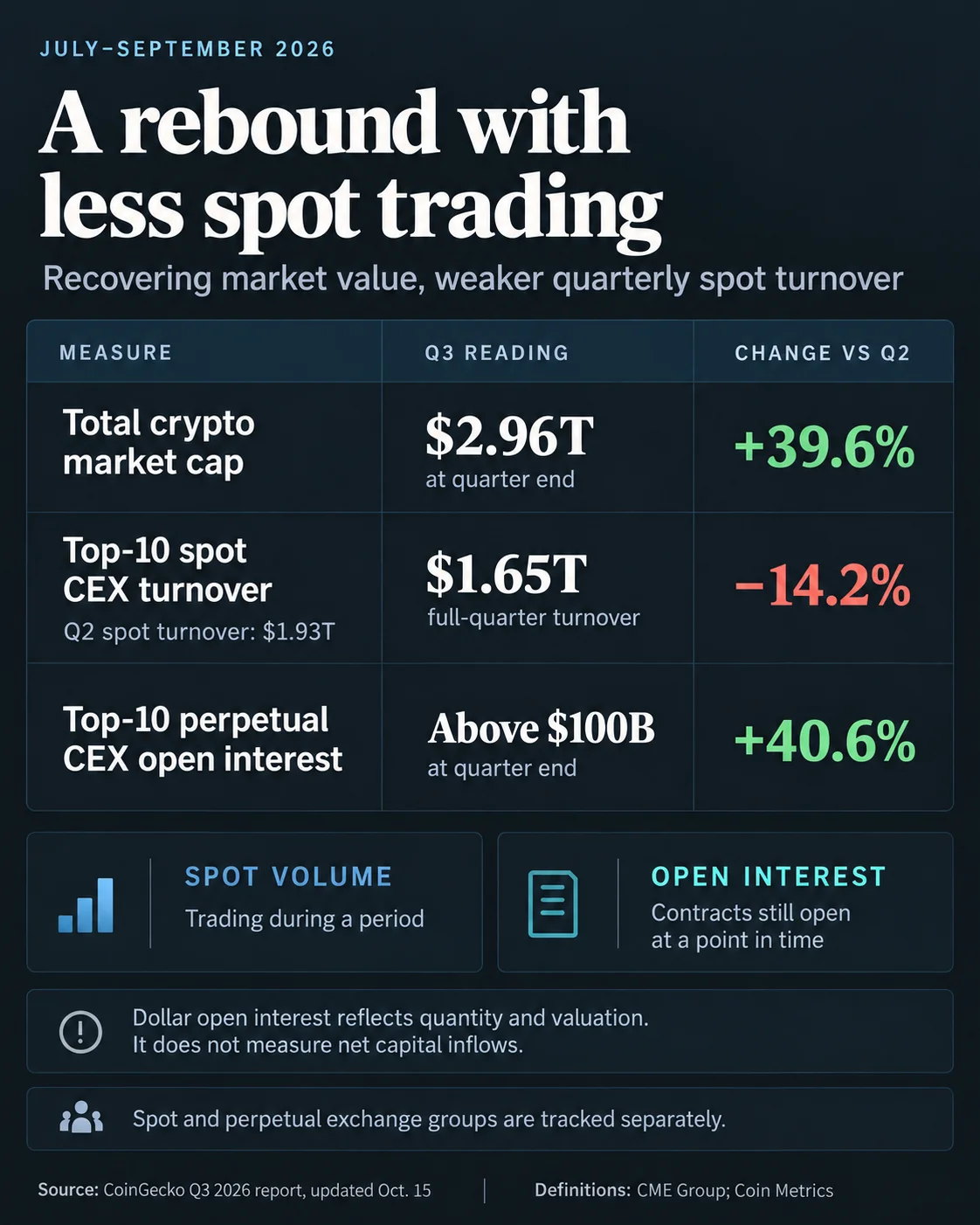

Crypto’s market capitalization rose 39.6% in Q3 2026 to about $2.96 trillion, but CoinGecko’s top-10 spot exchanges recorded $1.65 trillion in turnover, down 14.2% from Q2. Across the top-10 perpetual exchanges, dollar open interest increased 40.6% and ended September above $100 billion.
Why it matters
The figures describe different things. Spot turnover measures trading across the quarter; open interest measures the dollar value of contracts still open at quarter-end. CoinGecko tracks separate top-10 groups for spot and perpetual markets, so the totals cannot show that funds moved from spot into derivatives.
Nor does higher dollar open interest establish a net bullish position. Every futures contract has a buyer and a seller, and traders may be speculating or hedging. For some contracts, a higher underlying asset price can increase notional value even if the number of contracts does not rise. The 40.6% increase alone therefore cannot confirm fresh capital inflows or a change in leverage.
Market impact
The rebound in market value outpaced the recovery in trading activity. Binance’s share of the tracked spot market grew from 38.7% in Q2 to 42.7% in Q3 as turnover across the cohort contracted. KuCoin and Deribit were exceptions to the broad rise in perpetual open interest, recording declines.
CoinGecko’s broader market-wide series adds a late-quarter contrast: average daily trading volume reached $94.8 billion in September, up from $57.7 billion in July, while the full-quarter daily average fell 8.6% from Q2’s $73.3 billion. The distinction between a monthly improvement and a quarterly decline matters when assessing the rebound. October open interest would require a newer snapshot; the September figure is not a measure of current exposure.
Frequently asked questions
-
How did crypto market capitalization and spot turnover compare in Q3 2026?
Market capitalization rose 39.6% to about $2.96 trillion. CoinGecko’s top-10 spot exchanges recorded $1.65 trillion in turnover, down 14.2% from Q2.
-
What does the above-$100 billion open-interest figure measure?
It represents the dollar value of perpetual futures positions still open at the end of September, rather than trading activity over the whole quarter.
-
Does the rise in open interest prove new money entered crypto derivatives?
No. Dollar open interest can change with underlying asset prices and contract specifications, and the 40.6% increase alone cannot establish fresh inflows.
-
Why can open interest not show whether traders are net bullish?
Each futures contract pairs a buyer with a seller. Open interest does not reveal whether positions are speculative or hedges, or establish a net bullish bet.
-
How did September trading volume compare with the full-quarter trend?
CoinGecko’s broader series showed average daily volume of $94.8 billion in September versus $57.7 billion in July, while the Q3 daily average fell 8.6% from Q2.
 Crypto News
 WuBlockchain
 WatcherGuru
 Whale Alert
 TheBlock
 Lookonchain